Bracket Orders Explained: How Stops and Targets Automate Your Risk
Bracket orders lock in your stop-loss and profit target the moment you enter a trade, removing emotional decision-making from your exits. Learn how this rule-based order type protects your account — and how Xeanvi puts transparent execution in your hands.
By Troy Swartwood, Founder & Software Engineer · Published 2026-05-28 · Updated 2026-06-23
Every day trader faces the same brutal moment: you enter a trade, the position moves against you, and instead of cutting the loss, you freeze. You wait. You hope. Then the loss gets worse. Bracket orders exist to make that moment impossible. This order type locks in your exit plan — both your profit target and your stop-loss — the instant you enter a trade, automating your risk management so your emotions never get a vote. This guide breaks down exactly how bracket orders work, why rule-based trading infrastructure is the foundation of a sustainable strategy, and how platforms like Xeanvi put this control directly in your hands.
What a Bracket Order Actually Does to Your Trade
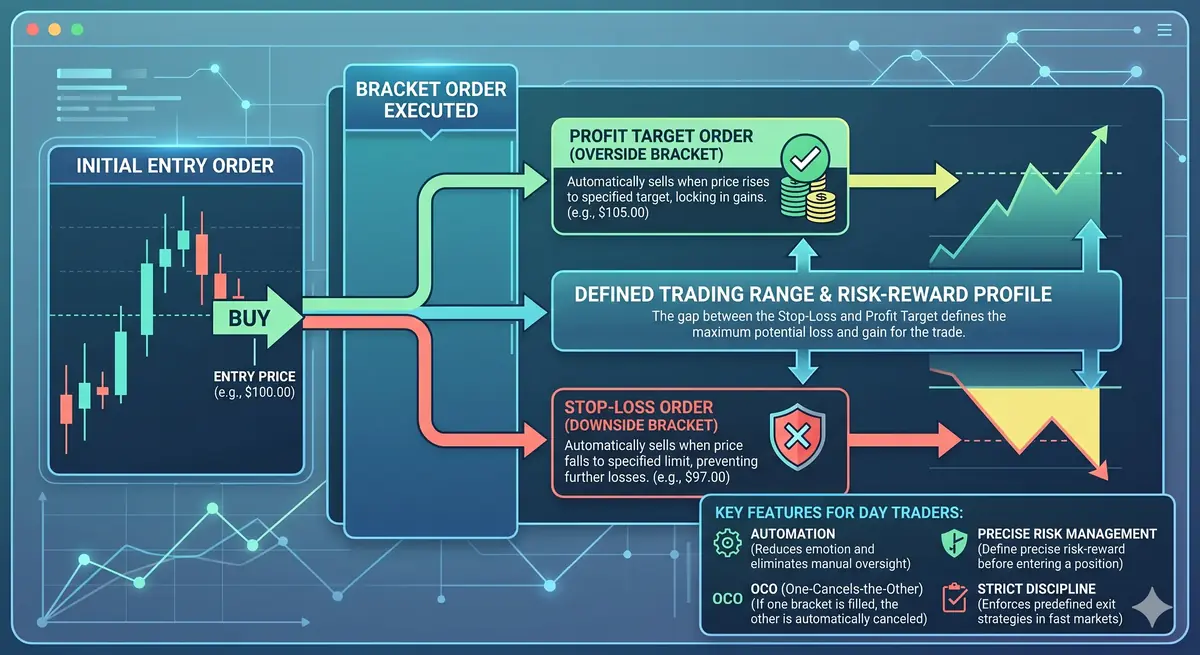
A bracket order is not a single instruction. It is three orders sent to your broker simultaneously the moment you enter a position. Think of it as building a fence around your trade the second it opens.
Here is the structure:
- The Entry Order: This is the primary order that opens your trade — a buy or sell at your chosen price.
- The Take-Profit Order: This is the upper boundary of your bracket. It automatically closes your trade at a pre-defined profit target if the market moves in your favour.
- The Stop-Loss Order: This is the lower boundary. It automatically closes your trade at a pre-defined maximum loss if the market moves against you.
The moment one of these exits triggers, the broker cancels the other automatically. The trade is closed. The risk is gone. No manual intervention required.
This is not a prediction about where the market goes. It is a defined range — a hard upper and lower boundary — that removes the decision from your hands entirely once the trade is live.
The Exact Problem Stop-Loss Orders Solve (That Discipline Alone Cannot)
Ask any experienced day trader what kills accounts and the answer is rarely a bad strategy. It is execution. Specifically, it is the gap between what a trader plans to do and what they actually do under pressure.
Without this structure in place, a live trade forces you into a constant psychological battle:
- You watch the price tick against you and convince yourself it will reverse.
- You move your stop-loss further away to give the trade "more room."
- You exit a winning trade too early because you fear giving back profits.
- You hold a losing trade too long because cutting the loss feels like admitting failure.
Stop-loss orders built into a bracket structure make these decisions irrelevant. The rule is set before the trade is live, when your thinking is clear and unemotional. The broker executes it exactly as instructed, regardless of what the market is doing or how you feel in the moment.
This is the core mechanical advantage for day traders: the bracket enforces the plan you made when you were thinking clearly, not the decision you might make when you are stressed.
How the Bracket Range Is Calculated Before You Enter
The structure is only as strong as the logic used to set the range. Placing your stop-loss and profit target at random numbers defeats the purpose entirely. Here is how disciplined traders approach this before sending the order to their broker.
Setting the Stop-Loss Boundary
Your stop-loss should reflect how much capital you are genuinely willing to lose on this single trade — not how much you hope to avoid losing. Common approaches include:
- Fixed dollar risk: Risking no more than 1% of your total account on any single trade, calculated before entry.
- Technical levels: Placing the stop below a recent swing low (for a long trade) or above a swing high (for a short trade), so the stop-loss only triggers if the market structure that justified the trade is broken.
- ATR-based stops: Using the Average True Range of the instrument to set a stop that accounts for normal market volatility rather than arbitrary round numbers.
Setting the Profit Target Boundary
The take-profit side of the bracket should be defined with the same discipline. The most common framework is the risk-to-reward ratio — and Investor.gov's introduction to investment risk is a solid starting point for understanding why this ratio matters before you trade live capital.
- If your stop-loss is $100 away from your entry price, a 2:1 risk-to-reward ratio means your profit target is set $200 away from entry.
- This does not guarantee a win. Over a series of trades, however, it means you do not need to be right the majority of the time to remain profitable — the math works in your favour.
Setting this ratio before entry is what turns a bracket from a convenience into a risk management system. Once sent to your broker, the range is fixed and the discipline is baked into the order itself.
Bracket Orders vs. Manual Exits: Why Rules Beat Reactions
Some traders resist this approach because they want to "manage the trade actively." That instinct is worth examining honestly. Active management can be valuable — but only when it is itself rule-based, not reactive.
The danger of manual exits is not that traders lack intelligence. Watching a live trade changes how the brain processes information. Loss aversion — the psychological tendency to feel losses more acutely than equivalent gains — actively distorts decision-making in real time. Behavioural finance research has documented this effect across professional and retail traders alike.
Brackets short-circuit this by removing the live decision entirely. The stock market order is placed. The range is defined. The broker executes the outcome. Your role as a trader shifts to finding the next valid setup — not managing an emotion during an open position.
This is why bracket orders are not a tool for passive traders. They are a tool for traders who take risk management seriously enough to systematise it.
Why Transparent, Rule-Based Orders Matter More Than Any Trading Bot
The trading software landscape is full of products that claim to manage your risk automatically. Many operate as black-box algorithms — systems where the logic triggering your exits is either hidden from you, or so complex it cannot be explained in plain language. At that point, you are trusting the bot, not a rule.
For day traders who want to understand and control their own risk, that is a fundamental problem. The bracket order is the opposite of a black box. It is a transparent, rule-based stock market order with three defined outcomes:
- The trade hits the profit target. It closes. The bracket is cancelled.
- The trade hits the stop-loss. It closes. The bracket is cancelled.
- You manually cancel the bracket before either level is hit, taking back control on your terms.
No hidden logic. No opaque algorithm deciding when your trade closes. The rules you set are the rules that execute — every time, without exception.
Xeanvi is built on exactly this principle. Rather than handing control to a mysterious trading bot, the platform lets you build bracket orders and wider rule-based workflows using transparent, auditable logic — so you can see precisely what triggers each action, and why. You can explore how that execution layer is structured on the Xeanvi transparency page, and see the full range of order-building tools on the features page. Every stop-loss, every profit target, every stock market order sent to your broker flows from a rule you defined and can read in plain language.
Getting Started With Bracket Orders: A Practical Checklist
Before placing your first bracket order, work through this checklist to ensure the structure you are building is genuinely protecting your account. For a deeper framework on building these rules into a repeatable trading process, the Xeanvi Playbook walks through exactly how systematic traders approach setup and execution.
- Define your maximum loss first. Decide the exact dollar amount or percentage of account capital you are risking on this trade before you calculate anything else.
- Calculate position size from the risk, not the other way around. Let the stop-loss distance determine how many shares or contracts you trade, not your gut feeling about the size of the move.
- Set the profit target before you enter. Do not adjust it upward once the trade is live because the position is moving in your favour. The bracket is a pre-defined range, not a moving target.
- Confirm your broker supports OCO (One Cancels Other) orders. This is the underlying mechanic that cancels the take-profit when the stop-loss fires, and vice versa. Most modern trading platforms support this natively.
- Review the bracket on a demo account first. Understand exactly how your platform sends these orders and what the confirmation looks like before trading live capital.
The Discipline Bracket Orders Cannot Replace
Automated exits handle execution. Strategy remains entirely yours. The work of identifying a valid trade setup — reading price action, understanding market context, knowing which instruments fit your edge — is something no order type can do for you.
What this structure removes is the most dangerous variable in the system: your emotional response to an open position. Trading does not get easier. What changes is that your pre-planned risk management becomes impossible to override in the moment it matters most.
For day traders ready to build that kind of systematic discipline into every trade, Xeanvi's pricing page outlines what access to rule-based, transparent execution looks like in practice.
Nothing in this article constitutes financial advice. All trading involves significant risk of loss, including the potential loss of all capital invested. Bracket orders and stop-loss orders do not guarantee against losses in all market conditions. Always ensure you fully understand any order type before trading live capital.