Can AI Automate Stock Trading?
The promise of AI automating stock trading sparks both excitement and skepticism. While AI offers powerful tools for data analysis and execution, understanding its true role and limitations is crucial for retail day traders.
By Troy Swartwood, Founder & Software Engineer · Published 2026-05-20 · Updated 2026-06-23
The Rise of Automation in Trading
The concept of artificial intelligence (AI) automating stock trading has moved from science fiction to a tangible reality for many financial institutions and, increasingly, for retail traders. However, the term "automation" in this context often carries different meanings and expectations. For retail day traders, understanding what AI truly can and cannot do is important for using it responsibly.
AI in trading is not about predicting the future with certainty. Instead, it is about processing large amounts of data, identifying patterns, and executing predefined strategies with speed and consistency that human traders often struggle to maintain.
The Role of AI in Modern Trading Automation
AI serves as a sophisticated tool within the trading ecosystem, augmenting human capabilities rather than replacing them entirely. Its primary contributions lie in two key areas:
Data Analysis and Pattern Recognition
- Processing Power: AI algorithms can analyze market data, news feeds, and historical price movements at a scale and speed impossible for a human. This includes identifying subtle trends, correlations, and anomalies that might inform a trading strategy.
- Backtesting Efficiency: Before deploying a strategy, AI can rapidly backtest it against years of historical data, providing insights into its potential behavior under various market conditions. This helps traders refine their approaches and understand potential risks.
Enhancing Execution Discipline
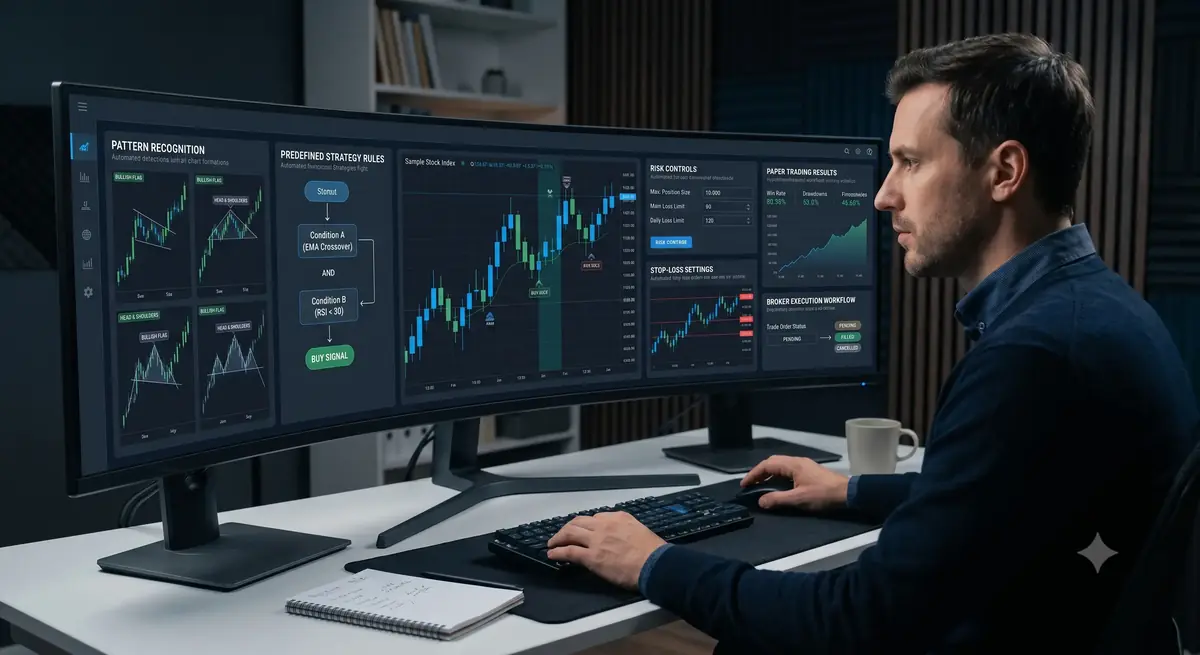
One of the most significant benefits of AI-powered automation for retail traders is its ability to execute trades based on predefined rules without emotional interference. Fear, greed, and hesitation are common pitfalls for human traders. An automated system, however, can follow the plan exactly as configured.
- Consistent Strategy Application: AI helps ensure that your trading playbook is followed precisely, entering and exiting trades when your defined conditions are met.
- Speed of Execution: In fast-moving markets, milliseconds can matter. Automated systems can react to market changes and submit orders faster than manual traders.
- Risk Management Enforcement: Automated systems can be programmed to follow risk parameters, such as stop-loss levels and position sizing, helping reduce uncontrolled exposure.
What Automated AI Stock Trading Can and Cannot Do
It is important to maintain a realistic perspective on AI's capabilities.
Strengths of AI in Trading
- Efficiency: Automates repetitive tasks and data analysis.
- Discipline: Executes strategies without emotional bias.
- Speed: Reacts to market conditions faster than humans.
- Scalability: Can monitor multiple markets and assets simultaneously.
Limitations and Important Considerations
- No Certainty of Results: AI does not possess a crystal ball. It operates on probabilities, programmed logic, and historical data. Market dynamics are complex and unpredictable.
- Dependence on Programmed Rules: An AI system is only as good as the strategy and rules it is given. Poorly designed strategies can lead to poor outcomes, regardless of automation.
- Inability to Adapt to Unprecedented Events: "Black swan" events or sudden, unforeseen market shifts can challenge even sophisticated systems because they may fall outside historical patterns.
- Requires Human Oversight: Automated systems need monitoring, maintenance, and adaptation by a human trader. Market conditions evolve, and strategies may need adjustment.
XeanVI's Approach to Trading Automation
At XeanVI, we believe in empowering traders with intelligent tools for disciplined execution, not in offering shortcuts or unrealistic outcome claims. Our platform focuses on automating the workflow and execution discipline of your trading strategies.
We provide the features to define your trading playbooks, set clear entry and exit conditions, and manage risk parameters. Our AI-powered automation then follows those rules precisely, reducing the emotional element that can derail even well-planned strategies.
XeanVI is designed to be your co-pilot, executing your predefined strategies with consistency. It is a tool for strengthening your trading process, helping you stick to your plan, and manage your risk effectively while you focus on strategy development and market analysis.
Building Your Automated Trading Workflow With Discipline
Leveraging automated AI stock trading effectively requires a structured approach:
- Define Your Strategy: Clearly articulate your entry signals, exit signals, and risk management rules. This is your playbook.
- Integrate Risk Management: Set strict stop-loss orders, take-profit levels, and position sizing rules that your automated system will enforce.
- Paper Trade Extensively: Before deploying any automated strategy with real capital, test it thoroughly in a paper trading environment. This allows you to refine your approach without financial risk.
- Monitor and Adapt: Even automated systems require oversight. Regularly review performance, analyze market changes, and be prepared to adjust your strategies as needed.
Conclusion
Automated AI stock trading offers powerful capabilities for retail day traders, primarily in execution discipline, faster analysis, and consistent strategy application. However, it is not a shortcut around risk. AI is a sophisticated tool that, when used responsibly and with a clear understanding of its limitations, can improve a trader's workflow and adherence to a trading plan.
For traders seeking to bring structure, discipline, and efficient execution to their strategies, platforms like XeanVI provide automation tools for navigating the markets with greater consistency. Strong trading still requires robust tools, sound strategy, continuous learning, and diligent risk management.
Educational source: For a general risk overview, see Investor.gov's day trading overview.