Chain Reaction Trading: How One Bad Trade Creates a Cascade of Costly Decisions
Many day traders attribute losses to a bad setup, but often, it's a single emotional decision that triggers a destructive chain reaction. Learn how to identify and prevent these cascades of costly mistakes.
By Troy Swartwood, Founder & Software Engineer · Published 2026-06-11 · Updated 2026-06-23
Most traders believe their biggest losses come from bad setups. In reality, many trading accounts suffer because one losing trade triggers a series of emotional decisions that compound the damage. This process is what we call chain reaction trading.
Chain reaction trading occurs when a trader abandons their plan after a loss and begins making decisions based on emotion instead of rules. The original trade may only cost a small amount, but the decisions that follow can create much larger losses.
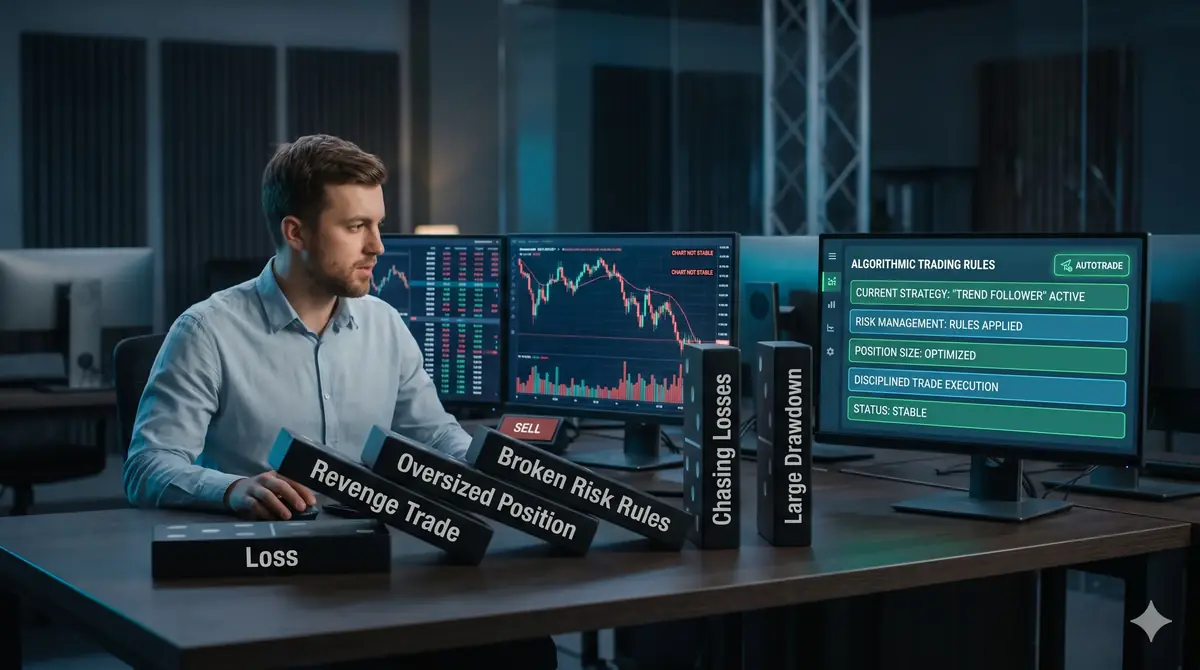
For many retail traders, the problem is not the first losing trade. The problem is the domino effect that follows. Revenge trading, oversized positions, broken risk rules, and impulsive entries often create far more damage than the original loss ever could.
What Is Chain Reaction Trading?
Chain reaction trading describes a sequence of emotionally driven decisions that occur after a trade does not go as expected. Instead of accepting the loss and moving on to the next valid opportunity, the trader attempts to recover immediately.
As emotions increase, discipline decreases. Risk management rules begin to disappear, position sizes grow, and trading decisions become reactive rather than strategic.
While every trader experiences losses, not every trader experiences chain reaction trading. The difference is often determined by how closely they follow their trading plan after a setback.
The Anatomy of a Trading Chain Reaction
A single losing trade can trigger several common behaviors:
- Revenge Trading: Entering a new position immediately after a loss without waiting for a qualified setup.
- Oversizing Positions: Increasing position size beyond planned risk limits in an attempt to recover losses faster.
- Breaking Risk Rules: Ignoring stop-loss levels, daily drawdown limits, or maximum position sizes.
- Chasing Losses: Taking trades that do not meet established entry criteria simply because the trader feels pressure to recover.
- Ignoring Exit Signals: Holding losing positions longer than planned or exiting winners too early out of fear.
- Compounding Emotional Mistakes: Each poor decision creates additional stress, leading to even worse decision-making.
This cycle is the foundation of chain reaction trading. Once emotions begin driving decisions, the original trading strategy becomes irrelevant.
Real-World Example of Chain Reaction Trading
Consider a trader who starts the day with a rule to risk no more than $100 per trade.
The first setup meets all criteria and is executed correctly. Unfortunately, the trade stops out and loses the planned $100.
At this point, the trader has followed the plan perfectly.
Instead of waiting for the next qualified setup, they immediately enter another trade. This second trade is not part of their strategy, but they convince themselves the market "owes" them a winner.
The second trade fails.
Frustration grows. The trader increases position size to recover losses faster. Stop-losses become wider. Entry requirements become looser.
By the afternoon, the trader has completely abandoned their original trading plan. What started as a controlled $100 loss has now become a $700 or $1,000 loss.
This is chain reaction trading in action. The account damage was not caused by the first losing trade. It was caused by the emotional decisions that followed.
Why Chain Reaction Trading Happens
Human psychology naturally seeks to avoid loss. When traders experience a losing trade, many feel an immediate urge to recover their money as quickly as possible.
This emotional pressure can override rational decision-making. Instead of evaluating the next opportunity objectively, traders become focused on recovering recent losses.
Professional traders understand that losses are part of the business. They focus on following their process rather than trying to win every trade.
Educational resources from Investor.gov consistently emphasize the importance of risk management, emotional discipline, and avoiding impulsive investment decisions.
The most successful traders are not necessarily those who avoid losses. They are the traders who avoid turning small losses into large ones.
Building Protection Against Chain Reaction Trading
The best defense against chain reaction trading is a clearly documented process.
A detailed trading playbook should define:
- Entry criteria
- Exit criteria
- Position sizing rules
- Maximum daily loss limits
- Risk-to-reward requirements
- Market conditions that qualify for trades
When rules are documented in advance, traders are less likely to make emotional decisions during stressful market conditions.
The goal is to make decisions based on predefined criteria rather than temporary emotions.
How Automation Helps Prevent Chain Reaction Trading
One of the most effective ways to reduce chain reaction trading is through rule-based automation.
When a strategy follows predefined rules, trades are executed according to the plan rather than emotional impulses.
Automation does not seek revenge after a loss. It does not increase position size because it feels frustrated. It does not ignore stop-losses because it hopes a trade will recover.
Instead, it follows the same process consistently.
This is one reason many traders use XeanVI. Rule-based automation helps enforce discipline by ensuring trades align with predefined conditions rather than emotional reactions.
Platforms focused on transparency also allow traders to understand exactly why trades are approved, blocked, or executed, helping reinforce consistency and accountability.
Practical Steps to Prevent Chain Reaction Trading
- Create a written trading plan.
- Establish strict daily loss limits.
- Define maximum position sizes before the trading session begins.
- Use stop-loss orders consistently.
- Review both winning and losing trades regularly.
- Practice strategies through paper trading before risking capital.
- Consider rule-based automation to reduce emotional decision-making.
- Continue learning through educational resources and market reviews available on our blog.
Key Takeaways
- Chain reaction trading begins when a trader reacts emotionally to a loss.
- The first losing trade is rarely the largest problem.
- Revenge trading, oversized positions, and broken risk rules often cause the most account damage.
- A written trading playbook helps maintain discipline during difficult trading sessions.
- Rule-based automation can reduce emotional decision-making and improve consistency.
- Long-term trading success depends more on following a process than on any single trade outcome.
Final Thoughts
Every trader experiences losing trades. Losses are a normal part of participating in the market.
The difference between successful traders and struggling traders is often what happens immediately after a loss. One losing trade does not have to become a chain reaction.
By following a defined trading plan, respecting risk limits, and using systems that enforce discipline, traders can prevent small setbacks from turning into major account drawdowns.
The objective is not to eliminate losses. The objective is to eliminate chain reaction trading and remain consistent enough to execute your strategy over hundreds of trades, not just one.