Day Trading Automation for Prop Firm Rules | Xeanvi
Manual trading breaks down when speed, emotion, and prop firm rules collide. This guide explains how day traders can use automation, data, risk management, and paper trading to improve execution discipline without relying on vague software promises or developer-heavy workflows. Start with rules.
By Troy Swartwood, Founder & Software Engineer · Published 2026-05-23 · Updated 2026-06-23
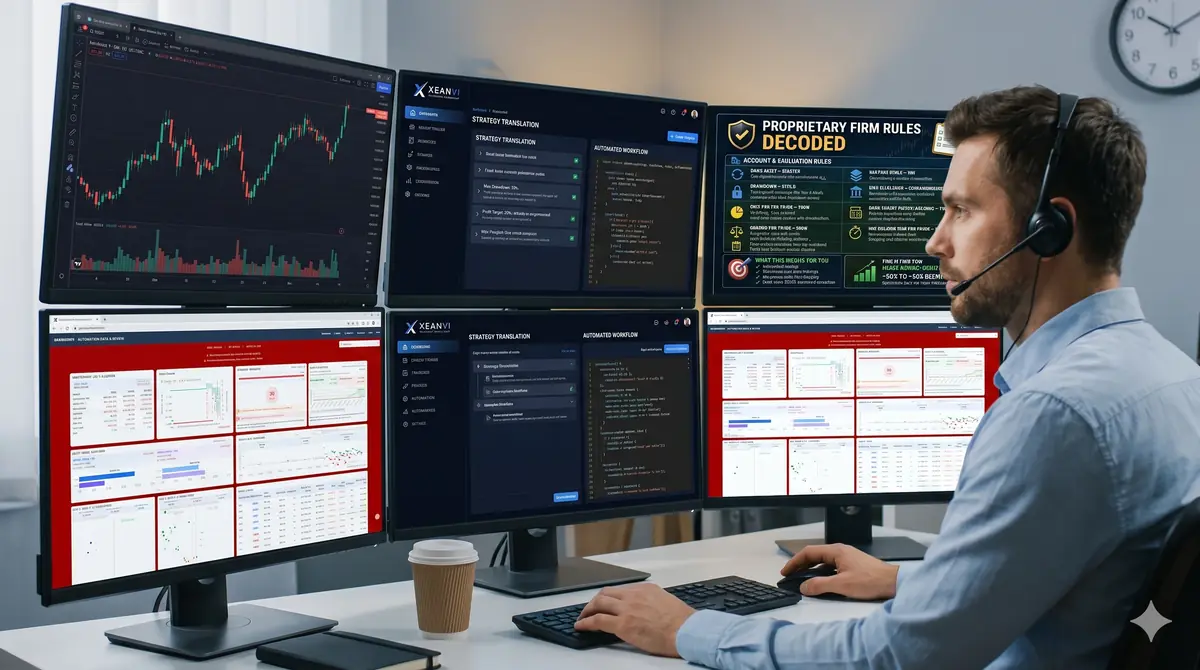
Day traders use day trading automation to move from reactive clicks to controlled execution. Proprietary trading firms judge traders by rule discipline, risk limits, and consistency under pressure. Xeanvi builds automated trading infrastructure for manual traders making that transition; the Xeanvi Playbook gives that process a practical starting point, and this guide explains the mechanics without forcing you through developer documentation.
Here is the blunt truth: automation does not rescue a weak strategy. It helps disciplined traders execute the same plan every time, collect cleaner data, and stop making last-second decisions that were never part of the setup.
Risk and transparency note: This article is educational, not financial advice. Day trading involves substantial risk, and traders should use risk management, test rules through paper trading or simulation first, and never trade money they cannot afford to lose. For a neutral educational primer, review Investor.gov’s day trading overview.
Day Trading Odds Become Clearer When Rules Replace Reactions
Odds in day trading are not a magic forecast. They are the practical result of how often traders follow a tested setup, size correctly, exit on plan, and avoid unnecessary trades.
Manual traders often know the rules before the market opens, then break them when price moves fast. The frustration is not always strategy quality; it is execution discipline under pressure.
Manual execution puts too many decisions into the worst possible moment. The chart is moving, pressure rises, and the mouse click becomes emotional. Automation can help by turning a trading plan into a sequence of conditions.
For example, traders can define:
- Entry conditions: The exact market behavior that must appear before a trade is allowed.
- Position size: The amount of risk allowed per trade, based on account rules.
- Stop placement: The price level where the trade idea is considered wrong.
- Profit-taking rules: The point where the platform reduces or closes exposure.
- Stand-down rules: The conditions that stop trading after a loss limit, time limit, or rule violation.
Xeanvi is built around this practical shift. Instead of asking traders to become software engineers, the platform helps translate repeatable trading decisions into automated execution logic.
Success Rate Comes From Process Data, Not Better Hunches
A trader’s success rate should be reviewed through process data: setup quality, execution consistency, risk control, and whether the plan was followed.
Many traders judge themselves only by profit or loss. That creates confusion because a good trade can lose money, and a bad trade can make money by accident.
Clear review separates outcome from behavior. The question is not only “Did this trade win?” The better questions are:
- Did the setup match the plan?
- Did the entry happen at the intended level?
- Was position size correct?
- Did the exit follow the rule?
- Did trading stop when the daily limit was reached?
This is where automation gives traders cleaner feedback. If the rules are defined before execution, the data after execution becomes more honest. The review can show whether the strategy failed, the market changed, or the human process broke down.
Data Turns a Guess Into a Trade Review
Data turns trading from memory into evidence. It shows what happened, when it happened, and whether the rule set performed as expected.
Screenshots, scattered notes, and vague memory make it difficult to know whether the problem was the setup, timing, risk, or trader behavior.
A useful workflow should collect the information that actually helps traders improve. That means focusing on practical review points, not bloated dashboards full of vanity metrics.
- Trade timing: Did entries cluster during the best or worst part of the session?
- Rule adherence: Did the trade meet the setup conditions?
- Risk behavior: Did size increase after a loss?
- Market condition: Did the strategy perform better in trend, range, or high-volatility conditions?
- Execution quality: Did slippage, delay, or hesitation affect the result?
Xeanvi’s role is to help traders connect execution with review. The platform does not need to make users sound technical. It needs to make their decisions measurable.
A Firm Mindset Protects Traders From Rule Drift
A firm mindset means traders treat rules as operating controls, not suggestions. This is how many proprietary trading environments protect capital and standardize behavior.
Rule drift can damage an account faster than one bad prediction. Size changes, stop movement, overtrading, and late-session revenge trades all break the process.
A proprietary trading firm does not usually care about confidence. It cares about risk, consistency, and whether traders can follow constraints under pressure. That mindset is useful even for independent retail traders.
The point is not to copy a firm blindly. The point is to borrow the discipline:
- Define maximum daily loss before the session starts.
- Set position limits before emotion enters the trade.
- Use repeatable setups instead of random chart reactions.
- Review execution quality, not just account balance.
- Stop trading when the rule says the session is done.
A Proprietary Trading Firm Offer Is Discipline Before Funding
A proprietary trading firm offer may look like access to capital, but the practical value is the rule framework around risk, evaluation, and accountability.
Many traders focus on the payout opportunity and ignore the rules that can disqualify them: drawdown limits, consistency requirements, restricted trading behavior, or daily loss rules.
Every firm rule set should be read as an execution checklist. Traders need to know what behavior is allowed before placing trades, not after a violation occurs.
Automation helps here because it can turn firm restrictions into pre-set boundaries. For example, traders can build a workflow around:
- Daily loss caps that stop new trades after a defined threshold.
- Maximum position size that prevents emotional overexposure.
- Time-based restrictions that avoid trading outside approved windows.
- Instrument filters that keep traders inside the planned market list.
- Trade frequency limits that reduce revenge trading.
Xeanvi’s positioning is straightforward: traders should not need to manually remember every guardrail while also reading the market. The platform should help keep the workflow aligned with the rule set.
Traders Need Guardrails Before They Need More Indicators
Traders often add more indicators when the real issue is uncontrolled execution. Guardrails address the behavior that damages an otherwise reasonable strategy.
The common frustration is circular: search for a better signal, repeat the same behavior errors, then blame the strategy. Oversized trades, late entries, early exits, and emotional re-entries are execution problems first.
More indicators can create the illusion of control. Guardrails create actual control. A simple system that blocks bad behavior is often more useful than another chart overlay.
Practical guardrails include:
- No-trade zones after major losses.
- Predefined stop logic that removes negotiation during the trade.
- Session limits that prevent fatigue trading.
- Setup filters that block trades outside the plan.
- Review tags that show which mistakes repeat.
Professional execution does not come from making the process more complicated. It comes from making the process harder to violate.
Conversations With Traders Reveal the Manual Execution Gap
Conversations with traders often reveal the same gap: the strategy is written one way, but live execution happens another way.
That gap creates distrust. Traders may feel that their platform, broker, emotions, and timing are all working against them, even when the core issue is an unstructured execution process.
The manual execution gap is the space between “what I planned” and “what I actually did.” For many active traders, that gap appears in small ways:
- The trader enters two seconds late because of hesitation.
- The trader moves the stop because the loss feels uncomfortable.
- The trader takes a partial profit too early because fear takes over.
- The trader re-enters after a loss without a valid setup.
- The trader forgets a firm rule during a fast session.
These are not rare mistakes. They are common operational failures. Xeanvi focuses on that operational layer: helping traders convert intent into execution rules that can be monitored, reviewed, and improved.
People Misread Automation as Skill Replacement
People often think automation can replace skill, judgment, and risk control. In reality, useful trading automation enforces a plan the trader already understands.
Beginners often fear two extremes: either the software is too complex to use, or it is a black box that hides dangerous decisions.
The right way to view automation is simple: it is a rule-following assistant. It should not replace judgment, risk planning, market education, or paper trading. It should reduce the number of emotional clicks a trader makes after the plan is already defined.
A healthy automation workflow should make the trader more accountable, not less accountable. The trader should know:
- Why the trade was allowed.
- What rule triggered the trade.
- How much risk the trade carried.
- Where the invalidation level was.
- When the system should stop trading.
That is the difference between automation and blind delegation.
Summary Screens Keep the Plan Readable Under Pressure
A clear summary screen gives traders a quick view of rules, exposure, limits, and recent execution behavior without forcing them to dig through complex menus.
During live day trading, messy dashboards create hesitation. Traders need the important information visible before a mistake happens.
A useful summary should answer practical questions quickly:
- Am I allowed to take another trade?
- How much risk have I used today?
- Which setup is currently active?
- Did the last trade follow the rules?
- Am I close to a firm or personal limit?
This matters because complexity creates hesitation. Xeanvi’s approach is to keep the workflow understandable for traders who want automation without becoming buried in engineering language.
Xeanvi Connects Day Trading Data, Firm Rules, and Trader Review
Xeanvi connects day trading rules, data, and firm-style controls into a workflow that helps traders execute, monitor, and review their process.
Many traders want automation but get blocked by developer docs, fragile scripts, unclear risk settings, or fear that the software will behave unpredictably.
The practical workflow should be simple enough to understand and strict enough to matter. Traders should be able to move from idea to rule set without losing control of the process.
- Define the setup. The trader identifies the market condition, trigger, and invalidation point.
- Set the risk rules. The trader defines position size, daily loss limits, and stop behavior.
- Map the execution logic. The platform translates the rule set into repeatable action.
- Monitor live behavior. The trader can see whether the system is acting inside the intended limits.
- Review the data. The trader studies execution quality, rule adherence, and recurring mistakes.
This is where automated trading becomes practical for manual traders. The goal is not to make trading effortless. The goal is to make the process visible, repeatable, and less vulnerable to emotional execution.
Traders Should Automate Repetitive Execution Before Strategy Ideas
Repetitive execution is usually the best place to start: entries, stops, size limits, time filters, and review logs. These rules are easier to define than vague strategy ideas.
Jumping straight into a fully automated system can create a fragile workflow if the strategy rules are not yet clear.
The better path is incremental. Start with the parts of the process that already have clear rules. Then test whether those rules hold up in live or simulated conditions.
A practical automation sequence looks like this:
- Automate risk limits first. Prevent the worst behavior before optimizing performance.
- Automate exits next. Remove emotional stop movement and inconsistent profit-taking.
- Automate entries only when the setup is clearly defined. Avoid turning vague instincts into rigid code.
- Automate review logs. Make it easier to find recurring mistakes.
- Refine with evidence. Use data to adjust rules, not frustration.
This is the approach serious traders should respect. Automation should make the process cleaner before it makes the process faster.
Data Checks Give Traders a Practical Audit Trail
Data checks create an audit trail that shows whether the trader, platform, and rule set behaved as expected.
When something goes wrong, traders need to know whether the issue was market behavior, strategy logic, platform setup, or human override.
An audit trail protects the trader from guessing. It gives structure to review and makes platform trust easier to build over time.
Traders should review:
- Trigger logs: Which condition allowed the trade?
- Order timing: When did the trade fire compared with the intended setup?
- Risk status: Was the trade inside the defined limit?
- Override behavior: Did the trader manually interfere with the plan?
- Session result: Did trading stop according to the rules?
Xeanvi’s value is in this operational layer. It helps day traders move from emotional execution to rule-based execution while keeping the process understandable enough to review.
Summary: People Need Execution Rules They Can Trust
The practical summary is simple: people do not need more trading noise. They need execution rules they understand, trust, and review consistently.
Too many traders waste years chasing new indicators while ignoring the operational mistakes that damage their accounts and violate firm rules.
Day traders build a stronger process by treating trading like a controlled system. A proprietary trading firm rewards that same mindset because capital protection matters more than confidence. Automation sits between those two needs: it helps traders follow rules when the market makes rule-following difficult.
Xeanvi supports that transition by helping day traders turn manual execution into a cleaner automated workflow. The platform does not promise certainty, income, funding, or profitable outcomes. It helps create structure: defined rules, clearer data, risk controls, and a review process that shows where execution can improve.
Bottom line: If traders cannot define the rule, the platform should not automate it. If they can define the rule, automation can help execute it with less emotion and more consistency.