How Much Should Trading Automation Software Cost?
Trading automation software costs are more than a subscription price. This guide explains the key factors that influence pricing, including automation features, execution reliability, broker integrations, data access, support, and the value of disciplined trading workflows.
By Troy Swartwood, Founder & Software Engineer · Published 2026-05-10 · Updated 2026-06-23
Understanding the Value Behind Trading Automation Software Costs
For many retail day traders, the question of how much trading automation software should cost is a significant one. It's a commercial decision, weighing potential benefits against an investment. However, the 'cost' isn't just a number; it's a reflection of the technology, features, support, and the potential impact on your trading workflow and discipline.
At XeanVI, we believe in transparency and empowering traders with tools that can help enforce their strategies. While specific pricing models vary across the industry, understanding the components that drive these costs can help you make an informed decision.
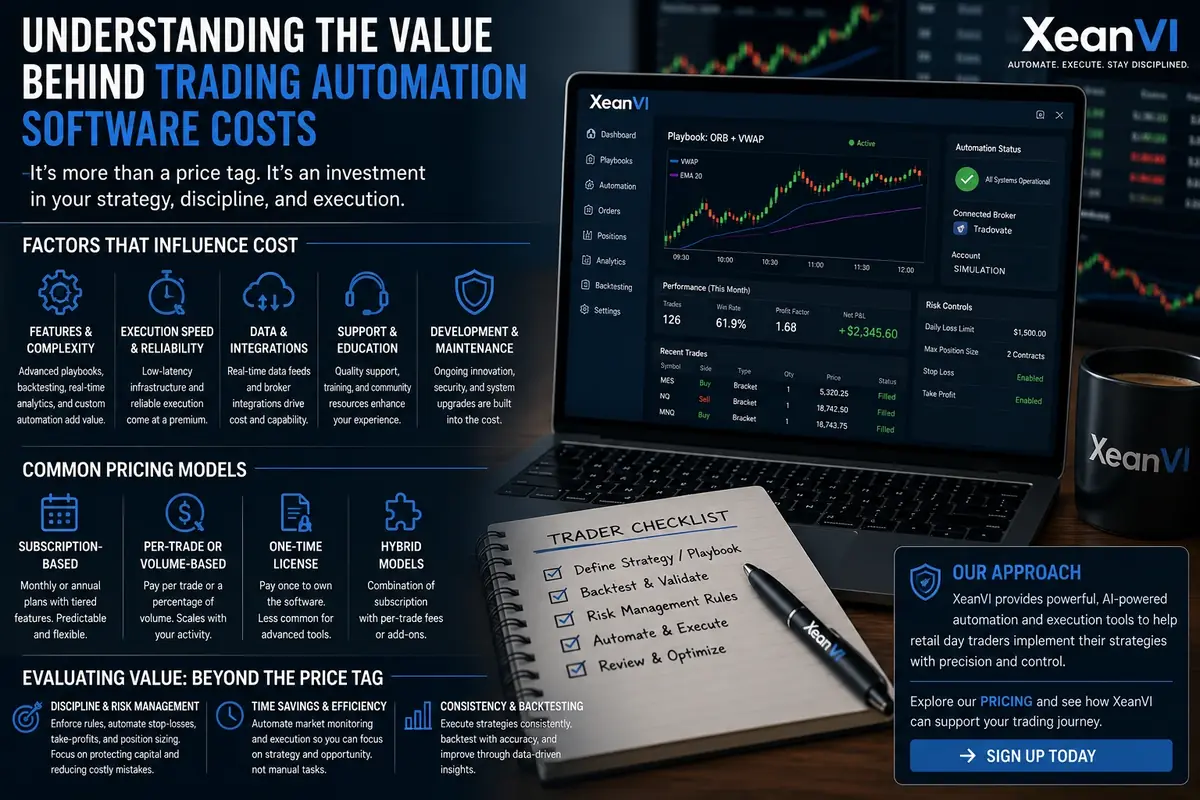
Factors Influencing Trading Automation Software Pricing
Several key elements contribute to the overall cost of a trading automation platform:
- Feature Set and Complexity: Basic automation tools might offer simple order execution, while advanced platforms provide sophisticated playbook creation, backtesting capabilities, real-time data analysis, and advanced order types like bracket orders. The more robust and customizable the feature set, the higher the potential cost.
- Execution Speed and Reliability: Platforms designed for high-frequency or low-latency trading often come with a premium due to the specialized infrastructure required to ensure rapid and dependable order execution.
- Data Feeds and Integrations: Access to real-time market data is crucial for automated trading. Software that includes or integrates seamlessly with premium data feeds and multiple brokerage platforms may have higher associated costs.
- Support and Education: Comprehensive customer support, educational resources, and community forums can add significant value, especially for traders new to automation.
- Development and Maintenance: The ongoing development of new features, security enhancements, and system maintenance are continuous costs for software providers, which are naturally reflected in pricing.
Common Pricing Models for Trading Automation Software
You'll typically encounter a few common pricing structures:
- Subscription-Based: This is the most prevalent model, offering monthly or annual plans. Tiers often exist, providing access to different levels of features or trading volume limits. This model provides predictable costs.
- Per-Trade or Volume-Based: Some platforms charge a small fee per trade executed or a percentage of the trading volume. This can be cost-effective for infrequent traders but may accumulate for high-volume strategies.
- One-Time Purchase (License): Less common for advanced platforms due to ongoing development and data costs, but some simpler tools might offer a perpetual license.
- Hybrid Models: A combination of a base subscription fee plus per-trade charges or premium feature add-ons.
Evaluating Value: Beyond the Price Tag
When assessing the cost, consider the value proposition beyond the immediate expense:
The Role of Discipline and Risk Management
Automated trading software can be instrumental in enforcing trading discipline. By executing predefined rules, it can help mitigate emotional decision-making, which is a common pitfall for many traders. Features like automated stop-losses, take-profit orders, and position sizing controls are critical components of a robust risk management framework. The value here isn't just about potential gains, but also about potential loss mitigation.
Time Savings and Efficiency
Manually monitoring markets and executing complex strategies can be time-consuming and prone to human error. Automation allows traders to define their playbooks and let the system work, potentially freeing up time and increasing efficiency. This can be particularly valuable for strategies involving specific entry/exit conditions or patterns like the Opening Range Breakout (ORB) or VWAP-based trades.
Consistency and Backtesting
Automation enables consistent execution of a strategy, which is vital for accurate backtesting and iterative improvement. The ability to test and refine a strategy without manual intervention provides invaluable insights into its potential efficacy under various market conditions.
XeanVI's Approach to Value
At XeanVI, our focus is on providing powerful, accessible AI-powered trading automation and execution discipline tools. We aim to offer a platform that helps retail day traders define and enforce their strategies, manage risk, and execute with precision. We encourage you to explore our features and understand how our platform is designed to add value to your trading journey.
To learn more about our specific offerings and how they align with your trading needs, we invite you to visit our pricing page. Understanding the investment in your trading infrastructure is a crucial step towards building a disciplined and potentially more consistent trading approach. Ready to explore the possibilities? Sign up today.
Educational source: For a general risk overview, see Investor.gov's day trading overview.