Is it Illegal to Use AI for Day Trading?
Many day traders wonder whether it's illegal to use AI for day trading. For retail traders in the US, it isn't. The harder problem is finding tools transparent enough that you can see what they're doing.
By Troy Swartwood, Founder & Software Engineer · Published 2026-05-20 · Updated 2026-09-24
Short answer: No — using AI to trade stocks is legal in the US
No. It is not illegal to use AI for day trading in the US. Trading with software is a regulated activity, not a prohibited one, and SEC and FINRA rules apply to an automated account exactly as they do to a manual one. What makes trading illegal is conduct: manipulation, spoofing, unregistered advice. The tool doesn't matter.
Is AI trading legal for retail traders?
Plenty of people ask me some version of this before they'll touch automation at all. Many day traders, eager to put technology to work, want to know one thing first: is it illegal to use AI for day trading? For retail traders the answer is no. It isn't illegal, and automated tools have quietly become standard equipment for anyone trying to build a trading playbook that survives contact with a real market.
The confusion comes from the company the technology keeps. Financial markets are heavily regulated, and the high-frequency trading desks that dominate the headlines run strategies most retail traders will never see the inside of. That's a very different world from yours. The rules that actually govern your account are simpler than the mythology suggests: follow market rules, don't manipulate anything, and know what your system is doing before you fund it, which is guidance that long predates every AI trading tool now on the retail market.
Nothing in US securities law treats a decision made by a model differently from the same decision made by a person. If you can place a trade manually, you can trade stocks with AI on the same terms. The law cares about the conduct of the trade, not the software that produced it.
What regulations apply? (SEC, FINRA)
Using software to execute trades against predefined rules is generally permissible for individual traders. Brokerage firms publish APIs or integrate with third-party platforms that place orders automatically. You stay responsible for the strategy, the risk management, and your own compliance.
The same rulebook governs AI stock trading as governs manual trading. The SEC enforces the federal securities laws, including the anti-fraud and anti-manipulation provisions of the Securities Exchange Act. FINRA supervises the broker-dealer carrying your account and enforces conduct rules through it. The one that bites day traders hardest is the pattern day trader rule: place four or more day trades within five business days in a margin account and you must keep $25,000 in equity. Automating your entries buys you no exemption from either regime.
- You own the output. Automation doesn't transfer accountability. If your system fires a bad order at 9:31, that's your order.
- Automated systems have to operate inside the bounds of fair and orderly markets, the same as any human trader.
- Most reputable brokers support automated trading as long as you stay within their terms of service.
- Your tax reporting doesn't change. Wash-sale rules and short-term capital gains treatment apply to bot fills exactly as they do to manual ones, and a high-frequency strategy can generate a genuinely miserable number of taxable lots.
When could AI trading cross a legal line?
The illegality lives in the conduct, not the tool. An algorithm can commit a securities violation faster and at greater scale than a person can, which is precisely why regulators watch automated order flow so closely. Four lines matter:
- Market manipulation. Placing orders to move a price rather than to get a fill breaks the Securities Exchange Act. Ramping a thin small-cap counts whether a human or a model decided to do it.
- Spoofing means entering orders you intend to cancel, to paint a false picture of supply or demand. Congress named it explicitly in the 2010 Dodd-Frank Act, and regulators pursue it in equities as straight manipulation. Automation makes spoofing easier to run and far easier for surveillance systems to catch.
- Wash trading is trading with yourself: buying and selling the same instrument across accounts you control to manufacture volume. Section 9(a)(1) of the Exchange Act prohibits it. A bot working both sides of a book can drift into this without anyone intending it, which is the version that catches retail traders off guard.
- Taking money to tell other people what to trade can make you an investment adviser who has to register with the SEC or your state. Trading your own account with AI is nobody's business but yours. Selling signals is where retail traders most often stumble across the line.
Notice what's absent from that list: using a model to find setups, size positions, or fire orders. None of that is unlawful on its own.
Do brokers allow trading bots?
Yes. Mainstream US brokers permit automated trading, and several publish APIs built specifically for it. Alpaca explicitly supports algorithmic and automated trading through its API, which is the broker XeanVI runs on. Brokers do layer their own terms on top of the regulations: rate limits on order submission, restrictions on certain order types, and the same margin and pattern-day-trader requirements that apply to manual accounts. Read the agreement for the broker you actually use. Permission to automate is not permission to ignore the account rules.
The Real Challenge: Accessibility, Not Legality
So if legality isn't the hurdle, what is? For most retail traders the obstacle has been getting hold of tools they can actually understand. Traditional algorithmic platforms assume you can code, or that you have quant training, or capital most people don't have. They end up feeling like black boxes.
We built XeanVI because that gap seemed worth closing. Automated execution and disciplined trading shouldn't be reserved for institutional desks, so the goal was to strip out the jargon and the intimidating interfaces and leave something a working trader can read.
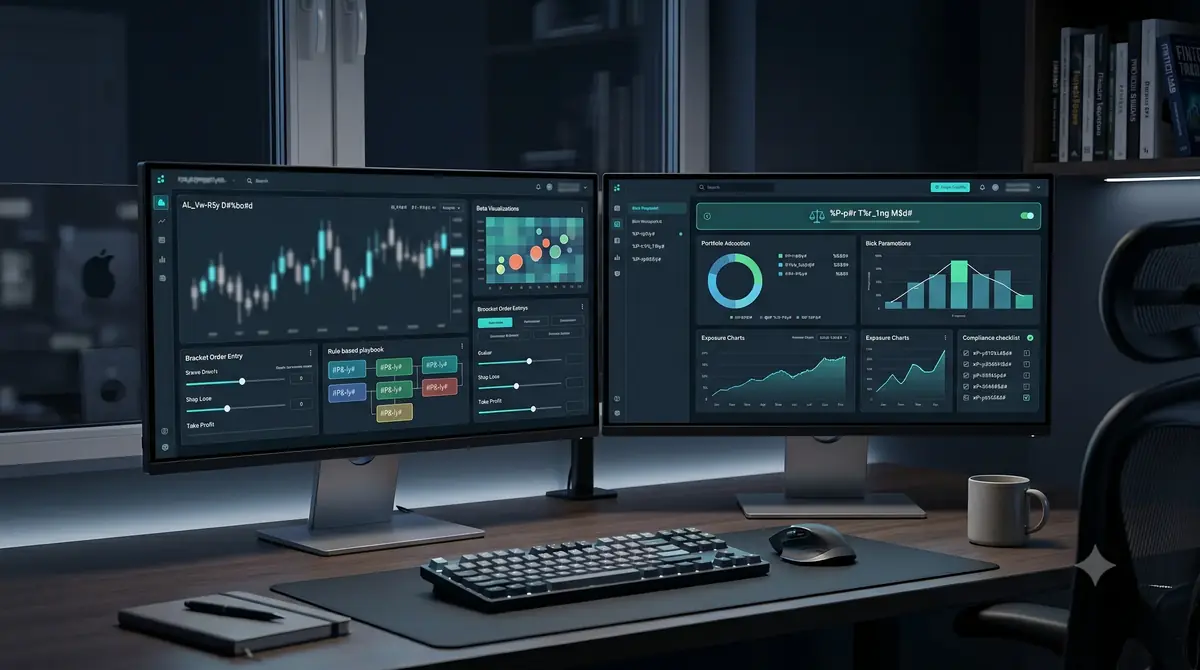
Rather than wrestling with code, you build and automate strategies through visual playbooks. That keeps your attention on the actual edge and on managing risk instead of on technical plumbing.
Embracing Discipline with Automated Workflows
Trading with AI doesn't hand over control. It enforces the discipline you already decided on. Strategies that demand precise timing and consistent execution, such as opening range breakouts (ORB) or volume-weighted average price (VWAP) setups, are the natural candidates. Define the rules in a playbook and your trades execute exactly as planned, with no room for a bad morning to rewrite them.
Take automated bracket orders. Setting a profit target and a stop-loss at the same moment as the entry means your risk management arrives with the trade instead of after it. Maintaining that by hand during a fast tape is close to impossible.
Building Confidence Through Transparency and Practice
The common fear with automated systems is the black box: not knowing what happened or why. XeanVI publishes its AI logic and transparency so you can inspect and control what runs. You define the rules. You set the parameters. You watch the results.
Test any strategy properly before it touches real capital. Backtest it, then paper trade it, and refine the playbooks until the behaviour stops surprising you. Paper trading costs you nothing except time, and it shows you how a strategy handles conditions you didn't anticipate. Nothing here is guaranteed, and past performance of any strategy tells you less than traders want it to.
Want to see how automated execution changes your discipline? Connect your broker and build a first strategy. The platform exists to make trading automation reachable, not to make it magic.
Key Considerations for Responsible Automated Trading
Automated trading is legal and genuinely useful. It is also an excellent way to lose money quickly if you skip the boring parts:
- Set hard risk parameters inside every strategy and respect them. Never risk capital you can't afford to lose.
- Understand the logic. Know why a playbook works and where it breaks. Copying a strategy you can't explain is how people find out what a drawdown feels like.
- Automated systems still need watching, because market conditions shift and yesterday's edge decays.
- Do your own research as markets evolve, and keep learning about new strategies, market structure, and platform features.
Final thoughts
So, is it illegal to use AI for day trading? No. Not in the US, not for retail traders, and not on any mainstream broker. Trading involves risk of loss regardless of what software you point at it, and the line you actually have to watch is conduct: manipulation, spoofing, wash trading, and giving compensated advice without registering. Stay on the right side of those and the technology is simply a tool.
This article is educational and is not financial advice. Consult a licensed professional about your own situation.
Ready to take control of your execution? Sign up for XeanVI and build your first automated strategy.
Educational source: For broader context on day trading rules and risks, review FINRA's day trading investor education resource. For more insights and educational content, visit the XeanVI blog.