Trading Bot Cost Exposed: The Hidden Fees, Infrastructure, and Real Math Behind Automated Trading
Most automated trading pitches lead with a headline price — and hide everything else. This breakdown exposes the real trading bot cost: cloud hosting, exchange fees, market data, and the risk controls generic bots skip.
By Troy Swartwood, Founder & Software Engineer · Published 2026-06-01 · Updated 2026-06-27
Every AI crypto trading bot pitch leads with a "headline price." A sleek dashboard. A monthly fee that looks manageable. What that price never includes is the server you need to run it, the market data feed it requires, the exchange fees that compound on every single order, or the risk controls you assumed were already built in. Trading bot cost is not a line item — it is a layered infrastructure problem, and most retail traders only discover that after real money is on the line. This post breaks down every layer so you can evaluate the true overhead before you commit to any automated strategy.
Why the Headline Price of an AI Crypto Trading Bot is the Smallest Number on Your Bill
Vendors selling AI crypto trading bots and automated software have learned that a low subscription fee closes deals. The headline price is the number on the landing page — the one that makes you think "I can afford this." What it rarely covers is the compute environment where the strategy actually runs, the real-time data the strategy requires to function, or the brokerage and exchange costs generated every time the bot places a trade.
Breaking down where that gap lives:
- Subscription fee (the headline price): Typically $30–$300/month depending on the vendor tier. This pays for the software license. It does not pay for execution infrastructure.
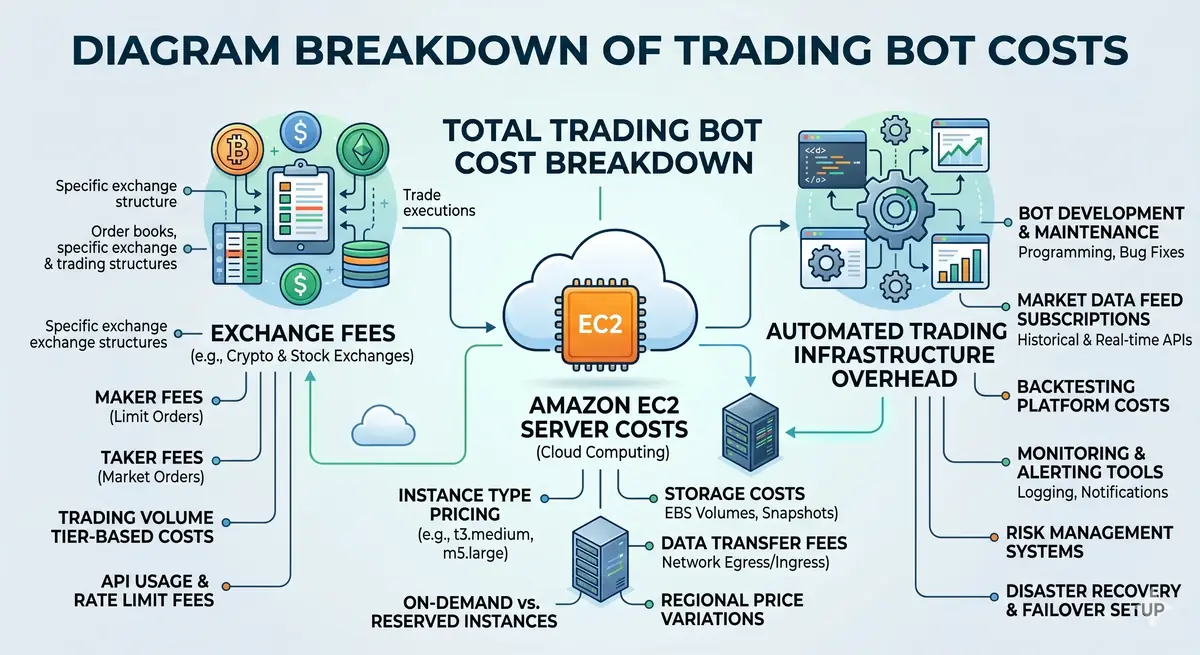
- Cloud hosting (e.g., Amazon EC2): Most retail crypto trading bots require you to run your own server instance to keep the strategy live 24/7. A t3.medium instance on Amazon EC2 runs roughly $30–$60/month before data transfer costs. Opt for a compute-optimized instance for latency-sensitive strategies and that number climbs significantly.
- Premium market data feeds: Free data is delayed data. Running a real strategy on delayed market data introduces signal lag that erodes every edge the model was built on. Professional-grade real-time feeds from providers like Polygon.io or directly from the exchange start at $50–$200/month.
- API connection and maintenance costs: Many vendors charge per-broker integration or per-API call volume above a threshold. These are rarely disclosed upfront.
- Exchange fees and the Trading Fee Schedule: Addressed in detail below — and this is where the real math gets ugly.
Add those numbers together before you evaluate any bot. The headline price is a marketing figure. Your actual monthly overhead is the sum of every line above.
Exchange Fees: The Tax on Every Trade Your Bot Places
Exchange fees are the most consequential and least discussed component of automated trading infrastructure cost. Every time a crypto trading bot places an order, the exchange applies a fee based on its Trading Fee Schedule. For a human trader placing 10 trades a day, that overhead is manageable. For an automated strategy placing 100 or 200 trades a day, exchange fees become a structural cost that can eliminate a profitable strategy's edge entirely.
Maker vs. Taker Fees: How Aggressive Execution Drains Capital
Most exchanges operate on a maker-taker fee model. Makers add liquidity to the order book (limit orders that sit and wait). Takers remove liquidity (market orders that execute immediately). Taker fees are consistently higher — typically 0.04%–0.10% per trade on equity and futures platforms, and up to 0.10%–0.50% on crypto exchanges.
An AI trading bot that defaults to market orders — or one built without explicit order-type controls — will consistently pay taker fees. Run that math on a $50,000 account trading 150 round trips per month at a 0.05% taker rate:
- 150 trades × $50,000 position size × 0.05% = $3,750/month in exchange fees alone
- That is $45,000 per year in pure transactional friction before accounting for any other overhead
- Your strategy needs to generate that return before you break even on execution cost
None of that is hypothetical. AI crypto trading bot vendors almost never walk you through this math — their demo accounts and backtests frequently omit realistic fee modeling, showing gross returns while your live account absorbs net-of-fees reality.
How High-Frequency Models Compound the Fee Problem
Hype-driven AI trading bot marketing gravitates toward high-frequency signals — the more trades, the more impressive the activity looks on a performance dashboard. But high-frequency models interact with the Trading Fee Schedule in a compounding way. Each additional signal generates another order. Each order adds exchange fees. Each layer of fees raises the strategy's required gross return threshold further. Unless the edge is large enough to absorb that friction — and documented rigorously — the strategy bleeds out gradually, not dramatically. Traders often attribute this to "market conditions" rather than the fee structure they accepted at sign-up.
The Real Infrastructure Stack: What It Actually Costs to Run an AI Crypto Trading Bot
Beyond exchange fees, running a reliable automated trading strategy requires a production-grade infrastructure stack. This is the category where most retail traders discover the largest gap between expectation and reality.
Server Reliability and Latency: Why Amazon EC2 Is Just the Starting Point
An AI trading bot that runs on your local machine will miss trades when your machine sleeps, restarts, or loses internet connectivity. The standard infrastructure fix for a retail crypto trading bot is a cloud-hosted virtual machine — Amazon EC2 is the most common entry point, but which instance tier you actually need determines a significant slice of your total trading bot cost.
- t3.micro / t3.small: Suitable for low-frequency strategies with minimal data processing. $8–$20/month. Often under-powered for real-time market data parsing.
- t3.medium / t3.large: The realistic baseline for most retail strategies. $30–$70/month.
- c5 or c6i compute-optimized instances: Required for latency-sensitive or multi-instrument strategies. $80–$200/month and above.
- Managed database (RDS or equivalent): If the strategy logs trade history or stores position data, add $15–$50/month for a managed database instance.
Amazon EC2 compute cost is only part of the trading bot infrastructure bill. Server management adds an ongoing time commitment — operating system patches, dependency updates, API credential rotation, uptime monitoring. None of that is automated. Someone has to own that work, and for most retail traders running their own bot environment, that someone is you.
Market Data: The Input Quality Problem
AI crypto trading bots and automated models are only as accurate as the market data they consume. Free and delayed data creates a systematic input problem specific to trading bots: the signal the model acts on does not reflect what the market actually looks like at execution time. When the market data is stale, the automated trading strategy fires on a ghost — and exchange fees accumulate on every one of those misfired orders.
Real-time, institutional-grade market data costs money. Traders running equities strategies through platforms with direct exchange data feeds pay exchange-mandated data fees — sometimes $15–$25/month per exchange just for the right to receive real-time quotes. Add consolidation fees for multi-exchange data and that line item grows quickly.
For a broader look at how data quality affects strategy performance, FINRA's investor education resources provide useful foundational context on how transaction costs and information asymmetries affect retail trading outcomes.
Risk Controls: The Infrastructure Layer Most Bots Skip
The most dangerous gap in generic automated trading setups is not the fee structure — it is the absence of enforceable risk controls at the execution layer. A strategy that works in a low-volatility environment can generate runaway losses when market conditions shift sharply, if the bot lacks hard limits on position size, drawdown, or daily loss exposure.
This is where the distinction between rule-based automation and opaque AI models becomes critical. Rule-based systems apply explicit, auditable controls: maximum position size per instrument, daily loss circuit breakers, order type restrictions, and defined exit conditions. Building those controls into a structured trading playbook before you go live is what separates recoverable bad days from account-ending events — these are not optional risk management suggestions, they are structural safeguards.
Black-box AI models obscure these controls, or lack them entirely. When the model behaves unexpectedly in a volatile session, the trader has no visibility into why, and no reliable mechanism to intervene before the damage accumulates. See how Xeanvi's transparent trading bot framework enforces rule-based execution controls — the logic is transparent, auditable, and defined entirely by the trader.
The Xeanvi Model: Transparent Execution, No Hidden Infrastructure Overhead
Xeanvi was built to eliminate the infrastructure complexity that makes generic bot setups so expensive in practice. Instead of purchasing a black-box strategy and then separately sourcing a cloud server, a market data subscription, and hoping the risk controls are adequate, Xeanvi provides direct, integrated automation where the trader defines the rules and the platform handles execution — with full visibility into every parameter.
The key differences from the generic vendor model:
- No separate server required: Xeanvi's infrastructure hosts execution natively. You do not manage an Amazon EC2 instance, pay for uptime monitoring, or troubleshoot dependency failures at 3 a.m.
- No opaque algorithms: Every rule in your trading playbook is transparent and auditable. You set the entry conditions, the exit logic, the position sizing rules, and the risk thresholds. Nothing executes outside those parameters.
- Direct broker integration: Xeanvi's broker integrations connect your strategy directly to your brokerage account — no middleware, no third-party relay, no additional API cost layer between your rules and your execution.
- Fee-aware strategy design: Because the execution environment is transparent, traders can model realistic exchange fees against their strategy's expected trade volume before going live. The math is visible. The overhead is calculable.
An automated trading setup you cannot inspect is a trading bot cost you cannot control. Xeanvi inverts the black-box model entirely: you dictate the exact execution boundaries, the platform enforces them reliably, and every parameter that drives your automated trading strategy is visible before a single order reaches the exchange.
Building an Honest Cost Model Before You Automate
Before committing capital to any automated strategy, build a full cost model that accounts for every layer of overhead. Use this framework as a starting point:
- Platform/software fee: Monthly subscription or license cost. This is the only number most vendors advertise.
- Hosting/infrastructure cost: Cloud server (Amazon EC2 or equivalent), database instance, monitoring tools. Estimate $30–$150/month for a functional retail setup.
- Market data cost: Real-time feed subscription per exchange or asset class. $50–$200/month depending on scope.
- Exchange fees (variable): Estimated monthly trade volume × average position size × applicable taker/maker rate from the Trading Fee Schedule. This number scales with strategy activity and must be modeled honestly.
- Maintenance time cost: Assign an honest hourly value to server management, strategy monitoring, and troubleshooting. This is a real cost even when it is not a direct cash expense.
Total that number. Then ask whether your automated trading strategy's documented edge — stress-tested against realistic market conditions — generates enough gross return to clear that trading bot cost overhead and still produce a net positive outcome. If the math does not work on paper, it will not work live.
Total Cost of Ownership: DIY Bot vs. Generic SaaS vs. Rule-Based Platform
Most trading bot cost comparisons only show the subscription fee. This table models the realistic monthly overhead across three common automated trading setups, using conservative real-world estimates for each cost layer.
| Cost layer | DIY Bot | Generic SaaS Bot | Rule-Based Platform (Xeanvi) |
|---|---|---|---|
| Headline subscription | $0 | Low monthly fee | Flat monthly fee |
| Cloud server / hosting | You provision & pay (EC2) | You provision & pay | Managed — included |
| Market-data feed | You source & pay | Often extra | Included |
| Exchange / broker fees | Full taker exposure | Full taker exposure | Execution-aware routing |
| Risk controls | Build yourself | Usually absent | Built in |
| Engineering & maintenance time | High (ongoing) | Low | None |
Note: Exchange fees (maker/taker) apply to all three setups equally — they are brokerage costs, not platform costs. The math on those is covered above.
The Break-Even Calculation Every Trader Should Run First
Before deploying any automated strategy, run this calculation against your realistic setup:
- Estimate your monthly infrastructure cost using the table above — software, hosting, data, integrations.
- Calculate your expected monthly exchange fees: projected trade count × average position size × your broker's taker rate.
- Add both numbers together. That is your monthly break-even threshold — the gross return your strategy must generate before you make a single dollar of net profit.
- Compare that threshold against your documented edge. If your backtested strategy averages 2% monthly gross return on a $25,000 account ($500), but your total overhead is $400/month, your actual net margin is $100 — and one losing month eliminates four months of net gains.
Most retail traders skip this calculation entirely. They evaluate a strategy on gross return and discover the net reality only after months of live trading. Running the math before deployment is not pessimism — it is the baseline discipline that separates sustainable automated trading from expensive experimentation.
Deploying an automated crypto trading bot is a legitimate strategy for rule-based market participation. But it is not passive income, and it is not cost-free. The traders who sustain it are the ones who understand the full cost structure before they deploy — not after.
Explore how Xeanvi's blog continues to break down the real mechanics of algorithmic trading, or visit Xeanvi to see how transparent, rule-based automation handles execution without the hidden overhead.
This content is for educational and informational purposes only. It does not constitute financial advice. All trading involves risk, including the potential loss of principal. Past strategy performance does not guarantee future results.