What Are Trading Bots? How They Move Your Money
Trading bots move real money through your exchange accounts via API keys—but black-box systems hide the strategy controlling your capital. This guide explains how bots actually work, the danger of opaque crypto trading bots, and why transparent, rule-based automation keeps you in control.
By XeanVI Team · Published 2026-05-30 · Updated 2026-10-18
Trading bots move real money in and out of your exchange accounts, often while you sleep, and that single fact is why understanding them matters more than any marketing promise you'll read. At Xeanvi, we've spent years building automated trading infrastructure for day traders, and we've watched too many beginners hand their money to a pre-built bot they didn't understand—only to discover the strategy underneath was a black box they could never inspect. This guide explains exactly what a trading bot is, how it connects to your accounts, and why the difference between an opaque bot and transparent, rule-based automation is the difference between understanding your risk and ignoring it.
We're not here to sell you a magic algorithm. We're here to explain the plumbing—clearly, honestly, and without the jargon that usually hides the risks.
How a Trading Bot Actually Connects to Your Exchange Accounts
A trading bot is software that places trades for you based on a set of instructions. That's it. The "intelligence" everyone talks about is really just a strategy—a list of rules deciding when to buy and when to sell. The bot's job is to watch the markets and execute those rules faster and more consistently than a human clicking buttons.
To do that, a bot needs a way to reach your money. It connects to your exchange accounts through an API (Application Programming Interface)—essentially a secure doorway your exchange opens so outside software can place orders on your behalf. When you set up automated trading, you generate API keys and hand them to the bot.
Here's the part that should make you pause: those keys grant power over your accounts. Depending on the permissions you set, an API key can let a bot trade, view balances, and in poorly configured cases, even withdraw funds. If you don't understand the strategy controlling those keys, you've handed access to your money to software whose behavior you can't predict.
The API Permissions That Protect (or Endanger) Your Money
Not all API access is equal, and knowing the difference is one of the most practical defenses a beginner has. Before you connect any bot to your accounts, you should understand exactly what you're authorizing:
- Read-only access: The bot can see your balances and positions but cannot place trades or move money. Useful for tracking, harmless to your capital.
- Trade permission: The bot can open and close positions. This is what automated trading actually requires—and where the risk begins.
- Withdrawal permission: The bot can move money out of your account. There is almost no legitimate reason to ever grant this to a trading bot. Leave it off.
- IP whitelisting: Many exchanges let you restrict API keys to specific addresses, so a leaked key can't be used from somewhere else. A small step that meaningfully shrinks your attack surface.
The pain point here is real: most beginners never read these settings. They paste their keys into a bot, click connect, and assume the software is on their side. Transparent automation flips that relationship—you decide the permissions, and you understand exactly what the strategy is allowed to do.
The Different Types of Trading Bots You'll Encounter
Trading bots come in several types, and the differences matter because each one carries a different level of transparency—and therefore a different level of risk to your accounts.
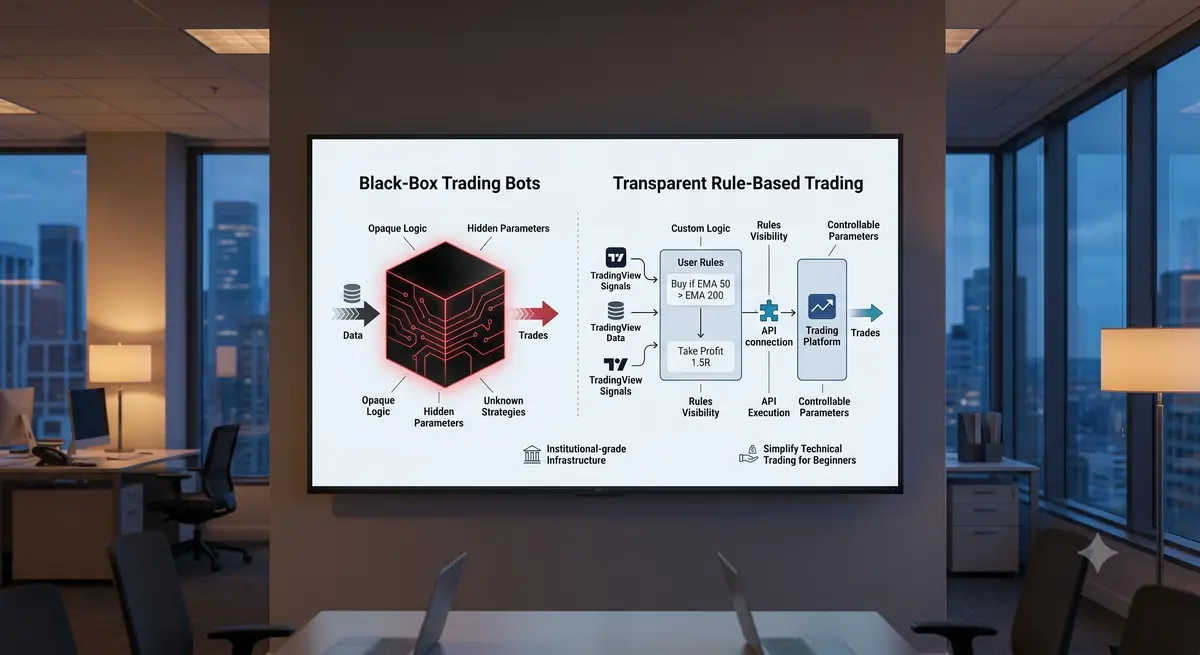
- Black-box pre-built bots: These promise profits and don't disclose the strategy. You don't see the rules; you just see the results (or losses). Many "crypto trading bots" marketed to beginners fall into this category.
- Signal-following bots: These execute trades based on signals from an external source, such as a charting platform. You see the trigger, but the quality depends entirely on the signal's logic.
- Rule-based automation: You write the strategy. The bot simply executes the conditions you define. Every decision is one you can inspect, test, and change. This is the transparent model Xeanvi is built around.
- Market-making and arbitrage bots: More advanced types that exploit price differences across markets. Powerful, but rarely appropriate for beginners and almost never transparent when sold off-the-shelf.
The advantage of understanding these types is simple: once you can name the kind of bot you're using, you can judge whether you actually control the strategy behind it—or whether you're relying on rules you've never been allowed to read.
Why "Crypto Trading Bots" Earned a Bad Reputation
The market for crypto trading bots is crowded with products that promise to turn Bitcoin volatility into easy profit. The reality is harsher. When a bot won't show you its strategy, you can't tell whether it's a sophisticated system or a coin flip dressed up in a dashboard. And because crypto markets move fast and trade around the clock, a flawed bot can produce losses quickly—long before a beginner notices what went wrong.
This is the exact fear that keeps thoughtful traders cautious: losing money to a system they were never allowed to understand. The solution isn't to avoid automation. It's to insist on transparency.
How a TradingView Signal Triggers an API to Execute a Trade
One of the clearest examples of transparent automation is connecting a charting platform like TradingView to your execution engine. Here, you can see every link in the chain—which is exactly the point.
Here's how a single trade flows from chart to execution:
- You build a strategy on TradingView using rules you define and can read—for example, a specific price condition or indicator crossover.
- When the market meets your condition, TradingView fires an alert. This alert is the signal.
- The signal travels to your execution engine, carrying instructions you wrote: which asset, which direction, what size.
- The engine uses your API connection to place the order on your exchange accounts.
- The trade executes—based on a rule you can see, audit, and shut off at any moment.
Notice what's missing from this chain: a strategy you can't inspect. At no point does an opaque algorithm decide things on your behalf. The bot is just the muscle. You remain the brain. That's the structural difference between automated trading you can understand and automation that operates on rules you'll never see.
What Can Go Wrong With Trading Bots
Even with full transparency, automation carries real risks every beginner should plan for. A strategy that performed well in backtesting can fail in live markets because past conditions don't repeat. A technical glitch—a dropped internet connection, an exchange outage, or a delayed signal—can leave a position open when you intended to close it, or fire an order you never wanted. Sudden volatility can trigger your rules in ways you didn't anticipate, and a single misconfigured setting (wrong position size, missing stop) can compound a small mistake into a large loss. Leaked or over-permissioned API keys can expose your accounts to theft. None of these risks disappear with rule-based automation—but transparency at least lets you see the rule that caused the problem, fix it, and shut it off.
Because of these risks, treat automation cautiously. Test any strategy in a paper trading (simulated) environment before risking real money, start with small position sizes, and use stop-losses and sensible risk limits. For neutral, beginner-friendly education on automated and algorithmic trading risks, FINRA's investor resources at finra.org/investors are a useful place to start.
Why Xeanvi Provides the Engine, Not the Magic
Xeanvi exists because we believe trading bots should never be black boxes. We don't sell you a mysterious algorithm and ask you to trust it with your accounts. Instead, we provide the execution engine for your strategy—the rules you write, the conditions you set, the logic you can read line by line.
This matters for every framework that defines trustworthy automation. You bring the experience and the strategy; we provide the reliable infrastructure to execute it. The only logic running is the logic you can inspect. If you want to understand the philosophy behind transparent execution, our transparency page lays out exactly how and why we refuse to operate as a black box.
For traders ready to build their first set of rules, our beginner's trading playbook guide walks through how to structure a strategy from the ground up, and the Xeanvi Playbook gives you a framework to turn those ideas into transparent, executable rules. You can learn more about who we are and why we built this on our about page, and explore more practical guides on the Xeanvi blog.
The Bottom Line on Trading Bots and Your Money
A trading bot is a tool, not a guarantee. It connects to your accounts through an API, executes a strategy, and moves real money—which means the single most important question you can ask is whether you understand the rules driving it. Black-box bots keep that answer out of reach. Rule-based automation hands it to you.
This article is for educational purposes only and is not financial advice. Automated trading involves real financial risk, including the potential loss of your entire investment, and no responsible platform—Xeanvi included—can promise profits or guarantee outcomes. Always do your own research, manage your risk carefully, and consider consulting a licensed financial professional before trading. What we can offer is transparency: the ability to see, test, and control exactly what your automation does with your capital.