Trading Playbook: Rules for Disciplined Day Trading
A trading playbook helps day traders define their strategies, entry and exit rules, risk controls, and daily routines. This guide explains why a written playbook is essential for reducing emotional trading, improving consistency, and supporting disciplined execution.
By Troy Swartwood, Founder & Software Engineer · Published 2026-05-17 · Updated 2026-06-23
Introduction: Defining the Trading Playbook
In the dynamic and often unpredictable world of day trading, success is rarely a matter of chance. It is often the result of planning, discipline, and consistent execution. This is where a trading playbook becomes an important tool. Simply put, it is a written guide that details a trader's specific strategies, entry rules, exit rules, risk management protocols, market preparation routines, and trade review process. It serves as a personal instruction manual designed to reduce emotional decision-making and provide a clear framework for different trading scenarios.
Why Trading Playbooks Are Essential for Day Traders
Day trading demands quick decisions under pressure, which can easily lead to impulsive actions driven by fear, greed, or frustration. A well-defined plan helps counter these problems by giving the trader a clear structure before the trade begins.
- Promoting Discipline and Consistency: By outlining clear rules, the playbook helps traders stick to their strategy even when faced with volatility or emotional pressure. This consistency is important for long-term performance review.
- Enhancing Risk Management: It defines specific risk parameters, such as position sizing, stop-loss levels, and daily loss limits, helping protect capital and reduce the chance of severe losses.
- Facilitating Performance Analysis: With a consistent set of rules, traders can review their trades more accurately, identify what is working, and refine their strategies based on objective data instead of emotion.
- Reducing Emotional Trading: When a clear plan is already in place, traders are less likely to make reactive decisions based on fear, greed, revenge trading, or hesitation.
Key Components of an Effective Trading Playbook
Every trader's rulebook will be different, but strong trading plans usually include several core components.
1. Trading Strategy and Setup
This section defines the specific conditions that must be met before a trade can be considered. It should remove vague decision-making and force the trader to identify only valid setups.
- Market Selection: Which instruments you will trade, such as stocks, futures, forex, or other markets.
- Timeframes: The charts and timeframes you will use for analysis and execution.
- Entry Criteria: Precise conditions that trigger an entry, such as price action, volume behavior, VWAP reclaim, or an Opening Range Breakout setup.
- Exit Criteria: Rules for taking profits, cutting losses, scaling out, or closing a position when the trade thesis is no longer valid.
- Indicators and Tools: Any technical indicators, charting tools, scanner conditions, or market structure signals used in the decision process.
2. Risk Management Rules
This is one of the most important sections of any trading plan. A trader can have a strong setup and still fail without proper risk control.
- Position Sizing: How much capital you allocate to each trade, often based on a percentage of account risk.
- Stop-Loss Placement: Where the protective stop-loss order should be placed before or immediately after entry.
- Daily and Weekly Loss Limits: The maximum acceptable loss before trading stops for the day or week.
- Trade Management: Rules for scaling in, scaling out, moving stops, or using tools such as bracket orders to automate parts of the process.
3. Pre-Market and Post-Market Routines
Strong trading preparation does not start when the market opens and it does not end when the final trade closes. Your documented process should include structured routines before and after the session.
- Pre-Market Preparation: How you review market conditions, scan for potential setups, check economic news, and identify stocks that match your criteria.
- Post-Market Review: A disciplined process for reviewing trades, journaling outcomes, identifying mistakes, and documenting areas for improvement.
4. Psychological Preparedness
Trading can be mentally demanding. Your written rules should include steps for handling emotional pressure, especially during losses, missed trades, or volatile market conditions.
- Emotional Management: Guidelines for staying calm, avoiding impulsive trades, and stepping away when decision quality declines.
- Handling Losses: Acknowledging that losses are part of trading and having a plan to reset mentally instead of revenge trading.
The Role of Automation in Executing Your Playbook
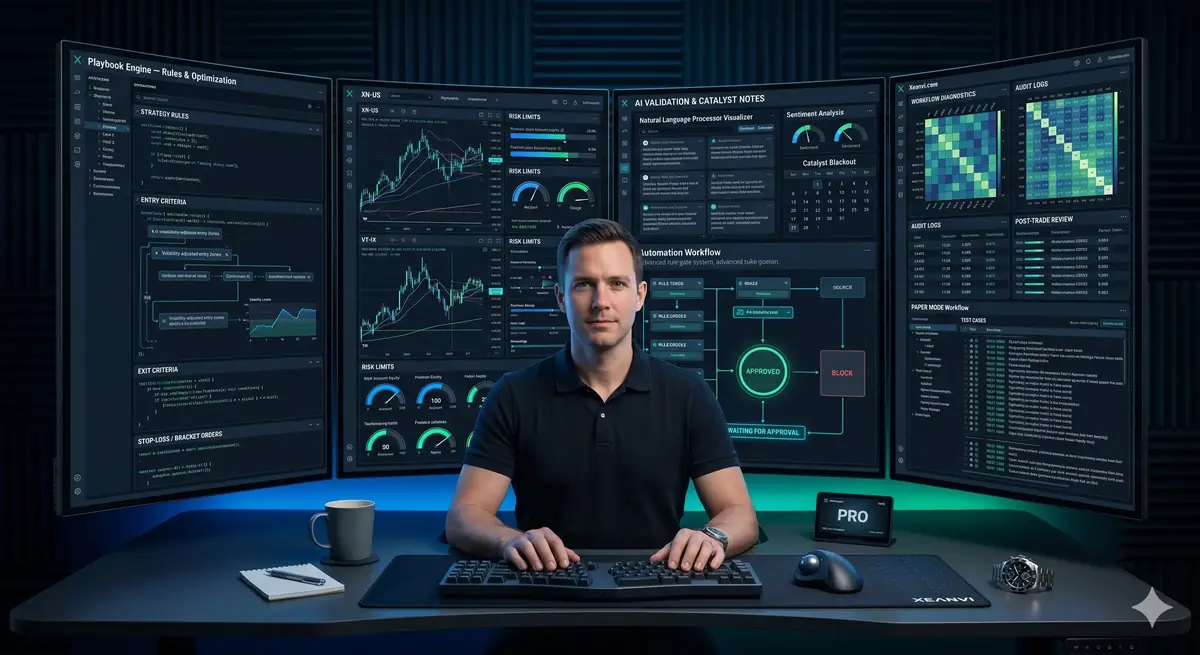
Once your rules are clearly defined, platforms like XeanVI can help execute strategies with more precision and discipline. By automating entry rules, exit rules, and risk management instructions, traders can reduce manual errors and emotional interference.
XeanVI's focus on automation workflows and execution discipline helps traders follow predefined rules while giving them more time to focus on strategy development, review, and refinement. Automation supports execution, but it does not remove market risk or make trading outcomes certain.
Developing and Refining Your Trading Rules
A trader's playbook is not a static document. It should evolve as the trader gains experience, studies results, and adapts to changing market conditions. Start with a basic version, then test it using paper trading before applying it to live markets.
Paper trading allows traders to refine strategies without risking real capital. Over time, trade reviews can reveal whether the rules are too loose, too restrictive, or poorly matched to current market conditions. Continuously review your trades against your documented process, identify patterns, and make data-driven adjustments. For more insights on refining your approach, explore our blog.
Conclusion
For serious day traders, a structured trading playbook is not optional. It provides the framework for disciplined decision-making, risk management, trade review, and consistent execution. By investing time in creating and refining your process, you give yourself a clearer framework for navigating fast-moving markets with less emotional interference.
Educational source: For broader context on day trading rules and risks, review FINRA's day trading investor education resource.