Why 97% of Day Traders Lose Money
97% of day traders lose money — not because they lack data, but because their execution system is manual and emotionally driven. This post breaks down the trading mistakes behind the failure rate and explains how rule-based automation with Xeanvi moves you out of the losing 97%.
By Troy Swartwood, Founder & Software Engineer · Published 2026-06-23 · Updated 2026-09-24
Not financial advice: Trading involves substantial risk of loss. Past performance is not indicative of future results. This post is for educational purposes only.
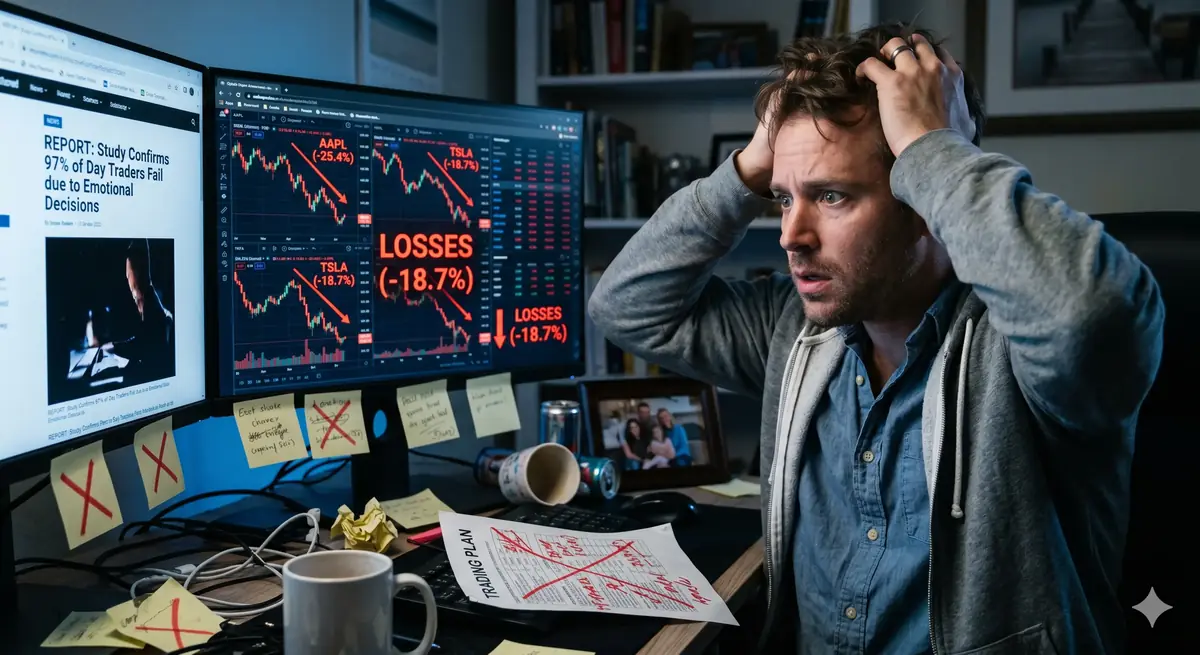
The number is brutal, and it doesn't lie: 97% of day traders lose money (Chague, De-Losso & Giovannetti, 2020). Not occasionally. Not in their first month while they find their footing. Consistently, across years, across markets, across every data subscription and charting setup money can buy. Day traders pour time, capital, and genuine intellectual effort into the markets — and nearly all of them still watch their money disappear. The question nobody asks loudly enough isn't what indicator are they missing? It's why does the execution model itself keep failing? That's what this post breaks down.
The Failure Is Not in the Chart. It Lives in the Execution Layer.
Most traders treat failure as an information problem. They assume that if they could just see the market more clearly — more data, sharper signals, better tools — the losing would stop. That's why platforms like Bookmap attract a devoted following. Bookmap's order-flow heatmap lets traders visualize where large limit orders are stacked in real time, showing the "walls" of buy and sell pressure sitting above and below the current price. It's genuinely sophisticated market intelligence.
And yet, day traders who use Bookmap still lose. Not because Bookmap is a bad tool — it isn't. But because seeing the right information and acting on it correctly are two entirely different skills, and the human brain is wired to sabotage the second one under pressure.
When price starts moving against an open position, behavioral finance describes a well-documented pattern: the deliberate, rules-based part of decision-making gets overridden by an acute stress response. This is closely tied to loss aversion (Kahneman & Tversky, 1979) — the tendency for losses to feel roughly twice as painful as equivalent gains, which pushes traders from deliberate toward reactive choices. A trader who spent weeks building a clean, logical strategy suddenly finds themselves doing things that strategy explicitly forbids: holding losers too long, sizing up to "make it back," or freezing entirely while money bleeds out tick by tick.
This isn't a discipline problem. It's a structural one. The human nervous system was not built to process rapid price fluctuations without panic. That's the founding premise behind Xeanvi — and Xeanvi's commitment to transparency starts from this uncomfortable truth, then builds a system around it.
The Anatomy of a Failed Trader's Execution Habits
The failed trader's execution pattern is predictable. It's not random. It's almost scripted — the same trading mistakes, repeated with minor variations, until the account runs dry. Xeanvi was built specifically to interrupt this pattern at the mechanical level.
Stage One: Confusing Complexity for Edge
Early-stage traders stack indicators. RSI, MACD, VWAP, Fibonacci levels, order-flow tools — all running simultaneously on the same chart. The belief is that more inputs produce better outputs. In practice, the opposite happens. More inputs create more conflicting signals, more hesitation at the moment of entry, and more justification for breaking rules when price doesn't behave as expected.
Sophisticated data subscriptions like Bookmap can sharpen a trader's market understanding. But they cannot replace a systematic process for managing orders. Seeing a large bid wall at a key price level is useful information — but only if the trader's response to that information is governed by predetermined rules, not by whatever emotion happens to be running in that moment.
Stage Two: The Manual Order Management Trap
Here is where most of the money gets lost. Not at entry. At management.
A trader enters a position with a clear plan: target at X, stop at Y. Then price wobbles. It doesn't hit the stop — it just hovers near it. And the manual trader, watching every tick, starts rationalizing. Maybe the stop is too tight. Maybe I should give it more room. Maybe this is just noise before the real move. They move the stop. Price hits the new level. They move it again. What started as a controlled 1% risk turns into a 4% loss because a human hand was on the mouse when it shouldn't have been.
This is not a rare edge case. This is the central mechanism of the day trader failure rate. The trading plan was fine. The orders were mismanaged in real time because execution was manual and unsupervised.
Stage Three: Revenge Trading and the Result Spiral
After a bad loss, the emotional brain wants one thing: to get the money back immediately. This produces revenge trading — taking outsized positions with compressed decision-making to recover quickly. The result is almost always a second, larger loss. Then a third. The account that was down 4% is now down 12% before lunch.
Revenge trading isn't a character flaw. It's a predictable neurological response to financial loss. The problem is that manual, discretionary trading gives it the perfect conditions to thrive: no circuit breakers, no enforced cooling-off, no system that simply refuses to place the emotional trade.
The Most Common Day Trading Mistakes That Drain Money
| Mistake | Why it loses money | How automation fixes it |
|---|---|---|
| Emotional, discretionary entries | Fear and greed override the plan, so trades fire on impulse instead of edge | Entries only trigger when predefined rule conditions are met — no impulse trades |
| Inconsistent position sizing | Oversized bets on "high-conviction" ideas turn one bad trade into a blown account | Position size is calculated from fixed risk parameters on every order |
| No predefined exit or stop | Winners are cut early and losers are held hoping for recovery | Stops and targets are set before entry and enforced automatically |
| Revenge trading after a loss | Chasing losses compounds drawdowns within a single session | The system trades the same way regardless of the prior outcome |
| Overtrading / chasing setups | Excess trades rack up fees and slippage that quietly erode capital | Only qualified setups are taken; frequency is bounded by the rules |
| Abandoning the plan mid-trade | Manual intervention breaks the strategy whose edge depends on consistency | Execution is hands-off, so the tested edge actually plays out over time |
Across the 97%, these trading mistakes appear with near-universal consistency:
- Moving stop-losses mid-trade: Redefining acceptable risk after a position is open. The result is losses that far exceed the original plan.
- Revenge trading: Chasing losses with larger, faster, less-considered positions. Compounds drawdowns rapidly.
- Overtrading: Entering positions outside the defined setup because boredom or FOMO triggers action. Quality edges get diluted by quantity.
- Sizing inconsistency: Trading larger when "feeling confident," smaller when "feeling cautious" — inverting position sizing exactly when it needs to be systematic.
- Early exits on winners: Closing profitable trades before targets are hit because the brain locks in small gains as a relief from anxiety. Cuts the reward side of the risk/reward ratio.
- Skipping the playbook: Deviating from a defined strategy mid-session because price action "looks different today." Almost always costs more than following the rules would have.
- Post-loss rule abandonment: After a losing streak, scrapping the entire system rather than analyzing whether the rules or the execution failed.
What every item on this list has in common: a human hand making a discretionary decision at the exact moment when a rule should have governed the outcome. The solution isn't more willpower. It's removing the opportunity to override the rules in the first place. That's precisely what a structured trading playbook is built to enforce.
Why More Data Doesn't Fix a Broken Execution System
The trading industry has a vested interest in selling the idea that better information produces better results. Data subscriptions, premium charting packages, sophisticated order-flow tools — they're all positioned as the missing piece. And for traders who already have a systematic execution process, better data can genuinely add value. It can refine entries, sharpen context, and improve the precision of how rules are defined.
But for traders whose fundamental process is still manual and emotionally driven, better data just produces more sophisticated-looking losses. A trader who watches a Bookmap heatmap shift and then moves their stop because the visual pattern made them nervous hasn't gained an edge — they've just added a more expensive tool to the same broken system.
The 97% statistic doesn't improve as data quality improves. It's been stubbornly consistent across decades of market access expansion, retail trading platforms proliferating, and information becoming cheaper and faster. The variable that doesn't change is the manual, emotionally-compromised execution layer sitting between the strategy and the orders.
This is also why opaque AI trading bots don't solve the problem — they just relocate it. When a black-box algorithm makes a decision you can't inspect or understand, you're still exposed to unpredictable behavior. You've just outsourced the opacity rather than eliminated it. The real fix is systematic execution that you designed, that you understand, and that runs without emotional interference. For traders building toward that, avoiding the overfitting trap is equally critical when constructing the rules themselves.
How Systematic Automation Moves Day Traders Out of the 97%
The traders in the 3% aren't smarter. They're not reading better charts or using more powerful tools. The defining difference is structural: their method for managing live orders is not manual. Rules govern execution. The emotional brain never gets a vote at the moment it matters most.
This is the operational logic behind Xeanvi. The platform is built on a single premise: the mouse should not be in your hand when a live position is running against you. Instead of watching price fluctuate and making real-time decisions under stress, you build your rules once — entry conditions, position sizing, stop-loss placement, target levels, exit logic — and Xeanvi manages your orders with cold, mathematical precision from that point forward.
There are no black-box algorithms making decisions you can't see or audit. Every rule is transparent, visible, and yours. If the strategy needs adjustment, you adjust the rules — not in the middle of a trade, but in a calm, deliberate session between markets. The platform enforces your playbook exactly as written, including the rules that are hardest to follow when money is on the line.
This structural separation between strategy design and live execution is what the 97% lack. It's not a personality trait. It's a system design choice. And it's one that individual day traders can now make without institutional resources or a team of quantitative developers.
For traders managing business capital or corporate funds alongside personal trading activity, the same principle scales — systematic rules applied to capital allocation consistently outperform discretionary management over time, as explored in the context of automating corporate treasury for compound growth.
What Switching to a Rule-Based System Actually Looks Like
Making the shift from manual to systematic execution isn't about abandoning your market knowledge or trading instincts. It's about codifying those instincts into rules that run without you second-guessing them in real time.
In practice, the transition involves three steps:
- Audit your current process for manual override points. Where in your existing trading does a human hand make a real-time judgment call? Entry trigger, stop placement, target adjustment, position sizing — map every decision node and ask whether a rule could govern it instead.
- Define your rules in plain logic, not vague intuition. "I'll exit when it looks like the momentum is fading" is not a rule. "I'll exit when price closes below the 9-period EMA on the 5-minute chart" is a rule. The difference is everything when the trade is live and the stress is real.
- Let the system enforce them without exception. This is where platforms like Xeanvi do the operational heavy lifting. The rules run. The orders route. You monitor. You don't intervene unless the pre-defined conditions for intervention are themselves part of the rules.
The result of this process isn't a guarantee of profit — markets are uncertain and no system eliminates risk. But it does guarantee something valuable: your strategy gets tested fairly. Not sabotaged mid-execution by the same emotional trading mistakes that have been draining trader accounts since markets existed.
If you're ready to take the mouse out of your hand, start with Xeanvi's monthly plan and build your first rule-based playbook.
Key Takeaways
- The 97% day trader failure rate is driven by manual, emotionally-compromised execution — not by a lack of data or indicators.
- Tools like Bookmap improve market visibility, but they cannot replace a systematic method for managing live orders.
- The most common trading mistakes — moving stops, revenge trading, overtrading, sizing inconsistency — all share one root cause: a human hand making decisions that rules should govern.
- Black-box AI bots relocate the opacity problem rather than solving it; transparent, rule-based automation is the structural fix.
- Xeanvi removes the emotional execution layer entirely — you define the rules, the platform manages the orders with mathematical precision.
- No system eliminates market risk, but systematic execution ensures your strategy is tested fairly instead of sabotaged by in-trade discretion.
Sources
- Chague, F., De-Losso, R., & Giovannetti, B. (2020). Day Trading for a Living? — 97% of individuals who day-traded for more than 300 days lost money.
- Barber, B., Lee, Y., Liu, Y., & Odean, T. (2004). Do Individual Day Traders Make Money? Evidence from Taiwan — only about 1% are reliably profitable.
- Kahneman, D., & Tversky, A. (1979). Prospect Theory: An Analysis of Decision under Risk.
- U.S. SEC / Investor.gov. Day Trading.
Not financial advice: Trading involves significant risk of loss and is not appropriate for all investors. The content on this page is for educational and informational purposes only. Xeanvi does not guarantee trading results or investment returns. Always assess your own risk tolerance before committing capital to any trading strategy.