Automated Trading Software Comparison: XeanVI vs. Composer and Trade Ideas
Trade Ideas scans with black-box AI. Composer builds visual portfolio logic. XeanVI executes user-defined rules deterministically through brokerage APIs. This automated trading software comparison breaks down architecture, transparency, API execution, and pricing for all three platforms.
By Troy Swartwood, Founder & Software Engineer · Published 2026-07-29
Educational Disclaimer: This algorithmic platform guide is strictly for informational purposes and does not constitute financial advice. Algorithmic trading involves a substantial risk of total capital loss. Automated execution does not eliminate market risk, and users are entirely responsible for their own risk management. We strongly recommend paper trading any new strategy in a simulated environment before deploying live capital. Always conduct independent due diligence.
Finding the right market infrastructure requires a brutally honest automated trading software comparison. Retail operators searching for an execution edge are usually choosing between three fundamentally different designs: an AI stock scanner, a visual portfolio builder, and a deterministic execution engine. By examining how each system generates decisions, routes orders, and charges for access, users can select infrastructure based on mechanical realities rather than marketing hype.
Trade Ideas discovers setups using artificial intelligence. Composer allocates portfolios visually. XeanVI executes deterministic rules. While all three platforms automate aspects of the market, they handle entirely different jobs. Picking the wrong tool for your operational style will cost significantly more than any monthly subscription fee.
Platform Architecture Comparison
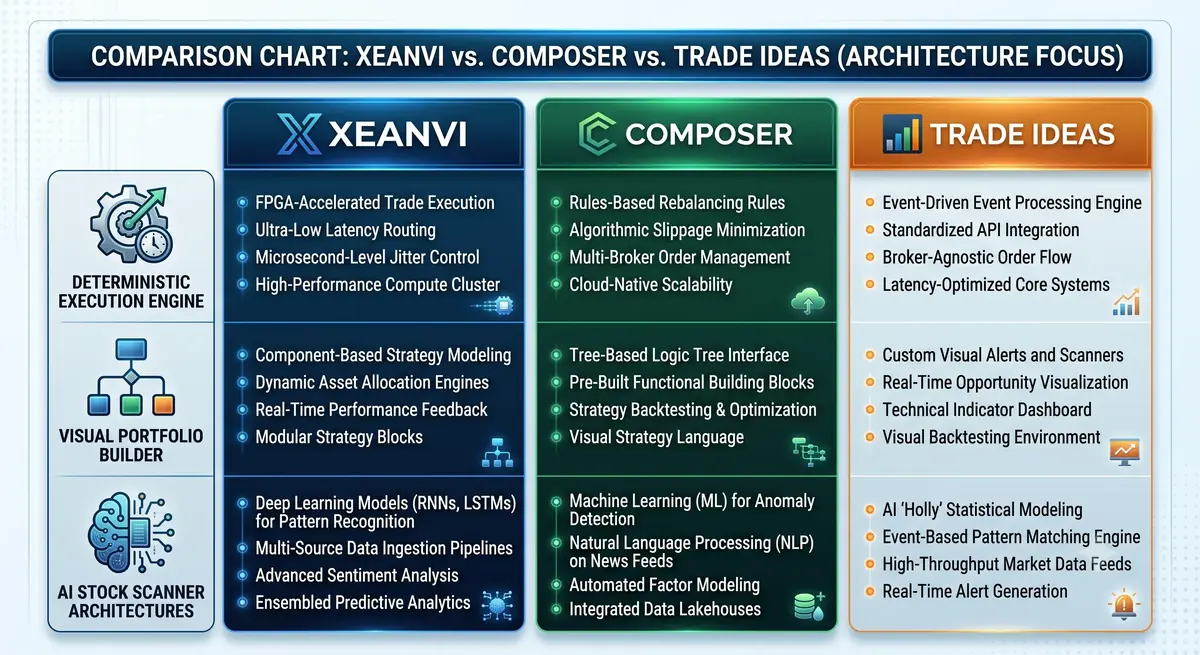
| Attribute | Trade Ideas Scanner | Composer Platform | XeanVI Execution Engine |
|---|---|---|---|
| Primary Function | AI stock scanner that surfaces trade setups | Visual portfolio builder for rules-based allocation | Deterministic execution engine for user-defined rules |
| Execution Transparency | Opaque — Holly AI logic is proprietary | Partial — symphonies are inspectable, but many copy unverified logic | Full — every rule is user-defined, transparent, and reproducible |
| Target Audience | Active retail traders who want idea generation | Passive-leaning investors automating allocation | Day and swing traders automating their own tested rules |
What matters most in an automated trading software comparison?
The most critical factor in an automated trading software comparison is understanding the difference between signal generation and order execution. Alerting software like Trade Ideas requires human intervention to manage risk, whereas an execution engine like XeanVI automatically enforces hard stop-losses and position sizing formulas.
Retail operators frequently confuse these two functions. Alerting platforms notify an operator that a liquidity event is happening; execution platforms physically route the order to the exchange while actively managing the downside risk. XeanVI forces operators to quantify their risk tolerance mathematically before the market ever opens. Consequently, when a volatile micro-cap collapses, the platform triggers an automated exit rather than waiting for a human to overcome their emotional paralysis.
What is the difference between XeanVI and Trade Ideas?
Trade Ideas operates as an AI-powered stock scanner that surfaces setups through its proprietary Holly engine, whereas XeanVI functions as a deterministic execution engine that automates a trader's own technical rules. Essentially, Trade Ideas suggests what to trade, while XeanVI executes how to trade.
Decision-layer mechanics separate these two platforms entirely. Trade Ideas software runs dozens of AI-generated strategies overnight, scores them against historical data, and streams the survivors as next-day signals. Subscribers receive the output but never the underlying weighting logic. When the Holly AI alters its behavior mid-session, operators cannot inspect the variables driving the change.
XeanVI completely inverts that relationship. Rather than generating opaque signals, XeanVI accepts your exact entry, exit, and risk conditions — moving-average crosses, VWAP reclaims, or time-of-day filters — and executes them identically every time those parameters are met. Because backtesting on XeanVI evaluates your actual rule set rather than a proxy strategy, historical results and live behavior share the exact same logic path. For a deeper look at signal-generation versus execution engines, our deep dive analysis of XeanVI and Trade Ideas covers scanner mechanics, latency, and autotrading paths in rigorous detail.
How does XeanVI compare to Composer for portfolio management?
Composer builds logic through a visual editor oriented toward macro asset rebalancing, while XeanVI targets precise day trading execution by routing user-defined rules through direct brokerage APIs. Composer manages asset allocation over weeks; XeanVI fires entries and exits in real time against exact technical conditions.
Within its ecosystem, Composer treats the "symphony" — a decision tree that shifts capital between assets on a schedule — as its core unit of work. That specific design perfectly suits investors seeking systematic exposure without watching the intraday tape. Execution cadence is measured in macro rebalances, and orders flow exclusively through their internal integrated brokerage.
Conversely, XeanVI treats the individual rule-triggered order as its primary unit of work. By monitoring live market data server-side, XeanVI evaluates each user-defined condition tick by tick, submitting orders directly through external API integrations the exact millisecond a rule fires. Intraday precision remains the core design target. Our detailed breakdown of XeanVI vs Composer thoroughly maps both architectures against holding periods, order granularity, and brokerage control.
Do Composer and Trade Ideas use black-box AI algorithms?
Trade Ideas relies on proprietary black-box models whose internal weighting is invisible to the user. Composer permits custom logic but heavily utilizes community-driven templates. XeanVI rejects black-box AI entirely, ensuring every execution rule is user-defined, fully transparent, and produces identical outputs for identical inputs.
In software engineering, a black-box system produces outputs whose generating logic the user cannot natively inspect. Trade Ideas qualifies as a black box because its strategy selection is proprietary by design. Composer sits closer to the middle. While their visual logic is technically inspectable, the platform's social layer encourages users to copy strategies whose baseline assumptions they never manually audit.
XeanVI enforces strict determinism. Identical inputs against an identical rule set produce identical orders, backed by a comprehensive audit trail. Operators who codify gap and volume criteria — utilizing frameworks like screening penny stocks based on gap risk — can encode those exact filters as parameters in their execution playbook. The complete operational catalog is fully documented on the XeanVI features page.
Which platform offers the best API execution for retail traders?
API execution quality relies entirely on server-side processing and direct order routing. XeanVI routes orders server-side to brokerage APIs like Alpaca without manual approval steps. Composer executes through its own brokerage during strategy rebalances, while Trade Ideas routes signals outward through its Brokerage Plus module.
Three mechanical realities dictate execution speed. First, browser-side logic dies when a laptop sleeps, whereas server-side evaluation runs continuously. Second, forcing a signal through a desktop client before reaching a broker adds latency and an unnecessary failure point. Third, any platform requiring a human click before sending the order is merely alerting, not truly automating.
XeanVI runs all three mechanics natively server-side. Order construction and direct API submission happen strictly on our infrastructure, meaning execution continues flawlessly regardless of local hardware status. The XeanVI Alpaca trading bot integration demonstrates this exact operational path — commission-free API brokerage on one side, deterministic evaluation on the other, and zero manual approvals required.
Algorithmic Platform Economics: Pricing and Value
Trade Ideas charges premium fees bundling AI signals with market data. Composer utilizes tiered subscriptions gating live access. XeanVI dynamically prices based on scalable infrastructure usage, meaning your cost directly tracks the execution capacity your strategy consumes rather than an inflated feature bundle. Current infrastructure tiers are available directly on the XeanVI pricing page.
Evaluating true cost requires pricing the entire stack: subscriptions, data fees, commissions, and the inevitable drawdowns resulting from unauditable signals. Regulatory context regarding risk is actively maintained by FINRA. Under the 2026 FINRA Rule 4210 amendments, day trading now operates on a real-time intraday margin framework rather than the legacy $25,000 minimum, radically changing the capital math for smaller accounts on all platforms.
Key Takeaways
- An honest automated trading software comparison reveals three distinct architectures: XeanVI executes deterministic rules, Trade Ideas generates AI signals, and Composer automates macro portfolio allocation.
- XeanVI remains the only platform of the three with zero black-box logic in the decision path, guaranteeing identical inputs strictly produce identical orders.
- Server-side rule evaluation paired with direct brokerage API submission defines genuine automation. Alerting platforms requiring manual confirmation are not execution platforms.
- Pricing models strictly follow architecture: data-bundle fees for AI signals, access tiers for portfolio rebalancing, and infrastructure-based scaling for deterministic execution.
- Always implement strict risk management controls and paper trade your strategies before deploying live capital into systematic environments.