Which Penny Stocks Should You Actually Trade? Gaps, Volume, and Risk Explained
The best penny stocks to trade are not on any static list. They change daily based on pre-market gaps, low float, and relative volume. This guide explains how day trading penny stocks actually works, why most micro-caps are worthless long-term holds, and how traders systemize risk to survive.
By XeanVI Team · Published 2026-07-16 · Updated 2026-10-05
Anyone searching for the best penny stocks to trade is usually asking the wrong question, and the market punishes wrong questions quickly. There is no permanent list of good micro-cap tickers, because the stocks worth trading on Tuesday are frequently the stocks collapsing by Thursday. Day trading penny stocks is a game of pre-market gaps, low float, and relative volume, and the winners rotate every single session. This guide explains how experienced traders actually find candidates each morning, why most micro-cap companies are fundamentally worthless as long-term holds, and how a systemized, rule-based process is the only realistic way to survive penny stock risks. XeanVI approaches this problem with deterministic, pre-defined execution rules rather than predictions, and that distinction matters more in micro-caps than anywhere else in the market.
Before going further, one fact needs to be stated plainly. The majority of companies trading under $5 are unprofitable, heavily diluted, or both. FINRA has warned investors for years that low-priced stocks carry elevated fraud and manipulation risk, including pump-and-dump schemes built specifically to offload shares onto retail buyers. Treating these tickers as investments is how accounts get destroyed. Treating them as short-duration volatility instruments, with hard rules and strict risk limits, is the only framing that holds up to scrutiny.
Which penny stock is booming?
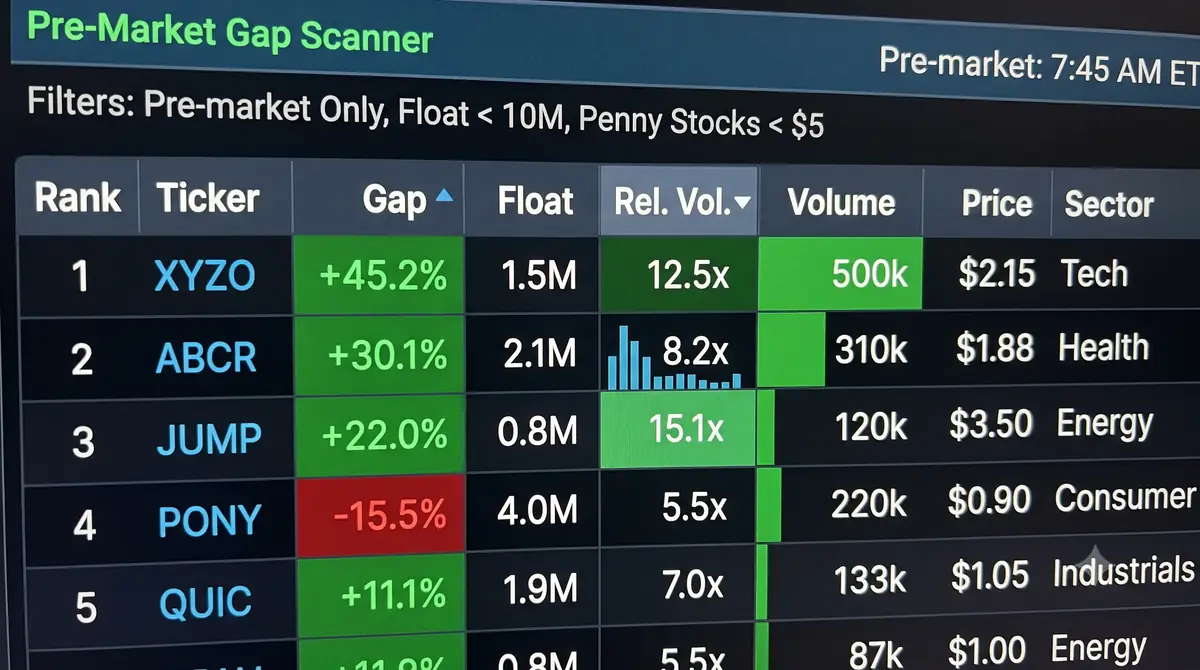
The booming penny stock changes roughly every 24 hours. A ticker gapping up 80% today on a press release will, in most cases, fade or crash within one to three sessions. Traders identify the current mover with real-time relative volume scanners each pre-market, because any static list published yesterday is already expired.
Three forces drive this daily rotation. A micro-cap stock booms when three conditions collide: a catalyst (an FDA headline, a contract announcement, a reverse-split repositioning), a low float (typically under 20 million tradable shares), and relative volume several multiples above its average. When a stock that normally trades 200,000 shares a day suddenly prints 15 million shares before the opening bell, that imbalance between supply and demand creates violent price movement in both directions.
The problem is that none of these conditions persist. The catalyst gets priced in within hours, dilutive share offerings frequently follow the spike because struggling companies sell into strength, and volume evaporates once momentum traders move on. This is why chasing yesterday's booming ticker is one of the most reliable ways to lose money in this niche. The stock that trended on social media last night has usually already completed the profitable portion of its move. Scanners exist precisely because the answer to "which penny stock is booming" must be recalculated live, every morning, from gap percentage and volume data rather than from headlines. We covered how promotional hype cycles distort this process in our breakdown of penny stock scanners versus death-spiral hype, and the core lesson is the same: the data feed decides, not the narrative.
What are the top 5 penny stocks to buy?
Published "top 5 penny stocks" lists are frequently paid promotions, recycled content, or stale data. The functional top 5 on any given day are simply the five low-float tickers gapping up hardest in pre-market with the highest relative volume and a verifiable news catalyst. That ranking resets daily and cannot be published in advance.
Follow the money behind these lists. Stock promoters can legally be paid to generate buying interest in specific micro-cap tickers, and disclosure of that compensation is often buried in fine print. When a website or newsletter names five specific penny stocks as "buys," a reasonable trader should assume one of three things: the list is sponsored, the list is scraped from old momentum data, or the author is front-running their own recommendations. None of those scenarios benefit the reader.
Experienced traders replace the static list with a repeatable morning filter. A typical scan configuration looks for stocks priced between $0.50 and $10, gapping up at least 10% from the prior close, with float under 20 million shares, pre-market volume above 500,000 shares, and a same-day catalyst. Run that filter at 8:00 a.m. Eastern and it produces the real top 5 for that specific session. Run it again tomorrow and the names will be almost entirely different. The skill is not in finding a magic ticker; it is in executing the same qualification process every day without deviation. XeanVI is built around exactly this principle of repeatable, rule-based qualification, because a process that changes with the trader's mood is not a process at all.
What cheap stock to buy today?
A low share price does not make a stock cheap, and today's correct answer depends entirely on liquidity. A $0.50 ticker with a 900-million-share float and thin volume is functionally expensive because you cannot exit it. Traders buy volatility and liquidity, measured by relative volume and float rotation, not a small number on the quote screen. Reading liquidity before price is a big part of what successful penny traders do differently.
Run the numbers on two example tickers, because the math contradicts retail intuition. Consider two stocks. Stock A trades at $0.40 with 800 million shares outstanding, average daily volume of 300,000 shares, and a bid-ask spread of $0.02. Stock B trades at $4.00 with an 8-million-share float, 20 million shares of volume today, and a one-cent spread. Stock A looks "cheaper," but a trader holding 25,000 shares of it may need days to exit without moving the price against themselves, and that $0.02 spread represents a 5% cost on every round trip. Stock B, despite the higher price, offers instant fills, a spread cost of 0.25%, and enough float rotation that a 10% intraday move is realistic. Stock B is the cheap one in every sense that matters to day trading penny stocks.
Float rotation is the metric that ties this together. When daily volume exceeds the entire tradable float — meaning every available share has theoretically changed hands at least once — price discovery becomes extremely fast and extremely volatile. That is the environment where intraday setups form. Share price alone tells a trader almost nothing. The same discipline applies at any account size: businesses parking idle capital face a version of this liquidity question too, which is why we wrote separately about automating corporate treasury decisions with rules instead of gut feel. Whether the account holds $2,000 or $2 million, liquidity constraints decide what is actually buyable.
Manual Execution vs. Deterministic Execution in Penny Stocks
| Execution Factor | Manual Retail Penny Stock Trading | Deterministic Execution (XeanVI) |
|---|---|---|
| Speed of stop-loss execution | Human reaction time plus manual order entry, often 3–10 seconds; a micro-cap can drop 15–20% in that window during a flush | Automated server-side triggers fire at the pre-defined stop price without hesitation or re-typing |
| Emotional risk | High; fear delays exits, hope converts day trades into overnight bag-holds, and revenge trading follows losses | Removed from execution; rules defined before the open cannot be renegotiated mid-panic |
| Ability to trade the symbol gap at the open | Limited; a human can watch two or three gapping tickers and often misses the first 60 seconds of price discovery | Rules configured before the open monitor every qualifying gapper simultaneously and execute the moment entry conditions print |
Which penny stocks have potential?
Intraday potential comes from technical setups, fresh catalysts, and short-squeeze metrics such as high short interest against a low float. Genuine long-term potential is rare, because most micro-cap companies fund operations through repeated share dilution that structurally erodes the price. Traders evaluate the next few hours, not the next few years.
Here is the uncomfortable arithmetic. The overwhelming majority of penny stock companies exist in a state of permanent capital hunger. They burn cash, they cannot access conventional credit, and their primary financing tool is selling new shares — often through instruments like convertible notes and at-the-market offerings that guarantee downward pressure. A company that dilutes its share count by 40% a year needs extraordinary business growth just to keep its stock flat. Very few achieve it. Anyone holding these names for months is fighting arithmetic, not just sentiment.
What does exist, reliably, is intraday potential. Three ingredients define it. First, a technical setup: a clean pre-market high to break, a consolidation pattern above volume-weighted average price, or a gap-and-go structure in the first fifteen minutes. Second, a catalyst with same-day relevance, because momentum without news dies at the first red candle. Third, squeeze mechanics: when short interest is high relative to a small float, forced covering can extend a move well past rational levels. Traders who quantify these three factors, and refuse trades where any factor is missing, are working with a genuine statistical edge measured in hours. XeanVI encodes that qualification logic into deterministic entry conditions, so the evaluation happens the same way on the hundredth trade as it did on the first. If you are comparing this style of transparent rule execution against opaque prediction bots, our analysis of what algo-bot marketing won't tell you lays out the distinction in detail.
Not financial advice: nothing in this section identifies any specific security as suitable for purchase, and short-term technical setups fail frequently. All trading involves substantial risk of loss.
What should you avoid when trading penny stocks?
The four most damaging behaviors are holding micro-caps overnight, averaging down into losing positions, trusting company press releases at face value, and trading manually without a hard, pre-set stop-loss. Each one converts a small, controlled loss into an account-level event. Avoiding these four errors matters more than finding better tickers.
Holding overnight. Penny stocks routinely announce dilutive offerings after the close, and a ticker that ended the day at $3.00 can open at $1.80 with no opportunity to exit in between. Gap risk in micro-caps is not a tail event; it is a recurring structural feature. Day trades should end as day trades. If you do plan to hold positions for days at a time, learn the rules for protecting capital through overnight holds before you size the first one.
Averaging down. Adding to a losing micro-cap position assumes the stock is temporarily mispriced. In this asset class, the far more common reality is that the move is permanent because dilution or fading momentum caused it. Averaging down concentrates capital into the portfolio's worst idea at the exact moment evidence says to leave.
Trusting press releases. Companies in this tier issue promotional headlines specifically to generate volume, and some of that volume exists so insiders and financiers can sell into it. A press release is a catalyst to trade around, with defined risk, and never a reason to believe in the underlying business.
Manual execution without a hard stop. Because penny stocks can drop 20% in seconds, manual order entry often results in massive slippage between the decision to exit and the actual fill. XeanVI allows day traders to set deterministic, server-side stop-losses and profit targets before the position is even opened, removing the hesitation that traps inexperienced traders in crashing micro-caps. These rules execute directly through supported brokerages via XeanVI's broker integration, so the exit fires at the defined price whether or not the trader is watching the screen.
One regulatory note also belongs on this list. FINRA Rule 4210 was amended to introduce a real-time intraday margin framework, replacing the long-standing $25,000 pattern day trader minimum with dynamic, exposure-based requirements. Traders active in volatile micro-caps should confirm with their brokerage how intraday margin is now calculated, because position sizing rules written for the old regime may no longer reflect actual buying power. Position sizing governed by pre-defined rules adapts to this environment far better than mental math at the open.
Key Takeaways
- The best penny stocks to trade change every session; traders find them each morning with gap and relative volume scanners, never from static or promoted lists.
- A low share price is not the same as a cheap stock — liquidity, float size, and spread cost determine whether a ticker is actually tradable.
- Intraday potential comes from setups, catalysts, and squeeze metrics; long-term potential is undermined by chronic dilution across most micro-cap companies.
- The four account-killers are overnight holds, averaging down, trusting press releases, and trading without a pre-set, automatically executed stop-loss.
- XeanVI replaces emotional, manual execution with deterministic server-side rules for entries, stops, and targets, which is the structural answer to penny stock risks that willpower alone cannot solve.
Systemizing this niche is not optional; it is the entry fee. The best penny stocks to trade tomorrow do not exist on any list today — they will appear on tomorrow's pre-market scanner, and only traders with rules already written will be positioned to act. Traders who define those rules before the open, size positions for worst-case gaps, and let automated execution enforce discipline give themselves a durable framework for day trading penny stocks. Those who improvise get selected against, usually within months. If you want to see exactly what deterministic execution costs and includes, XeanVI's pricing page lists every plan transparently, and the XeanVI platform overview documents how the rule engine works from scanner signal to server-side exit.
Not financial advice: this article is educational content about market mechanics and does not recommend buying or selling any security. Trading involves risk, penny stocks carry a substantial risk of total loss, and past volatility patterns do not predict future results. Consult a registered professional regarding your individual circumstances.