The Reality of Penny Stock Trading: AI Scanners vs. Death-Spiral Hype
No software predicts which penny stock will skyrocket. Price spikes come from Press releases and sudden liquidity, while death-spiral dilution traps hype buyers. Learn why volume scanners plus deterministic execution — hard stops and strict position size — outlast predictive Penny Stock Bots.
By Troy Swartwood, Founder & Software Engineer · Published 2026-07-14
Penny stock trading attracts retail buyers with the promise of overnight 10x returns, yet the mechanics behind micro-cap price action tell a different story. XeanVI examines the two forces that actually move these stocks — press releases and sudden liquidity — and explains why predictive legacy bots fail precisely when protection matters most: during toxic dilution spirals. The difference between surviving this market segment and funding someone else's exit comes down to position size discipline and deterministic execution, not prediction. This article breaks down each of the most-searched penny stock questions with factual answers, then shows how real-time AI scanners paired with hard rules replace guesswork with measurable order-flow data.
Which penny stock is going to skyrocket in 2026?
No software can accurately predict which penny stock will skyrocket in 2026. Micro-cap price spikes are driven by sudden liquidity events and press releases, not underlying fundamentals. Any AI trading agent claiming predictive certainty in this segment is selling probability dressed up as knowledge, because promotional catalysts are unknowable in advance.
Here is the mechanical reality. A penny stock moves 300% in a session because a press release — often paid promotion — hits newswires and floods a thin order book with retail demand. The float is small, so modest buying pressure produces outsized percentage moves. Nothing about the company's revenue, product, or balance sheet changed; only the liquidity changed. Since press-driven catalysts are decided by promoters and issuers, not by historical price patterns, no predictive model has access to the input that actually drives the move. A predictive legacy bot marketed as a crystal ball is merely pattern-matching yesterday's charts against tomorrow's unknowable promotional calendar. XeanVI takes the opposite stance: measure the liquidity event as it happens, and execute against the pre-committed rules XeanVI documents in its execution playbook.
What penny stock has 10x potential?
A 10x penny stock return is a mathematical anomaly, not a repeatable outcome. Most micro-cap companies fund operations through toxic convertible financing that aggressively dilutes shares. Each conversion adds new supply, pressures the price downward, and traps retail buyers who purchased on hype rather than float data.
The toxic convertible financing mechanism works like this: a cash-starved micro-cap issues convertible notes that convert to common shares at a discount to market price. When the lender converts and sells, the share price drops, which entitles the lender to even more shares on the next conversion. The toxic dilution spiral compounds — dilution drives price down, lower price drives more dilution. Retail buyers chasing a 10x headline are frequently buying the exact supply the note holder is unloading. FINRA has published repeated investor alerts on low-priced stock schemes and the promotional campaigns that accompany them; its guidance on stock risk is required reading before touching this market segment. XeanVI does not attempt to guess which company avoids dilution. Instead, XeanVI executes the absolute mathematical defense: capped position sizes and hard stop-losses that trigger regardless of how convincing the press release sounded.
Not financial advice: Penny stocks carry substantial risk of total loss. Dilution, halts, and delistings can eliminate positions entirely. Do your own due diligence before trading any low-priced security.
What penny stocks are going to skyrocket?
No responsible platform publishes tickers that are going to skyrocket. Algorithmic operators use real-time AI scanners to detect momentum as it happens, rather than relying on legacy bots to guess future price action. The difference is reactive detection versus prediction — one measures live liquidity, the other extrapolates from stale patterns.
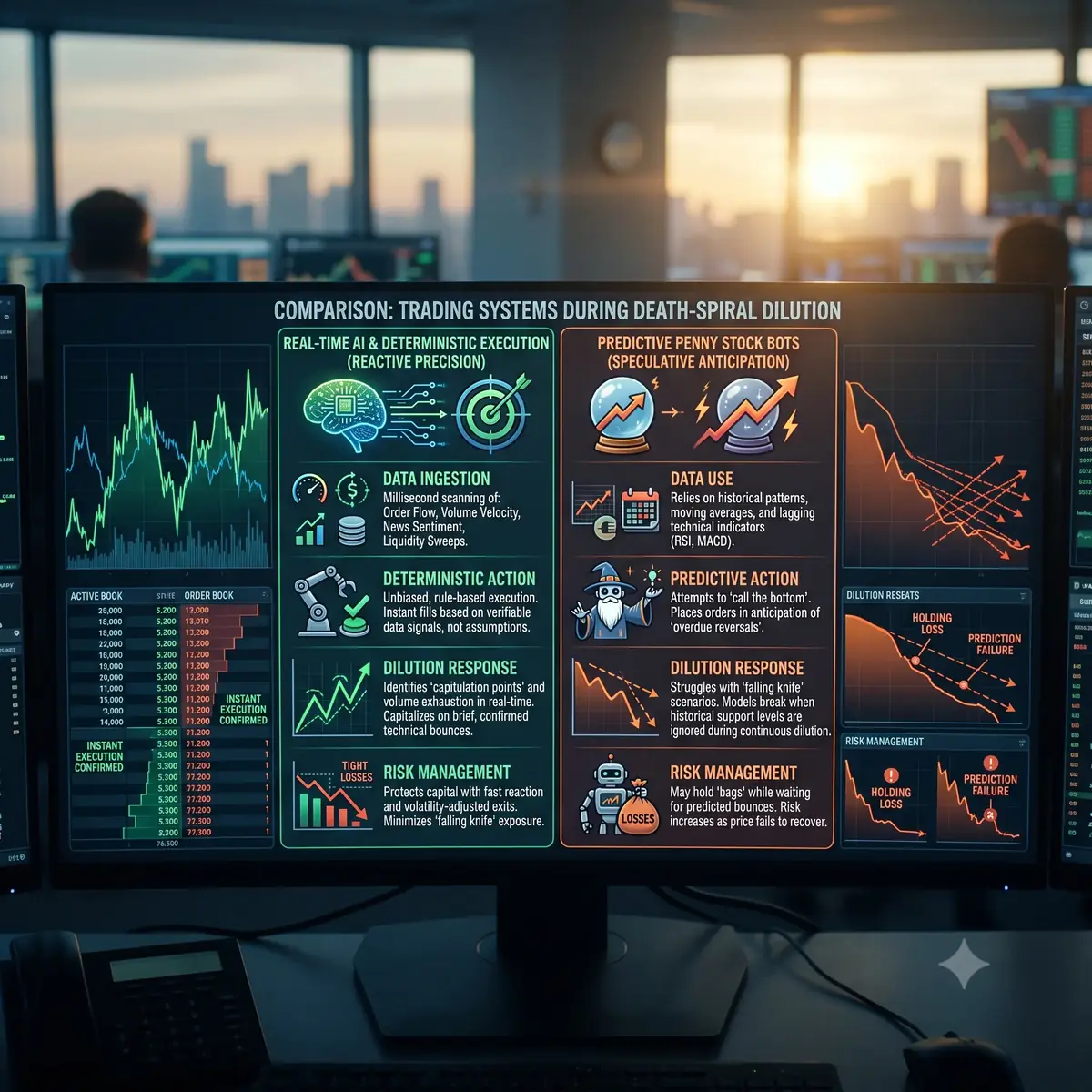
AI scanners solve a detection problem, not a prediction problem. A volume scanner monitors relative volume, float turnover, and price velocity across thousands of tickers simultaneously, flagging the handful showing live liquidity anomalies. That is verifiable, present-tense data. Legacy bots invert this logic — they train on historical patterns and project forward, which collapses in micro-caps because the promotional catalysts driving these price spikes never appear in the training data. The distinction matters enough that XeanVI documented it in detail in how trading bots work: the real mechanics behind automated execution. Detection tells you where liquidity is right now; prediction tells you a story about where it might be tomorrow. Only one of those is actionable with defined risk.
| Criteria | Predictive Legacy Bots | Deterministic Execution (XeanVI) |
|---|---|---|
| Position Size Management | Sizing often scales with model confidence, committing the most capital when predictions are aggressive. | Position size is strictly capped by a pre-set rule per trade, independent of any signal strength. |
| Reaction to Toxic Dilution | The model holds or averages down based on historical rebounds, absorbing toxic supply. | A hard stop-loss executes at the defined price level, exiting before dilution compounds the loss. |
| Execution Logic | Probabilistic outputs vary run to run, and the decision path remains opaque to the user. | Rule-based logic produces identical actions for identical inputs, completely inspectable before deployment. |
Unlike probabilistic AI or predictive Legacy bots that attempt to guess the next micro-cap breakout, XeanVI acts as a deterministic execution engine. It allows traders to connect to their volume scanners and enforce strict rules—such as hard stop-losses and precise position size limits—protecting capital when a penny stock collapses. XeanVI documents and exposes every rule in the system for inspection, a standard it details on its transparency page.
What are the top 5 penny stocks to buy right now?
Generic top 5 penny stock lists set retail buyers up to fail because they publish after momentum has already peaked. The stocks worth trading on any given day are simply those with a low float and a relative volume spike above 500% during the current session — conditions AI scanners identify in real time.
Consider the incentive structure behind every "top 5" list. By the time an article or newsletter names a ticker, the liquidity event that made it interesting is hours or days old, and early buyers need exit liquidity. Lists are distribution mechanisms. The operational alternative replaces the list with two measurable filters: float below roughly 20 million shares, and relative volume exceeding 500% of the 30-day average during the current session. Those two data points identify where genuine liquidity exists today — and where deterministic exits can actually fill. Sizing within that window follows the same math XeanVI covered in what is the 3-5-7 rule in trading: risk a fixed, small percentage per position so that no single toxic dilution candidate can damage the account. The infrastructure worth using is the one that enforces those limits mechanically, not the one that guesses tickers.
Key Takeaways
- No software can predict which penny stock will skyrocket, because press releases and sudden liquidity — not fundamentals — drive micro-cap price spikes.
- Toxic convertible financing is the structural reason 10x penny stock returns are anomalies: toxic dilution adds share supply on every price decline, trapping retail buyers.
- The core difference between tools is detection versus prediction — real-time AI scanners measure live order flow, while legacy bots extrapolate from stale historical patterns.
- Precise position size caps and hard stop-losses are the only mechanical defenses against dilution events, and deterministic execution enforces them identically on every trade.
- XeanVI functions as a rule-based execution engine connected to scanners, not a predictive black box — every rule is inspectable, and XeanVI publishes further operational breakdowns on its blog.