How Trading Bots Work: The Real Mechanics Behind Automated Execution
Trading bots don't generate profits automatically — they execute your rules with machine precision. This guide breaks down the three-stage architecture behind every automated trade: data ingestion, logic evaluation, and order routing. Understand the real mechanics before you deploy capital.
By Troy Swartwood, Founder & Software Engineer · Published 2026-06-14 · Updated 2026-08-23
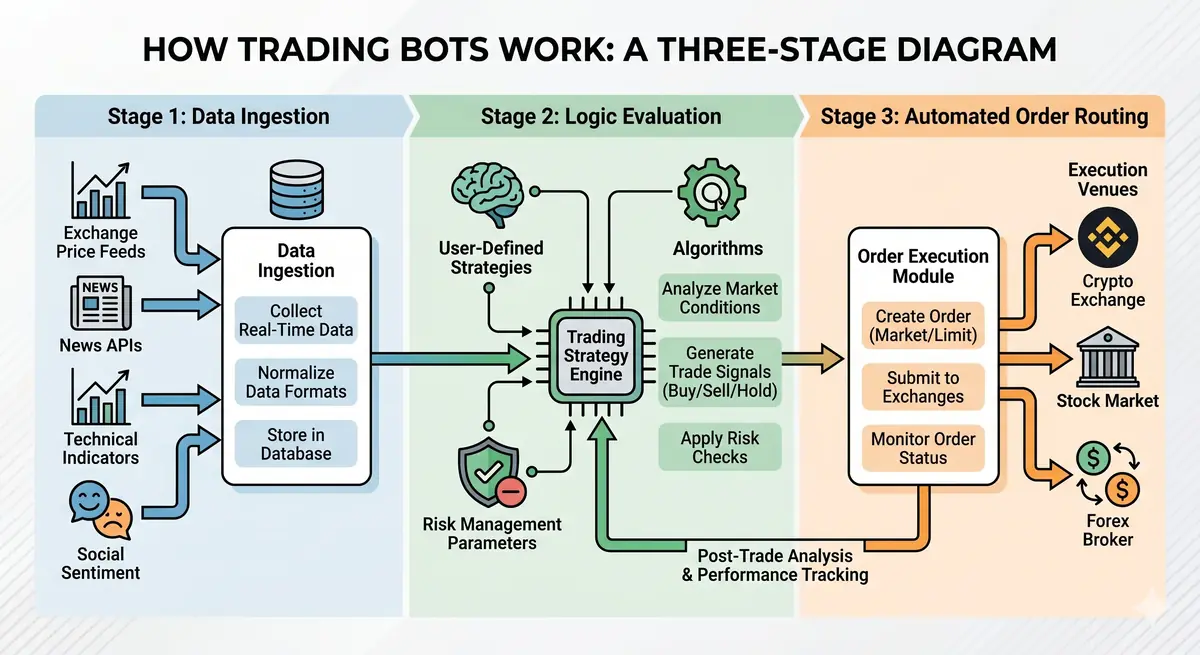
Trading bots process market data, evaluate rule-based conditions, and route orders to an exchange — all without a human touching the keyboard. Understanding how that machine logic actually operates separates traders who use automation strategically from those who buy a pre-packaged bot and wonder why it bleeds money. This post strips away the marketing language and walks through the three-stage mechanical architecture that every legitimate automated trading system shares: data ingestion, logic evaluation, and order routing.
Not financial advice: Automated trading involves significant financial risk. Past performance of any strategy does not guarantee future results. Always paper trade and validate before committing real capital.
Stage 1 — Data Ingestion: What the Bot Reads Before It Acts
Trading bots cannot act on intuition. Every decision a bot makes begins with a structured data feed — a continuous stream of market information delivered in real time. Before a single order fires, the bot's data layer must receive, parse, and organize incoming price data into a format its logic engine can evaluate.
In practice, that data stream typically includes:
- Bid/ask quotes — the current buy and sell prices at the top of the order book
- Last-trade price and volume — the most recently executed transaction and its size
- OHLCV bars (Open, High, Low, Close, Volume) — summarized price action over a defined period, such as a one-minute or five-minute candle
- Level 2 order book depth — how many shares or contracts are sitting at each price tier, giving the bot visibility into supply and demand pressure
The bot ingests this data through an API connection — an Application Programming Interface, which is simply a standardized pipeline that lets software talk directly to a broker or exchange without a human intermediary. Latency at this stage matters enormously. A feed that delivers price data 200 milliseconds slower than a competitor's system represents a genuine execution disadvantage before the strategy logic even runs.
One underappreciated risk here: API disconnection. If the data feed drops mid-session and the bot has open positions, it may continue executing stale logic on outdated prices — or freeze entirely. Transparent, rule-based platforms like Xeanvi surface these connection states explicitly so traders see exactly when the feed is live and when it is not.
Stage 2 — Logic Evaluation: How the Bot Decides to Act
Once live data enters the system, trading bots run it through their logic layer — the set of conditional rules that determine whether market conditions match the entry or exit criteria defined by the trader. This is where the strategy lives, and it is the most misunderstood part of automated trading.
What a Rule-Based Condition Actually Looks Like
Every automated trade begins as an if-then statement. A simple long entry rule might read: if the five-minute closing price crosses above the 20-period exponential moving average AND volume on that bar exceeds 150% of the 10-bar average, then generate a buy signal. The bot evaluates this condition on every new data event — every tick or every bar close, depending on configuration — and either confirms or rejects the signal.
More sophisticated strategies layer multiple conditions:
- Primary signal — the trigger that initiates the evaluation (e.g., a moving average crossover, a breakout above a prior high, an RSI reading entering oversold territory)
- Filter conditions — secondary rules that validate the signal (e.g., overall market trend direction, time-of-day restrictions, volatility regime checks)
- Invalidation rules — conditions that cancel a pending signal before the order fires (e.g., price retracing back below the breakout level before execution fills)
Algorithms evaluate these conditions sequentially in microseconds. No hesitation. No second-guessing. No emotional override. That mechanical consistency is where automated trades derive their real advantage — not from the sophistication of the logic itself, but from the guarantee that the logic executes identically every single time.
The Misconception: Bots Execute Rules, Not Judgment
The most damaging myth in retail trading is that buying a pre-built bot replaces the need for a sound strategy. Trading bots are execution engines, not strategy generators. The bot's job is to run your rules precisely. If the underlying strategy is unsound — if it has never been backtested across different market conditions, or if it was overfit to a specific historical period — the bot will execute that flawed strategy with perfect mechanical discipline straight into a drawdown.
A real technical edge comes from backtesting a sound, trader-defined strategy across statistically significant data, validating it in a paper trading environment, and then automating its execution to remove the human error layer. The algorithm amplifies whatever is already in the rules. It does not fix bad rules.
For a deeper look at the difference between using AI as a judgment replacement versus a rule-execution assistant, see the Xeanvi breakdown: Why AI Should Assist Trading Rules, Not Replace Judgment.
Stage 3 — Order Routing: How the Bot Executes the Trade
A confirmed signal is just a decision. Converting that decision into an executed trade requires the bot to construct a structured order object and transmit it to the broker or exchange through the API. This stage — order routing — is where execution speed, order type logic, and risk parameters all converge.
The Anatomy of a Bot-Generated Order
When trading bots send an order, they do not simply say "buy." They transmit a structured data packet that specifies:
- Instrument — the exact ticker, contract, or asset
- Direction — long (buy) or short (sell)
- Order type — market, limit, stop, or a bracket order combining entry, stop-loss, and profit target in a single instruction
- Quantity — the share or contract count, often calculated dynamically based on a position sizing formula tied to account equity and defined risk percentage
- Time-in-force — how long the order remains active (e.g., good-till-cancelled, day-only, immediate-or-cancel)
Bracket orders are particularly important for automated strategies. A single bracket order instruction simultaneously places the entry order, a stop-loss order at a predefined risk level below entry, and a limit sell at the target price. The bot does not need to monitor the position after entry — the bracket structure handles all three outcomes mechanically.
Execution Speed and Slippage
Human traders click buttons. Trading bots transmit API calls. The latency difference between those two actions — often measured in milliseconds — determines whether an order fills at the intended price or experiences slippage (the difference between the expected fill price and the actual fill price). In high-frequency environments, slippage compounds quickly across dozens of trades per session. In swing or intraday rule-based strategies, controlling slippage through limit orders and smart order routing is a component of the overall edge calculation.
Speed is not always a substitute for discipline, however. A bot that fires orders in milliseconds based on a poorly constructed strategy executes losses faster than a human could. The mechanical advantage only functions when the underlying algorithmic trading mechanics rest on a validated strategy foundation — as covered in detail in the Xeanvi trading playbook guide.
The Risk Layer: What Can Go Wrong in Automated Execution
No honest overview of how trading bots work is complete without a direct accounting of failure modes. Automated systems introduce operational risks that manual trading does not carry.
- Model drift — A strategy that was profitable in a low-volatility trending market may fail when the volatility regime shifts. Bots do not self-adapt unless explicitly programmed with adaptive rules. They continue running the original logic even as the market environment that produced the backtest results disappears.
- Overfitting — A strategy backtested on too narrow a historical window, or tuned too precisely to past data, will show strong historical metrics and produce poor live results. Overfit strategy detection is a critical step before any strategy goes live.
- API disconnection mid-trade — An open position with a disconnected execution engine is an unmanaged position. The bot cannot update the stop-loss, cannot exit, and cannot respond to market movement.
- Order duplication errors — Execution bugs or connectivity interruptions can cause the same order to fire multiple times, compounding unintended position size beyond the risk parameters.
- Flash crashes and gap risk — Even a perfectly designed stop-loss order cannot guarantee a fill at the stop price during a fast market. Gaps at open or during circuit-breaker events will skip the stop level and fill at a worse price.
The FINRA investor education resources on trading basics and risk management outline baseline controls every retail trader should understand before deploying automated systems.
Paper trading — running the bot in a simulated environment with live market data but no real capital — is the minimum standard before going live. Any automated system that skips this step is skipping the single most important validation gate in the entire process.
How Xeanvi Implements Transparent, Rule-Based Automated Execution
Most commercial trading bots obscure their logic. They market proprietary algorithms, AI-driven signals, and dynamic optimization without explaining what the system is actually doing at the order level. That opacity is not a feature. It is a liability. When a black-box bot enters a drawdown, the trader has no mechanism to understand whether the strategy is broken, whether the market regime has shifted, or whether the system is experiencing an execution error.
Xeanvi operates on the opposite principle. It is not a signal provider. It does not contain a hidden AI making decisions on your behalf. Xeanvi is a rule-based execution engine where you wire up your own conditions — your entry criteria, your stop-loss placement, your position sizing logic, your exit rules — and the platform runs those rules with mechanical precision every session.
The mechanical advantage Xeanvi provides is transparency: you see exactly which condition triggered the entry, exactly which order type was routed, and exactly where the risk parameters are set at every point in the trade lifecycle. There are no black-box algorithms making decisions you cannot audit.
For traders considering the cost side of automation before committing, the Xeanvi comparison of AI trading apps for beginners breaks down what you are actually paying for across different categories of automated tools — and why transparent execution architecture is the differentiator that matters.
If you are ready to automate a strategy you have already validated, review Xeanvi's pricing and platform options to see how rule-based automation fits your trading operation.
Summary: The Three-Stage Blueprint Every Trader Should Know
Trading bots work by executing a repeatable, three-stage process on every market event:
| Stage | What the bot does | Key risk | How XeanVI handles it |
|---|---|---|---|
| 1. Data Ingestion | Receives live price, volume, and order-book data through an API feed and organizes it for evaluation | Stale, missing, or bad data feeds flawed inputs into the logic | No proprietary "smart" feed or hidden AI reinterpreting the data — the engine acts on live broker data against the conditions you define, with nothing obscured |
| 2. Logic Evaluation | Checks incoming data against the trader-defined rule set, then confirms or rejects a signal | Over-fit or flawed rules produce confident-but-wrong decisions | You wire your own entry, stop-loss, sizing, and exit rules, and can see exactly which condition triggered each signal — no black box deciding on your behalf |
| 3. Order Routing | Sends a structured order — entry type, size, stop-loss, target — to the broker via API | Slippage, partial fills, latency, or rejected orders at execution | You see exactly which order type was routed and where the risk parameters sit at every point in the trade lifecycle |
Automated trading does not manufacture an advantage out of thin air. It executes a pre-defined trader strategy faster and more consistently than a human can. The strategy itself — its logic, its risk parameters, its validation history — is the entire source of any real edge. The bot is the delivery mechanism.
Understand the machine. Define the rules. Validate before deploying capital.