The Hidden Risks of Opaque Algorithms
Consumer AI trading apps like RockFlow, Tickeron, and Kavout Stock promise beginners an algorithmic edge — but hide the rules driving every signal. This post maps the opacity, defines what transparent automated trading software actually requires, and explains why knowing your own rules is the only durable advantage.
By Troy Swartwood, Founder & Software Engineer · Published 2026-06-07 · Updated 2026-06-23
Most AI trading apps for beginners sell the same promise: easier market access, faster decisions, and less manual work. You download the app, connect a brokerage account, review the signal feed, and let the software guide your next move. That sounds convenient. It is also where beginner risk starts.
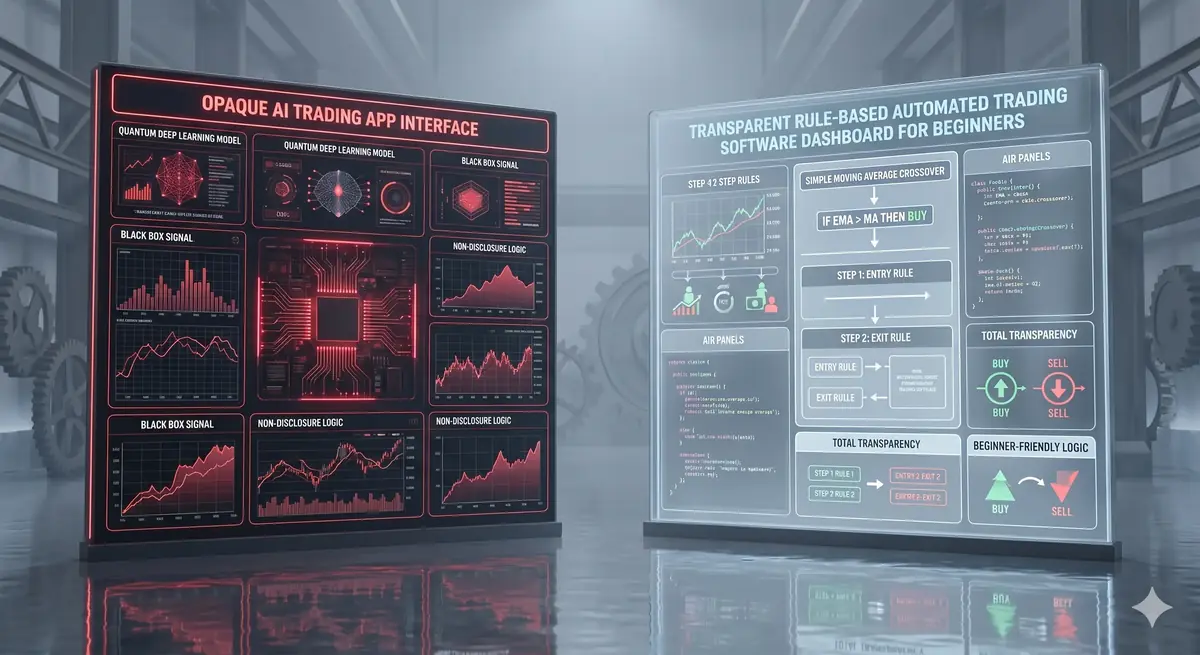
The real question is not whether an app uses artificial intelligence. The question is whether you can see the exact rules behind each trade idea, alert, position size, exit, and risk limit. If the platform gives you a score but hides the logic behind it, you are not trading with control. You are reacting to a black box.
Xeanvi takes the opposite approach. Instead of asking you to trust a hidden model, Xeanvi gives you visibility over the rules, triggers, limits, and execution conditions governing your capital.
Educational Disclaimer: Trading involves risk, and this is not financial advice. Algorithmic trading involves a substantial risk of financial loss. Evaluate all strategy development, risk management, and deployment decisions independently. Past performance of any software, platform, or system does not guarantee future results. Always consult a qualified financial professional and paper trade in a simulated environment before risking live capital.
What AI Trading Apps for Beginners Actually Mean in 2026
The phrase “AI trading app” covers a wide range of products. Some platforms use machine learning models trained on market data. Others rely on rule-based scanners, pattern recognition tools, sentiment feeds, or simplified signal dashboards. To a beginner, these categories can look almost identical because they are often packaged under the same “AI-powered” label.
That label creates confusion. A platform can advertise artificial intelligence while still hiding the most important information from the user:
- What market data does the system analyze?
- Which indicators or patterns matter most?
- How much weight does each input receive?
- What conditions trigger a buy, sell, hold, or warning signal?
- What invalidates the signal after it appears?
- How does the system behave during high volatility, thin liquidity, or data-feed errors?
Beginners do not need more mystery. They need clearer systems. A clean interface is useful, but it does not replace visible trading logic. If you cannot explain why an app produced a signal, you cannot judge whether that signal deserves your capital.
RockFlow, Tickeron, and Kavout Stock vs. Xeanvi: Where Opacity Enters
Platforms such as RockFlow, Tickeron, and Kavout Stock have helped bring automated market tools to retail users. They make trading ideas easier to find and easier to act on. That convenience has value. The problem is what often sits behind the interface: hidden decision logic.
For beginners, hidden logic is not a small limitation. It changes the entire risk profile. You may see a recommendation, confidence score, ranking, or alert, but you may not see the actual conditions that produced it. That creates an information gap between the platform and the trader.
RockFlow vs. Xeanvi: Social Signals and Easy Execution
RockFlow emphasizes access, community, and trade discovery. Users can browse trending ideas, follow signal activity, and move quickly from idea to execution. For a beginner, that lowers the intimidation barrier. Instead of building a strategy from scratch, the user can observe what other traders are watching and use the app’s tools to act faster.
The weakness is that social activity does not equal transparent strategy. If a trade idea trends inside the platform, the user still needs to know why. Is the signal based on volume? Momentum? News flow? Short-term price behavior? User activity? A combination of those inputs?
When the platform does not show the weighting logic, the beginner cannot separate a durable setup from crowd noise. Xeanvi avoids that problem by requiring the user to define the framework. The trade is not triggered because a feed looks active. It is triggered because a visible rule says the condition has been met.
Tickeron vs. Xeanvi: Pattern Recognition Without Full Parameter Control
Tickeron is known for AI-assisted pattern recognition and confidence-scored trade ideas. That can be useful for users learning chart structures, technical setups, and recurring market formations. A scanner that reviews many tickers faster than a human can save time.
The problem begins when the confidence score becomes a substitute for understanding. A score such as “87% confidence” may look precise, but precision is not the same as explainability. The user still needs to know what created that score, how the model weighs recent data, which historical samples shaped the result, and what market conditions reduce the score’s reliability.
Xeanvi gives the user a different operating model. Instead of depending on a hidden confidence output, the trader defines the entry conditions, exit rules, position-sizing method, and risk boundaries. That makes the system easier to audit after every trade. A loss is not just a failed prediction. It becomes data tied to a specific rule.
Kavout Stock vs. Xeanvi: AI Scoring and the Limits of Rankings
Kavout Stock offers the “K Score,” a machine-learning ranking designed to help users evaluate stocks through a quantitative lens. For traders who want data-driven stock selection without building their own models, that kind of score can feel useful.
But a ranking still leaves the user with hard questions. Which features drive the score? Do the weights change in different market regimes? Does the model respond differently during low-liquidity sessions? How often is the system updated? What happens when the relationships that worked in prior data stop working?
If those answers are hidden, the user is left with an output but no diagnostic process. Xeanvi removes that dependency by making the rule set visible. The trader can inspect the conditions, adjust them, test them, and decide whether the strategy still deserves to run.
The Core Problem: Easy Apps Can Create Strategic Blindness
Consumer trading software often defines ease as fewer decisions for the user. That can help onboarding, but it can also weaken judgment. When an app hides the logic, the beginner may feel more confident while actually understanding less.
That is the dangerous part. A beginner using a black-box system may not know:
- Why a specific trade was suggested or executed.
- What conditions would make the signal unreliable.
- Whether position size reflects the actual risk of the setup.
- How the system reacts when price gaps through an expected level.
- Whether a drawdown is normal for the strategy or a sign that the model is failing.
- When to pause the system instead of letting it continue trading.
Without those answers, the user is not managing a strategy. The user is monitoring an output. That is a weak position for anyone risking real capital.
To understand the cost side of automation, review our breakdown of true trading bot costs, infrastructure fees, and the real math behind automated trading.
What Transparent Rule-Based Execution Requires
A beginner does not need institutional infrastructure to trade responsibly. But every beginner does need a clear standard for evaluating automated trading tools. Before using any platform, check whether it gives you control over the following areas:
- Entry logic visibility: You should be able to read and edit every condition that can trigger a trade.
- Exit rule definition: Stop losses, profit targets, time-based exits, and manual overrides should be clear before the trade opens.
- Position sizing control: The system should show whether it uses fixed sizing, percentage-based sizing, volatility-based sizing, or another method.
- Rule-matched backtesting: Historical results should reflect your exact rules, not a generic model summary.
- Execution audit trail: Every filled order should trace back to the specific rule that triggered it.
- Risk boundary enforcement: Maximum daily loss, maximum position exposure, and session limits should be explicit and adjustable.
If a platform fails several of these checks, the interface may still be easy to use, but the system is not transparent enough for disciplined automation. Onboarding speed should never replace risk visibility.
Regulators have also focused on conflicts of interest and black-box risk in AI-driven financial tools. The SEC has addressed conflicts of interest connected to artificial intelligence in financial markets. You can also read our post on how regulatory frameworks apply to AI in day trading.
Infrastructure Risks Beginners Often Miss
Hidden trading logic is only one risk. Automated trading also depends on infrastructure. Even a well-designed strategy can fail if the connection, data feed, broker integration, or execution process breaks at the wrong time.
Beginners should understand these failure modes before using any automated system:
- API disconnection: If the connection between the trading platform and broker drops, open positions may be left unmanaged unless the system has clear contingency rules.
- Latency spikes: During fast markets, execution may occur later than expected. That can create slippage and distort the strategy’s expected performance.
- Data-feed errors: Stale or incorrect price data can trigger trades based on market conditions that are not real.
- Model drift: Machine learning models can lose effectiveness when market structure changes. A signal that worked in prior data may degrade without obvious warning.
- Platform outages: If the platform itself becomes unavailable, users need to know how orders, alerts, and open positions are handled.
These risks are manageable only when the user can see and define the system’s behavior. If the platform hides its logic, infrastructure failures become harder to diagnose and harder to control.
How Xeanvi Handles Automation Differently
The black-box model asks the user to trust a hidden algorithm. Xeanvi asks the user to define the rules first.
With Xeanvi, transparent, rule-based execution rails connect directly to your broker. You define entry triggers, exit rules, position sizing, trading-session constraints, and risk boundaries. Xeanvi then converts those defined rules into automated actions.
No proprietary signal engine makes unexplained trading decisions in the background. You can see the rule. You can audit the rule. You can trace the trade back to the condition that caused it.
That distinction matters. When RockFlow or Tickeron generates a signal, the user may still have to guess what logic produced it. When Xeanvi executes a trade, the action ties back to the framework the user built. If the market changes, the user can change the rules instead of waiting for a hidden model to adapt.
Xeanvi also includes Xean, an embedded market analyst that provides contextual commentary on market conditions and sector behavior. Xean helps with analysis, but it does not take control away from the user. The trader’s rules determine what happens next.
Why Knowing Your Rules Creates the Real Edge
Many consumer apps frame the edge as access to a sophisticated algorithm. That framing is incomplete. In practical trading, the stronger edge often belongs to the operator who can answer basic questions with precision:
- What exact conditions must exist before entering a trade?
- What condition triggers the exit?
- How is position size calculated?
- What is the maximum acceptable daily loss?
- When should the system stop trading?
- What evidence would show that the strategy needs revision?
A black-box app cannot give the user full answers because the rules are hidden. That leaves the trader dependent on the platform’s output. When the output stops working, there is no clean way to diagnose the failure.
A transparent system creates a feedback loop. Every entry, exit, win, loss, drawdown, and pause becomes information tied to a rule. That makes improvement possible. The user can test, revise, simplify, or stop the strategy based on evidence instead of guesswork.
Final Thoughts: AI Trading Apps for Beginners Should Be Judged by Transparency
AI trading apps for beginners are not automatically bad. Some provide useful scanners, alerts, rankings, and market context. The mistake is assuming that easier access means better control.
Before risking live capital, beginners should separate convenience from transparency. A useful trading platform should show how decisions are made, how risk is limited, and how each action connects to a rule the user understands.
- Opacity is a risk. Platforms can produce real signals while still hiding the parameters that drive those signals.
- Ease is not the same as control. A simple interface does not prove the user understands the system.
- Rules matter more than labels. “AI-powered” is less important than visible entry logic, exit logic, position sizing, and risk limits.
- Infrastructure risk is real. API failures, latency, data errors, model drift, and outages can damage an automated strategy.
- Your rules are your edge. The trader who understands every entry, exit, and risk boundary has a diagnostic advantage that black-box signal feeds cannot provide.
For beginners evaluating automated trading software, the standard should be direct: do not trust a system you cannot inspect. Use tools that make the logic visible, testable, and adjustable before any real capital is exposed.
Final Notice: Trading involves risk, this is not financial advice, and automated systems can experience technical failures. Always protect your capital through rigorous testing, paper trading, and defined risk controls before live deployment.