Best AI Trading Bot for Beginners: 2026 Shortlist and Red Flags
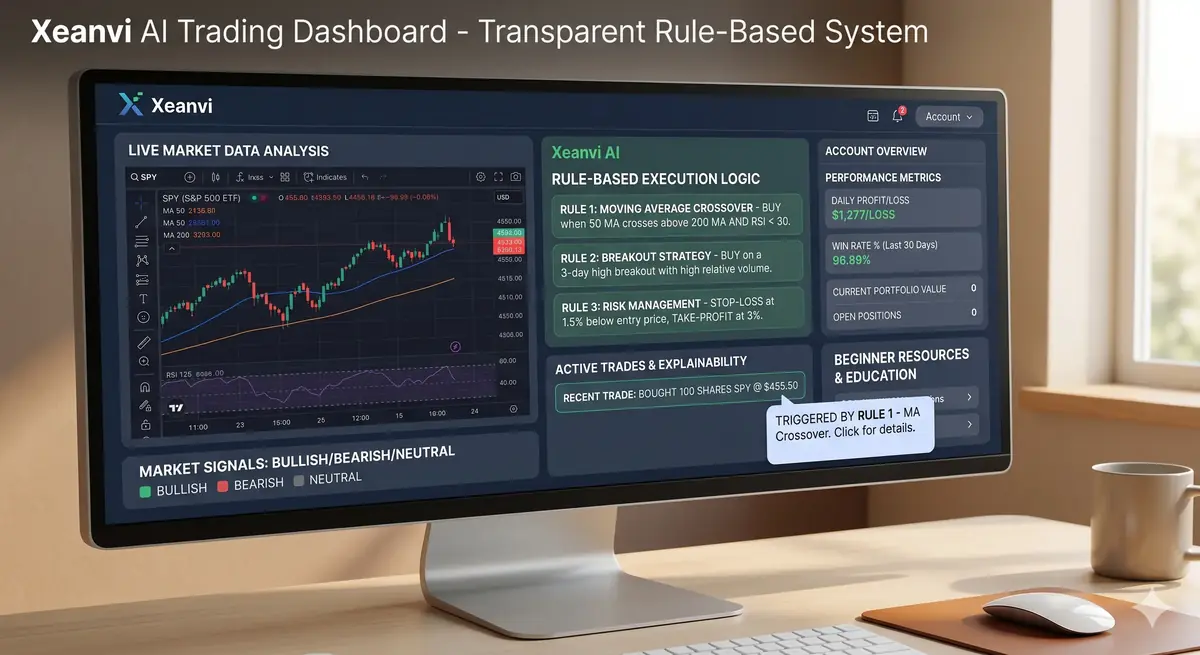
AI trading bots and agents don't work by magic—they work by rules. This guide breaks down how AI trading systems process market data, build inferences, and execute in plain English. Because if you can't see the logic behind a trade, you can't trust the platform placing it.
By Troy Swartwood, Founder & Software Engineer · Published 2026-05-24 · Updated 2026-10-06
If you search for the best AI trading bot for beginners, most of what you find is either crypto marketing or a list ranked by affiliate payout. This guide takes a different approach. You get a working framework for judging any automated trading platform, an honest shortlist of real options for stock traders, and the specific traps that cost new traders money before they ever place a good trade.
One thing up front: no bot, AI-powered or otherwise, removes market risk or guarantees profit. Anyone telling you otherwise is selling something. What a well-designed platform can do is enforce your rules consistently, cap what you can lose on a trade, and show you exactly why every decision was made.
That is the standard everything below is measured against.
The shortlist at a glance
| Platform | Best for | Approx. pricing | Broker / market | Risk controls | Transparency |
|---|---|---|---|---|---|
| XeanVI | Beginners running a defined intraday playbook on US stocks | $19.99/mo flat | Alpaca (OAuth; funds stay at your broker) | Per-trade loss caps checked before every order, risk-based sizing, a broker-side stop on every position | Gate-by-gate pass/fail logs, full audit trail |
| Trade Ideas | Traders who want a deep desktop scanner and a stream of AI-generated ideas | Higher-tier subscription | Multi-broker | Alerts and suggested exits; execution discipline is on you | Scanner logic visible; Holly AI's model is proprietary |
| Composer | Long-term, portfolio-level automation, not day trading | Subscription | Its own brokerage | Rebalancing rules, not intraday stops | Strategy logic ("symphonies") is visible |
| Pionex | Crypto only; not applicable to stock traders | Free built-in bots (exchange fees apply) | Own crypto exchange | Grid/DCA parameters | Bot logic documented |
Pricing and features change constantly, so verify current details on each provider's site before deciding. "Trade Ideas," "Holly," "Composer," and "Pionex" are trademarks of their respective owners, referenced here only for comparison.
If your question is simply "which one," the honest answer is that it depends on what job you are hiring the software for. The rest of this guide gives you the framework to decide, starting with the one distinction that matters more than any feature list.
What "AI" actually means in a trading bot
Every platform on the market says "AI." The word tells you nothing. The distinction that matters is this: does the platform operate on explicit rules (conditions you define or can inspect) or on opaque predictions you are asked to trust?
Rules-based automation executes logic you can read: if the setup passes these checks, enter with this size, this stop, this target. The AI's job is validation and analysis, reading a setup against your criteria, while the rules govern what actually happens with your money. When a trade fires, you can reconstruct exactly why. When it doesn't, you can see which gate failed. And you don't need to program any of it; here's how automating readable rules without code works in practice.
Black-box prediction asks you to hand over capital to a model whose reasoning you cannot see. It may show you a backtest (more on why those mislead below), but in live trading you get the output, a trade placed or a position closed, and none of the logic. When it works, you don't know why. When it stops working, you don't know that either, until the account balance tells you.
This distinction is the whole ballgame for a beginner. Your ability to audit and improve is what separates traders who develop a durable process from traders who blow up an account on a system they never understood. You can calibrate trust in rules you can see. You cannot calibrate trust in a black box; you can only hope.
How to choose the best AI trading bot for beginners: six features that matter
Whatever platform you evaluate, check for these six. Missing one is a meaningful gap. Missing several is a warning.
- Hard loss caps. Not "risk management tips" but enforced, per-trade maximum-loss limits that the execution layer will not exceed: a defined stop attached to every entry, sized so a losing trade costs a known, bounded amount. If the platform can't state its loss-cap mechanism in one sentence, it doesn't have one.
- Paper trading mode. You should be able to run your full workflow (scanning, validation, sizing, order routing) against live market data with zero real dollars, for as long as you want, before anything touches your account. Platforms that rush you to fund live trading have priorities that aren't yours. Worth knowing: paper fills are idealized and real fills slip, so paper mode proves your process, not your exact P&L.
- Transparent decision logic. Every trade, and every skipped trade, should come with a visible reason: pass/fail gates, logged criteria, an audit trail you can review at the end of the day. This is how you learn, and it's how you catch a misconfigured rule before it compounds.
- Your broker holds your money. The platform should connect to a regulated brokerage via revocable, permissioned access (OAuth), never by taking custody of your funds. If a "bot" asks you to deposit money into the platform itself, that is the single loudest red flag in this entire guide. XeanVI, for example, routes through your own Alpaca account, so your capital never leaves your brokerage.
- Stops that live at the broker. Every position should have a stop-loss resting at the broker, placed at entry or immediately after the fill. Not a mental stop, and not a stop you'll "add in a minute." Bracket orders are the cleanest version, and a broker-side stop is the mechanical difference between a capped loss and an account-denting one.
- Flat, comprehensible pricing. A fixed subscription you can weigh against your account size. Be wary of profit-sharing schemes, opaque fee stacks, and "free" bots monetized in ways you can't see. The real cost of running a trading bot is usually more than the headline number, and you want a platform where at least the headline is honest.
The shortlist, reviewed
XeanVI: rule-gated execution for beginners on US stocks
XeanVI is built around one workflow. You define a playbook (setup criteria, risk limits, sizing rules), Xean AI validates each candidate setup gate by gate, and only setups that pass get routed to your Alpaca account with a per-trade loss cap checked before the order goes out and a protective stop at the broker. Every decision is logged and reviewable, including every skip.
Strengths for a beginner: the loss cap is enforced at the execution layer rather than suggested, the full automated workflow runs in paper mode on the PRO plan, and the gate-by-gate transparency means you always know why, which is how a new trader actually improves. You can also see full scans free for 7 days before paying. At $19.99/month flat with no cut of your trades, the cost math works even for small accounts. The trade-off is scope. XeanVI is purpose-built for Alpaca-connected US stock execution, not a multi-broker, multi-asset terminal. For the full picture of how it compares to a scanner-first platform, see XeanVI vs Trade Ideas.
Trade Ideas: a powerful scanner that assumes discipline you may not have yet
Trade Ideas is a mature, well-regarded desktop platform whose core strength is market discovery: a deep real-time scanner, rich charting and backtesting, and Holly AI generating a stream of trade ideas across the whole market. For finding what's moving, it's excellent.
The beginner-relevant caveat is that Trade Ideas is fundamentally an idea engine. Acting on those ideas with consistent sizing, stops, and exits is largely on you, and that is exactly the part beginners struggle with. It's also priced at a level that assumes a serious commitment. Some traders eventually use a scanner for discovery and a separate execution layer for routing; they solve different problems. For the full side-by-side, see XeanVI, Composer and Trade Ideas compared.
Composer: real automation, wrong timeframe for day trading
Composer automates portfolio strategies, "symphonies" of rules that allocate and rebalance over days, weeks, and months. The logic is visible, the automation is real, and for a beginner whose actual goal is systematic investing, it's a legitimate tool.
It is not an intraday platform. If your goal is day trading, with entries and exits inside a session and per-trade stops, Composer isn't built for that job, and forcing it there is a category error. Full breakdown: XeanVI vs Composer.
Pionex and the crypto-bot category: a different product than you think
Most "best AI trading bot" lists are dominated by crypto platforms such as Pionex, Cryptohopper, and 3Commas. Pionex is the usual beginner pick: free built-in grid and DCA bots running on its own exchange. If you specifically want to automate crypto, it's a reasonable place to study.
But be clear about what these are: exchange-hosted crypto strategies, mostly grid logic that buys dips and sells rips inside a range. They don't trade stocks, they don't connect to a securities brokerage, and their risk profile (24/7 markets, no circuit breakers, custody on the exchange) is a different world from regulated US equities. If you searched for a trading bot and landed on crypto lists, that's the algorithm confusing two markets, not a recommendation.
What about ChatGPT?
A genuinely common beginner question. Short version: ChatGPT is useful for research, strategy education, and drafting rules, and it is not an execution engine. It has no broker connection, no enforced risk limits, and no real-time order handling, and confident-sounding output is not the same as a safe live trade. Use each tool for its actual job. The long version: Can ChatGPT do stock trading?
Red flags: the black-box traps
These are the patterns that separate marketing from software, drawn from what actually costs beginners money.
Claims of market prediction. No model reliably forecasts what the market will do next. Models estimate probabilities from historical patterns, and markets change regimes without notice. A platform leading with prediction claims is leading with its weakest, least verifiable promise. Regulators have warned about exactly this pitch; the SEC's investor guidance on automated tools is a useful baseline for the claims that should make you skeptical.
Backtest-only evidence. A beautiful backtest proves the model fits the past, often because it was tuned until it did. Overfitting is the default outcome of strategy development, not a rare mistake. Live, auditable, forward results (even paper results) beat any backtest.
Guaranteed or "target" returns. "1% daily" and "$200/day on autopilot" are arithmetic that collapses on contact with position sizing, spreads, and slippage. Any guaranteed-return claim is disqualifying on its own.
Deposit-to-the-platform custody. Covered above, repeated because it matters most: your money belongs at a regulated broker in your name. A bot that takes deposits is asking you to combine execution risk with counterparty risk.
No visible reason for trades. If you can't answer "why did it buy that?" from the platform's own logs, you cannot learn from it, audit it, or catch it breaking. Opacity isn't sophistication. It's unaccountability.
Urgency and lifestyle marketing. Screenshots of profits, countdown timers, rented Lamborghinis. Software that works sells on mechanism, not adrenaline.
FAQ
Which AI trading bot is best for beginners?
For automating a defined intraday playbook on US stocks with enforced loss caps, XeanVI is built specifically for that job. For market scanning and idea generation with self-managed execution, Trade Ideas. For long-horizon portfolio automation, Composer. For crypto, the exchange-hosted bots like Pionex. "Best" is a function of the job, and for a beginner the job should start with capped risk and visible logic, whatever platform you pick.
Are AI trading bots legal?
Yes. Using automation and AI to trade US stocks is legal, and algorithms account for a large share of daily market volume. What's illegal is using any tool, automated or not, to manipulate markets. Details and the actual regulatory lines: Is it illegal to use AI for day trading?
Do AI trading bots actually make money?
Some traders run profitable automated processes; many don't. The honest framing: a bot executes a process, and if the process has no edge, automation just runs the losing process faster. What automation reliably delivers is consistency and risk control, which is the foundation an edge gets built on. Anyone quoting you a return number is guessing or selling. Related math: trading bot profitability and the $25,000 PDT rule.
What about bots that send buy and sell signals?
Signal services tell you what they think. They don't solve execution, sizing, or stops, which is where beginners actually lose money. A signal without an enforced exit plan is just a tip. Deeper dive: AI trading bot buy/sell signals.
How much should one cost?
Flat subscriptions for retail platforms generally run from about $20 to a few hundred dollars a month, plus market-data or broker costs depending on the stack. The full cost picture, including the hidden parts, is here: how much should trading automation software cost?
Can I try one without risking money?
Yes, and you should insist on it. Any platform worth using offers a paper mode against live data. Run your full workflow there until the process behaves the way you expect. Not the profits: the process. XeanVI's 7-day trial is free to start, no card required, and automated paper execution comes with the PRO plan.
Key takeaways
- The best AI trading bot for beginners is the one whose logic you can read and whose losses are capped by the execution layer, not by your discipline in the moment.
- Rules-based beats black-box for anyone still learning, because visible logic is auditable and improvable.
- Your money stays at a regulated broker in your name. A platform that takes deposits is disqualified.
- Paper trade the full workflow first, and judge the process rather than the paper P&L.
- Match the tool to the job: XeanVI for capped intraday execution on Alpaca, Trade Ideas for discovery, Composer for portfolios, crypto bots for crypto.