ChatGPT for Stock Trading: How to Use It and Where It Stops
Many retail traders wonder if ChatGPT stock trading is possible. While powerful for analysis and strategy generation, ChatGPT lacks the direct execution capabilities and built-in risk management essential for navigating live markets.
By Troy Swartwood, Founder & Software Engineer · Published 2026-05-23 · Updated 2026-08-23
ChatGPT stock trading is one of the most-searched ideas in retail trading right now, and most of what's written about it falls into two camps: hype that pretends a chatbot is a trading system, and dismissals that ignore how useful it actually is. Both miss the point. ChatGPT is a genuinely strong tool for the thinking half of trading. It is the wrong tool for the doing half, and knowing exactly where that line sits is worth real money.
This guide covers both sides: how to use ChatGPT for stock trading in ways that actually help, what it cannot do no matter how you prompt it, and the honest math behind the "$200 a day with AI" pitch.
The short answer
- Good at: explaining concepts, summarizing filings and news, drafting and stress-testing trading rules, reviewing your trade journal, writing strategy pseudocode.
- Cannot do: connect to your brokerage, place or manage orders, enforce stops or loss limits, react in real time, or verify its own claims.
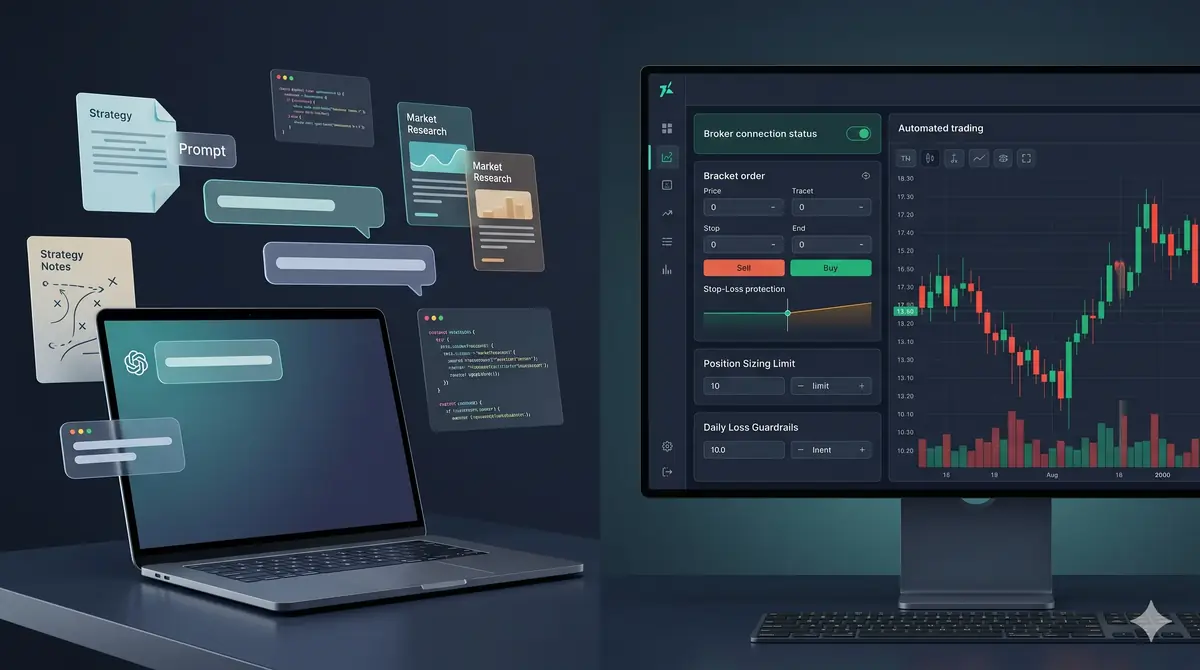
- The division of labor: use ChatGPT to build and refine your rules, and use a broker-connected execution platform to run them.
How to use ChatGPT for stock trading: four jobs it does well
1. Learn the mechanics faster. ChatGPT is excellent at plain-English explanations of things that trip up new traders: bracket orders, the PDT rule, float, slippage, order types. Ask it to explain a concept three different ways and quiz you afterward. For grounding, cross-check anything consequential against a primary source, because it will occasionally state a wrong detail with full confidence.
2. Summarize research inputs. Paste an earnings summary, a press release, or a filing excerpt and ask for the bull case, the bear case, and what a skeptic would check next. This compresses an hour of reading into minutes. It does not make the output true; it makes it organized. The judgment stays with you.
3. Draft and stress-test your trading rules. This is the highest-value use. A prompt like this produces a real starting point:
"Draft a rules-based day trading playbook for gap-and-go setups on US stocks under $10. Include: setup eligibility criteria, entry trigger, stop placement, profit target logic, maximum risk per trade as a percent of account, and conditions under which no trade should be taken. Then list the five weakest assumptions in the playbook you just wrote."
That last sentence matters. ChatGPT is better at critiquing a draft than most beginners are, and forcing it to attack its own output surfaces the holes before the market does. A written rule set like this is exactly what a trading playbook is, and it's the artifact an execution platform consumes.
4. Review your trade journal. Paste ten closed trades (entry, exit, size, reason) and ask where you broke your own rules. Pattern recognition over your own behavior is something it does well, and it has no ego investment in flattering you.
What ChatGPT cannot do, no matter how you prompt it
Here the marketing and the reality part ways.
No broker connection. ChatGPT does not place orders through your brokerage account. Every "ChatGPT trading bot" tutorial you've seen is actually a separate program someone wrote, calling a broker API, with ChatGPT somewhere in the loop as a text generator. The chatbot never touches the market.
No enforced risk controls. It cannot attach a stop to your entry, cap your loss on a trade, limit your position size, or stop you from revenge-trading at 10:15 a.m. It can describe all of those things beautifully. Describing a stop-loss has never once prevented a loss.
No real-time execution. Intraday trading is decided in seconds. A conversational interface that thinks in paragraphs is structurally the wrong shape for order handling, fill monitoring, and reacting to a stop trigger.
Confident errors. Language models produce fluent, authoritative-sounding output that is sometimes wrong. In research, that's an inconvenience you catch by checking sources. In live execution, it's an unbounded liability. This is the core reason no serious operator puts a chatbot in the order path.
If you want the deeper technical breakdown of why a language model and an execution engine are different machines, see why AI should assist trading rules, not replace judgment.
The "$200 a day" math, honestly
The pitch writes itself: ask ChatGPT for picks, trade them, collect $200 a day. Run the arithmetic instead.
To make $200 a day on trades risking a sane 1 to 2 percent of your account, you need either a five-figure account or outsized per-trade risk. With less than $25,000 in a margin account, the PDT rule caps you at three day trades per rolling five sessions, so "daily" income is off the table for small accounts in the first place. And a chatbot pick with no enforced stop means your losers are unbounded while your winners are hoped-for. The full breakdown, including what compounding actually looks like under these constraints, is in trading bot profitability and the $25,000 PDT rule.
None of this means automation is a scam. It means income claims stapled to a chatbot are.
The right division of labor
The traders who get real value from ChatGPT stock trading workflows all converge on the same split:
- ChatGPT for thinking: learn concepts, digest research, draft the playbook, critique the playbook, review the journal.
- An execution platform for trading: a system that connects to your broker, validates each setup against your written rules, sizes the position off your risk limit, and attaches the stop and target as a bracket at entry.
That second half is the job XeanVI was built for. You bring the rule set (drafted with ChatGPT if you like), and XeanVI runs it against live market data: gate-by-gate validation, risk-based sizing, hard loss caps, and bracket-order routing through your own Alpaca account, with every decision logged. Your funds stay at your broker; the chatbot stays out of the order path. If you're comparing platforms for that execution layer, start with the best AI trading bot for beginners guide.
Paper mode exists for exactly this handoff: run the rules you drafted, with zero dollars at risk, until the process behaves the way the draft promised.
FAQ
Can ChatGPT trade stocks for me?
No. It has no brokerage access and cannot place, modify, or cancel orders. Anything marketed as "ChatGPT trading your account" is third-party software using a broker API, and it should be judged as software: by its risk controls, custody model, and transparency, not by the chatbot branding.
Is using ChatGPT for trading legal?
Yes. Using AI for research, analysis, or automation of your own trading is legal in US markets; market manipulation is illegal regardless of the tools involved. The actual regulatory lines are covered in is it illegal to use AI for day trading?
Can ChatGPT pick winning stocks?
It can generate ideas and summarize sentiment, and it has no reliable way to know what happens next. No model does. Treat any pick as a hypothesis that still needs your rules for entry, size, and exit before it deserves a dollar.
What about custom GPTs and AI agents that claim broker access?
The agent layer is real technology, but the question that matters doesn't change: what enforces the loss cap, and who holds the money? If the answer to either is "the chatbot" or "unclear," you have your answer.
Which is better for a beginner, ChatGPT or a trading bot?
Wrong versus. ChatGPT is a thinking tool and a trading platform is an execution tool, and a beginner gets the most from using both in their lanes: draft rules in one, enforce them in the other.
Key takeaways
- ChatGPT stock trading works when the chatbot handles research and rule-drafting, and a broker-connected platform handles execution.
- No prompt gives ChatGPT a brokerage connection, an enforced stop, or real-time order handling. Those live in the execution layer.
- Daily-income claims built on chatbot picks collapse against position sizing, the PDT rule, and unenforced stops.
- The strongest prompt pattern: have it draft your playbook, then make it attack its own draft.
- Move a drafted rule set into paper trading before any live dollar, and judge the process, not the paper profits.