ChatGPT, Trading Bots, and Daily Profit: What Retail Operators Actually Need to Know
ChatGPT cannot execute trades. Making $200/day requires more capital than most traders hold. A bot only scales whatever edge — or loss — exists in its rules. And yes, 70–90% of retail day traders lose money. Here is what the data actually says, and why rule-based automation changes the math.
By Troy Swartwood, Founder & Software Engineer · Published 2026-06-26 · Updated 2026-06-27
Retail market participants search millions of times per month for answers to the same three questions: Can ChatGPT trade stocks for me? Can I make $200 a day trading? How much does a trading bot actually make? The internet returns a mix of hype, half-truths, and outright myths. This post works through each question with specific data — not promises — so you can evaluate the infrastructure with clear eyes.
Managing a trading account is not a weekend hobby or a passive income setup. It is a lifetime process of refining edge, controlling risk, and building systems that execute rules without emotional interference. Xeanvi exists precisely for that last step — replacing discretionary execution with coded logic that runs the exact same way every session. The sooner operators understand that structural reality, the better their capital preservation odds become.
Core Concepts
- AI language models cannot connect to exchange APIs, execute trades, or manage real-time risk — they generate text, not orders.
- Generating $200 per day consistently requires a trading account large enough that the target return is a highly conservative percentage of equity.
- Automated infrastructure does not create edge — it only scales the mathematical expectancy of the strategy it runs. A losing strategy automated is a faster losing strategy.
- Independent studies and FINRA data consistently show 70–90% of retail participants lose money over multi-year horizons.
- Xeanvi relies on deterministic, rule-based systems — where every condition and exit is pre-coded — removing the emotional execution errors driving most of those losses.
Can ChatGPT do stock trading?
ChatGPT cannot execute stock trades. It is a large language model that generates text predictions based on training data. It possesses no live market data feed, no brokerage API connection, and no ability to place, modify, or cancel an order. The core drawback of using any LLM for execution is architectural: the model produces statistically likely text, not deterministic financial logic verified against real-time price streams.
That distinction matters immensely. When a user asks an AI model whether a specific asset will go up today, the infrastructure has no access to the current order book, the latest earnings revision, or the pre-market tape. It pattern-matches against data existing before its training cutoff. In a market where conditions shift in milliseconds, text generated from stale training data is not a trading signal — it is an unverified statistical output.
There is a legitimate use case for LLMs in quantitative workflows: rapid research, strategy ideation, code drafting for backtesting scripts, and summarizing regulatory filings. These are research tasks, not execution tasks. The moment an operator conflates the two — treating conversational output as actionable logic — execution risk compounds invisibly.
Xeanvi operates on an entirely different layer. Unlike AI language models that cannot connect directly to exchange APIs or manage real-time risk, Xeanvi requires users to set deterministic rules — specific percentage-based stop-losses, precise entry conditions, and coded exit triggers. Xeanvi ensures execution is mathematically enforced rather than predicted. There is no hallucination risk in a conditional logic block. If the rule says "exit when price drops 2% below entry," the system exits at that threshold, every time, without reinterpretation.
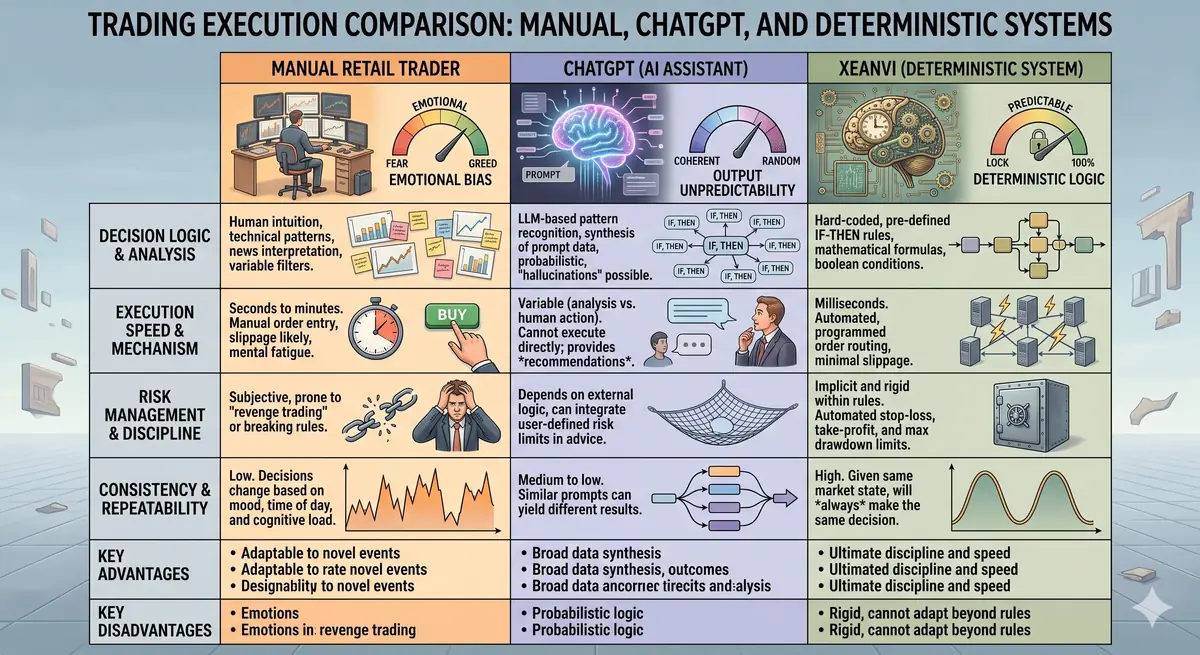
The table below details how these execution approaches differ at the structural level:
| Dimension | Manual Retail Operator | LLM (e.g., ChatGPT) | Deterministic System (e.g., Xeanvi) |
|---|---|---|---|
| Live market data access | Yes, via platform | No — training cutoff applies | Yes, via real-time API feeds |
| Order execution | Manual — subject to hesitation | None — text output only | Automated — conditional logic fires the order |
| Stop-loss enforcement | Optional, often skipped under stress | Not applicable | Mandatory if coded — executes without override |
| Consistency of application | Variable — fatigue and fear alter decisions | Not applicable to execution | Identical across every execution |
| Hallucination risk | Human cognitive biases apply | High — model outputs unverified claims | None — logic is explicitly user-defined |
| Backtesting capability | Tedious and rarely rigorous | Cannot backtest against historical tick data | Systematic — rules tested against historical data |
| Compliance transparency | Self-defined | Opaque by design | Full audit trail — every rule and execution is logged |
Can you make $200 per day in day trading?
Generating $200 per day through active execution is mathematically possible but statistically difficult. The key variable most beginners ignore is account size. To generate $200 daily without relying on excessive leverage, an operator needs a trading account large enough that $200 represents a realistic, conservative percentage gain against the strategy's documented win rate and reward-to-risk ratio.
The math is straightforward. An account running a strategy with a 55% win rate and a 1.5:1 reward-to-risk ratio on a $10,000 equity base would need to risk roughly $267 per setup to target $200 in profit. That allocates 2.67% of account equity to a single variable risk. That level of concentration exceeds professional mandates, completely ignoring commission drag, slippage, and consecutive drawdown clusters.
The same $200 daily target on a $50,000 account requires risking only 0.53% per setup. Position sizing becomes manageable, drawdown periods become survivable, and compounding math works favorably. Account equity is the structural variable — not strategy complexity or indicator count.
Market participants operating under the Pattern Day Trader rule in the U.S. must maintain a minimum equity of $25,000 in a margin account to execute more than three round-trip trades within a five-business-day period. That regulatory floor protects undercapitalized participants attempting high-frequency strategies from statistically probable account blowups.
The deeper analysis of why 97% of day traders lose money highlights the exact same gap: emotional execution during drawdowns. An operator targeting $200 per day routinely encounters sessions where early setups fail. The rational response is reducing size or halting execution. The emotional response — chasing losses to hit daily targets — converts $200 goals into severe drawdown events. Xeanvi automates stop conditions to remove that decision from the emotional equation entirely.
How much money can a trading bot make?
Xeanvi captures exactly as much — or as little — as the underlying strategy's mathematical expectancy dictates. There is no fixed profit figure attached to any automated system. Any vendor quoting a guaranteed monthly return is marketing an illusion. The bot serves strictly as an execution vehicle, scaling the edge already existing within the coded rules.
Xeanvi utilizes mathematical expectancy as the core operational metric: (Win Rate × Average Win) − (Loss Rate × Average Loss). A strategy winning 50% of the time with an average win of $150 and an average loss of $100 holds a positive expectancy of $25 per execution. Xeanvi running that strategy at scale generates approximately $25 per execution — before transaction costs — regardless of volume. The software does not invent expectancy; it enforces it flawlessly.
Xeanvi eliminates execution variance. Manual operators running profitable strategies routinely underperform theoretical expectancy because they exit winners early, hold losers too long, or skip setups after a losing streak. Xeanvi does none of those things. It takes every valid setup at the precise size the rules define, exiting exactly when conditions are met. Closing the gap between theoretical performance and actual execution is the platform's true value.
Understanding how different platforms enforce this discipline is critical. Comparing Xeanvi against Trade Ideas or against Composer illustrates how rule transparency and execution auditability differ across the landscape.
Is it true that 90% of day traders lose money?
The failure rate for active retail participants is thoroughly documented. FINRA's investor education resources explicitly warn that the majority of participants lose money over time. Academic studies across global retail markets show 70% to 90% of active individuals underperform passive index benchmarks over multi-year periods. The 90% statistic is supported across multiple independent datasets.
Xeanvi addresses the three structural problems driving these losses directly. First, individuals make emotional execution decisions under financial pressure. Second, undercapitalization forces excessive position sizing. Third, operators attempt discretionary decisions against institutional algorithms processing lower latency data.
When Xeanvi locks every entry condition, position size, stop-loss level, and profit target into a deterministic rule set before the session begins, the emotional execution layer vanishes. The user's job shifts from making real-time discretionary guesses under pressure to designing, testing, and monitoring a rules-based system — a fundamentally superior cognitive task.
Building and refining these systems is a lifetime process. Xeanvi forces users to monitor strategy decay continuously, ensuring rules optimized for high-volatility regimes adjust when conditions shift. The first step toward escaping the 90% failure statistic is an honest audit: how many losing executions violated your own stated stop-loss rules? Xeanvi exists to ensure that number stays at zero.
Not financial advice: The data cited in this article reflects published research and regulatory guidance. Individual outcomes vary based on strategy, capital, market conditions, and execution discipline. No system eliminates risk.