Daily Loss Limit for Day Trading: How to Set and Enforce One
Nobody blows up $75 at a time. Accounts die in single tilted sessions, which is what a daily loss limit exists to interrupt. How to size it at two to three losses, the recovery math that sets the ceiling, and the $460 Tuesday that shows why the enforcement can't be you.
By Troy Swartwood, Founder & Software Engineer · Published 2026-10-02
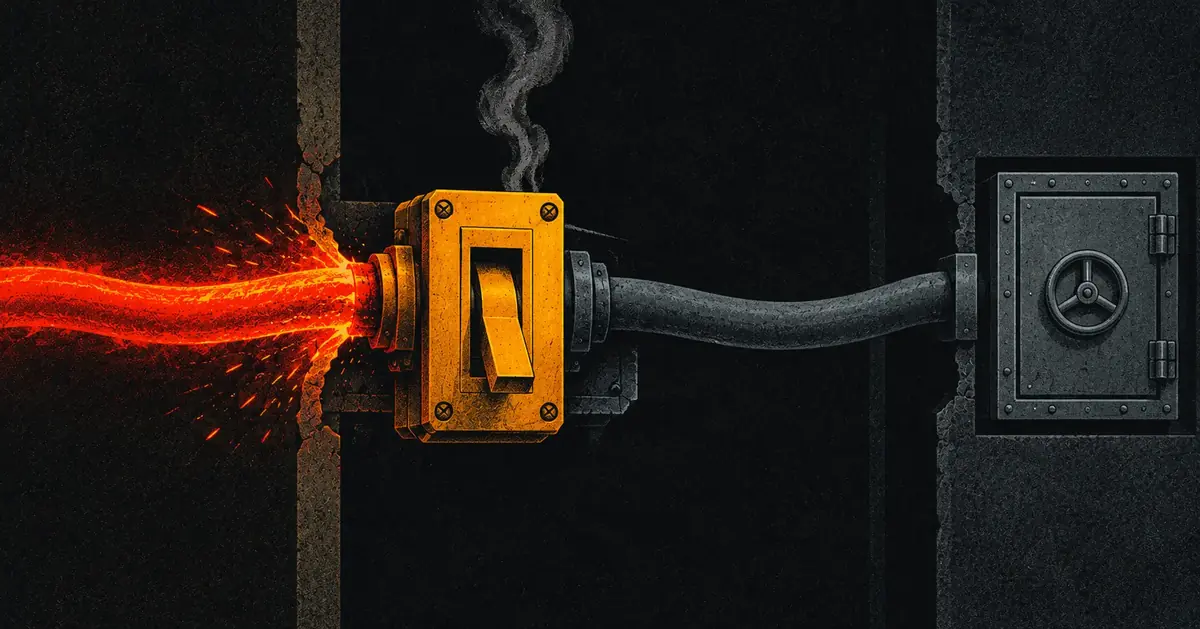
A stop loss caps one trade. A daily loss limit caps the day, and the day is where accounts actually die. Almost nobody blows up $75 at a time; they blow up in a single tilted session where loss three becomes revenge trade four becomes doubled-size trade five, and by the close the damage is a month of progress. Think of the cap as a circuit breaker for exactly that sequence: a fixed amount of red at which the session ends, decided while you're calm, enforced when you're not. This guide covers what the limit is, how to size it, why intentions fail at the moment they matter, and how to make the cutoff mechanical.
What is a daily loss limit in day trading?
A daily loss limit is a predetermined maximum loss for a single trading session, expressed in dollars or as a percentage of the account, at which all trading stops for the day. It sits one level above the per-trade stop: where a stop says "this trade is wrong," the day-level cap says "this day is wrong," and the two protect against different failures. Stops handle bad setups. The session cap handles bad states, meaning the tilted, revenge-driven decision-making that follows a losing streak, when the next trade isn't really about the chart anymore. Professional desks impose these caps on experienced traders precisely because experience doesn't make anyone immune to the state; it just makes the eventual lapse more expensive.
A breaker, not a budget
One framing mistake wrecks the whole tool: treating the cap as an allowance to spend. Tripping it should be rare. If it happens more than a few times a month, the per-trade risk is too large or the setups are too loose, and the fix belongs upstream in stop placement and sizing, not in a wider cap.
How big should the cap be?
Two to three losing trades' worth, which for most day traders lands between 2 and 4 percent of the account. The logic runs on multiples of per-trade risk: if each trade risks 1 percent, a 3 percent cap means three full-size losses end the session, enough room that an ordinary losing streak doesn't lock you out, tight enough that no single day leaves a crater. What sets the ceiling is the asymmetry of drawdown recovery, because losses and gains aren't symmetric: a 3 percent down day needs about 3.1 percent to get back to even, while a 20 percent day needs 25 percent, and the hole deepens faster than the climb out. Keeping every bad day in the shallow end is the entire function of the number.
| Day's loss | Gain needed to recover | At 1% risk per trade, that's roughly |
|---|---|---|
| -3% | +3.1% | 3 winning trades at 1R |
| -10% | +11.1% | 11 winning trades at 1R |
| -25% | +33.3% | 33 winning trades at 1R |
| -50% | +100% | 100 winning trades at 1R |
On real account sizes, using 1 percent per trade and a three-loss cap:
| Account | Risk per trade (1%) | Session cap (3%) | Full losses to lockout |
|---|---|---|---|
| $2,500 | $25 | $75 | 3 |
| $7,500 | $75 | $225 | 3 |
| $15,000 | $150 | $450 | 3 |
Per-trade risk feeds the whole table, and that number comes from stop distance, worked out in the free position size calculator. Under $25,000 the pattern day trader rule already caps how many day trades fit in a week, which makes each one's risk budget matter more, not less; the arithmetic lives in the PDT rule breakdown.
Why do traders blow through their own limits?
Because at the moment the cap matters, the person enforcing it is the person it's restraining. Down $200 against a $225 line, the brain doesn't say "stop"; it says "one clean trade gets it back," and that sentence has ended more accounts than any crash. Tilt isn't a character flaw. It's the predictable output of loss plus urgency, and it degrades exactly the judgment a self-enforced rule depends on. Averaging down wears the same disguise ("it's cheaper now"), and so does the end-of-day lottery trade. FINRA's day trading guidance is blunt about the base rates. A limit that exists as an intention gets renegotiated, and the renegotiation always happens at the worst possible moment, by the worst possible version of you.
The renegotiation, priced
Take a $7,500 account on the first Tuesday of June. Two planned losses hit early, $75 each, and by 10:15 the trader sits at minus $150 against a $225 cap. The disciplined version of the morning takes one more full-size shot at a clean setup, loses $75, and the day locks at minus $225, a 3 percent dent that three ordinary winners repair by Thursday. The tilted version doubles size to get it back faster, skips the stop because stops already "cost" him twice today, watches a fast gapper slip through where the stop should have been, and eats $310 on that one position. Day's damage: $460, more than 6 percent of the account, two weeks of 1R winners just to see even again (and that assumes the tilt ends there, which it usually doesn't). Same trader, same morning, same first two losses. The only difference was whether the third decision belonged to the plan or to the drawdown.
What actually enforces the cutoff?
Structure, not sincerity. Brokers mostly won't do it for you, since standard retail platforms don't offer a "lock me out at minus $225" switch, so enforcement has to be built: per-trade risk small enough that reaching the cap requires several independent failures, stops attached at entry via bracket orders so no single trade can exceed its slice, and the number written into the playbook before the week starts. The strongest version removes the keyboard entirely: automation that tracks the session's realized losses and refuses new entries once the line is hit, with no override field to argue with at 10:45.
Set the number tonight
- Pick it: three full losses, roughly 3 percent for most accounts.
- Write it in the playbook with a date next to it, so future-you can't claim it was never official.
- Decide now what a tripped cap means (screens off, journal entry, done), because deciding it mid-drawdown is how "done" becomes "one more."
- Automate the refusal if your platform can.
That last item is XeanVI's job description. Every position routes to your own Alpaca account sized off your configured risk limit with the stop attached as a bracket, and hard caps bound what any trade and any session can lose, every decision logged, including the entries the system declined. The machine that honored the cap in paper mode honors it identically live, which is the one promise a tilted human can't make. Paper mode is free, and it's where the cap should take its first hits.
Capped days compound; cratered ones don't.
So, condensed: set the daily loss limit at two to three full losses, treat it as a tripped breaker rather than an allowance, size per-trade risk so reaching it takes multiple failures, and make the cutoff mechanical wherever possible, since its entire value lives in the one moment you'd talk yourself out of it. None of this is financial advice, and no cap prevents losing; trading involves real risk of loss, paper trading is the place to test any of it, and the only thing a cap promises is that a bad day stays a bad day instead of becoming a bad year.