Your Day Trading Rules Need to Run Themselves: Margin, the PDT Rule, and a Smarter Investment Approach
Day trading rules aren't just regulatory fine print — they're the operational backbone of every margin account that survives long-term. Here's how to build and automate a framework that enforces itself.
By Troy Swartwood, Founder & Software Engineer · Published 2026-06-06 · Updated 2026-06-23
Not financial advice: This content is for educational purposes only and does not constitute financial advice. Day trading and margin account investing involve significant risk of loss. Paper trade any strategy before risking real capital. Consult a qualified financial professional before making any investment decisions.
Solid day trading rules are the difference between a margin account that compounds steadily and one that gets restricted, locked, or blown out inside a single bad session. Every retail trader who has opened a margin account and started placing day trades has eventually collided with the same wall: a rule they didn't fully understand, a capital lock they didn't anticipate, and an impulsive decision that made everything worse. A disciplined investment approach doesn't just help you trade smarter — it keeps you in the game. Day trading without a codified rule structure isn't a strategy; it's a controlled gamble with your own account restrictions baked into the outcome. This post breaks down exactly why rule-based frameworks protect margin accounts, how to build baseline capital controls, and where a platform like Xeanvi — built around your trading playbook — turns those rules from a checklist into an automated enforcement system.
What the PDT Rule Actually Does to Margin Investors
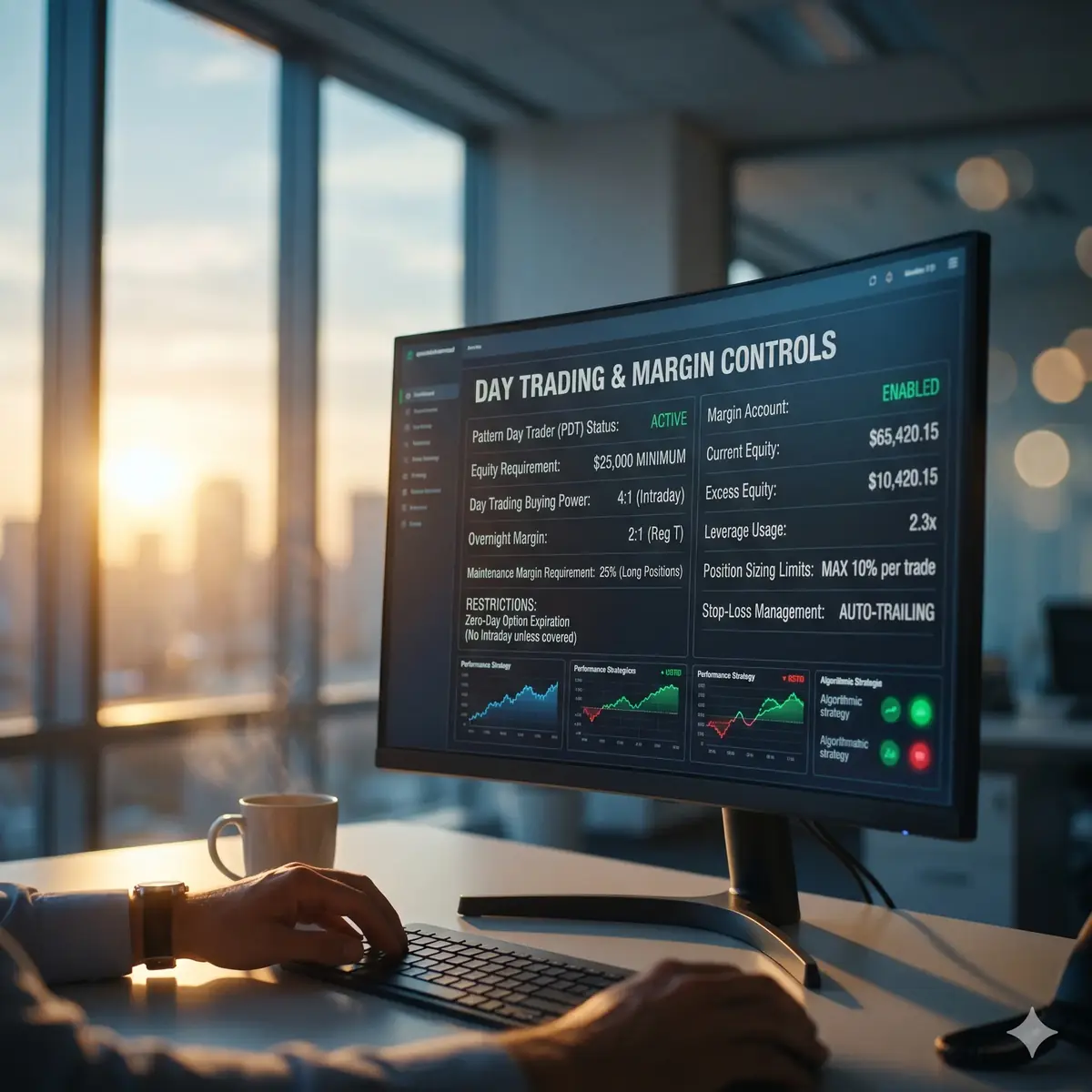
The Pattern Day Trader (PDT) rule is an SEC regulation that applies to any margin account placing four or more day trades within five business days — provided those trades represent more than six percent of all trades in that window. Once flagged, FINRA's pattern day trader classification requires a minimum equity balance of $25,000 in the account. Fall below that threshold and the account gets restricted. Trade through the restriction and the consequences escalate.
Margin investors running a manual investment approach face a structural problem here. The PDT rule isn't designed to punish active traders — it's a risk control mechanism. Without automated tracking baked into your execution environment, it is trivially easy to trip the counter without realizing it. A missed exit here, a quick scalp there, and suddenly your day trading activity has crossed a threshold your platform didn't warn you about in time.
- PDT threshold: Four or more day trades in a five-business-day rolling window on a margin account
- Minimum equity requirement: $25,000 to maintain pattern day trader status without restriction
- Restriction consequence: Account locked to closing transactions only until equity requirement is met or a 90-day restriction expires
- Day trade counter: Each round-trip — same security, same day, buy and sell — counts as one day trade
- Margin multiplier: Pattern day traders can access up to four times their maintenance margin excess for day trading buying power, which amplifies both gains and losses
Understanding the rule in theory is different from operationalizing it. A proper investment approach accounts for the counter at the strategy level — not after the trade is already in.
How Retail Platforms Like Robinhood Changed the Risk Equation
Robinhood and its generation of commission-free consumer apps did something important: they opened margin account access to millions of retail investors who had never traded before. That democratization has genuine value. The gamified interface, push notification trade prompts, and one-tap execution design, however, are optimized for engagement — not for enforcing the disciplined day trading rules that keep account activity from triggering regulatory guardrails.
Navigating SEC margin rules doesn't require a complicated investment approach — but it does require a deliberate one. Consumer apps surface the rules in the fine print; they don't build enforcement into the workflow. Margin investors who rely on willpower and post-trade review to stay compliant are working against the design of the platform they're using.
Consumer brokerage apps and systematic rule-based trading infrastructure are built for fundamentally different users. Day trading doesn't require you to watch charts all day — but it does require your rules to run whether you're watching or not.
What Goes Wrong Without Day Trading Rules
Most margin account blowups don't happen because a trader lacked knowledge of the rules. They happen because the rules existed only as intentions — and intentions collapse under pressure. A day trading session that starts with a clear plan can deteriorate within an hour when a losing position triggers loss aversion, buying power gets overextended chasing recovery, and the PDT counter gets ignored entirely because the focus has shifted to damage control. By the time the account restriction lands, the original investment approach is long gone. The damage isn't just financial — repeated rule violations erode confidence in the system, which makes the next violation more likely. That cycle is exactly what a codified, enforced rule framework is designed to interrupt. Defining your rules in advance using a structured trading playbook — and making sure those rules run automatically — is the structural fix for a behavioral problem that willpower alone will not solve.
Building the Rule Structure That Protects Your Margin Account
A systematic investment approach to day trading isn't about restricting opportunity. The goal is eliminating the conditions under which impulsive decisions override the rules you set when you were thinking clearly. The framework below represents a baseline architecture — not a trading strategy, but a protective operational structure that any margin account day trader should codify before placing another trade.
Position-Level Rules
- Maximum position size per day trade: Define a hard ceiling as a percentage of available day trading buying power, not a dollar amount. As buying power fluctuates, a percentage-based cap scales proportionally.
- Per-trade risk limit: Establish the maximum loss any single day trade is permitted to incur before the position is closed — automatically if possible, manually if not.
- Concurrent position cap: Limit the number of open day trades at any one time. Running multiple simultaneous positions on margin compounds exposure faster than most retail investors model in advance.
Account-Level Rules
- Daily drawdown ceiling: The total loss at which all day trading activity stops for the session, no exceptions. This is the rule most frequently abandoned under emotional pressure and the one that causes the most damage when it breaks.
- Day trade counter enforcement: An active, visible count of day trades used in the current rolling five-day window. Non-negotiable for any margin account subject to PDT rules.
- Equity floor monitoring: A standing alert — or better, an automated pause — triggered when account equity approaches the $25,000 PDT threshold.
- Margin utilization cap: Day trading buying power on a margin account can reach four times maintenance margin excess. Operating near that ceiling without a hard cap is not a strategy; it's a liability.
Session-Level Rules
- Defined trading hours: Restrict automated day trade execution to specific windows. Early morning volatility and end-of-session price action create conditions that manual investment approaches handle inconsistently.
- News and event filters: Pre-scheduled rule suspension around earnings releases, Fed announcements, or other high-impact events prevents the strategy from running in conditions it wasn't calibrated for.
- Re-entry restriction after stop-out: Once a position is stopped out, blocking immediate re-entry into the same instrument eliminates revenge trading at the mechanical level.
None of these rules are complex. All of them are routinely ignored when manual execution meets a volatile market and an emotional trader. That gap — between knowing the rule and enforcing it — is exactly where systematic infrastructure creates durable value. See how Xeanvi helps traders follow their own playbook when it matters most.
Why Manual Execution Breaks Day Trading Rules That Automated Systems Enforce
The investment approach problem isn't information. Every margin account holder who has hit a PDT restriction knew the rule existed. The failure mode is execution — the moment between knowing what the rule says and deciding, under pressure, that this particular trade is the exception.
Manual day trading on a margin account is structurally exposed to a predictable set of behavioral failure modes:
- Loss aversion overrides stop rules: Traders hold losing positions past their defined exit because a paper loss feels more tolerable than a realized one. The rule was set. Execution failed it.
- Overconfidence inflates position size: After a strong session, day trading position sizes creep beyond the defined cap. The limit existed on paper. No system enforced it live.
- Urgency bypasses the day trade counter: A fast-moving setup creates time pressure, the PDT counter goes unchecked, and the fourth day trade triggers an account flag before the session is even over.
- Fatigue degrades discipline late in session: Day trading rules that held for the first two hours are quietly abandoned in the third. Manual investment approaches have no mechanism to prevent this.
Removing willpower from the equation — for the decisions that rules are designed to govern automatically — is the structural fix. Better intentions won't get you there.
How Xeanvi Turns Your Rule Framework Into an Enforcement System
Xeanvi is built for day traders who have done the work of defining their investment approach and need a platform that executes it without introducing the failure modes of manual operation. Rather than monitoring your PDT counter on a consumer app and white-knuckling position size limits through a fast market, Xeanvi lets you encode your day trading rules directly into the execution layer.
Your trading playbook — position size caps, daily drawdown ceilings, day trade count limits, session filters — stops being a checklist you review before the open. Those parameters are enforced by the system whether you're watching or not. The rules run. The enforcement isn't optional. The audit trail is transparent, so you can review exactly what executed, when, and why.
Xeanvi's approach is explicitly rule-based, not a black-box algorithm making decisions you can't inspect or explain. Every Xeanvi feature is designed to support traders who take their investment approach seriously enough to automate it — not to generate trades through an opaque system they can't audit or override.
For margin investors operating under PDT constraints, knowing exactly what the system is doing with your capital — and exactly which rules it's enforcing — is non-negotiable. With Xeanvi, that information is always available, because the rules are always yours.
The Operational Reality of Day Trading Rule Compliance
Pattern day trader rules, margin account leverage limits, and SEC regulatory requirements aren't obstacles to systematic day trading. They are the operating environment every margin investor works within. A disciplined investment approach treats those constraints as design inputs, not footnotes.
Traders who build durable, rule-consistent day trading operations are not the ones with the best setups. They're the ones who stopped relying on manual enforcement of rules that should be automated, stopped treating the PDT counter as something to check after the fact, and stopped confusing a consumer app's interface with systematic execution infrastructure.
Paper trade your rule framework before committing real margin capital. Validate that the day trading rules you've defined actually govern the behavior you intend — then automate enforcement so that discipline holds under the conditions where manual willpower reliably fails.
Your investment approach is only as durable as its weakest enforcement point. For most retail day traders, that point is human — and it shows up exactly when the market is moving hardest and the rules matter most.