AI Trading Bot Buy Sell Signals: What They Are and Why Execution Still Matters
While machine learning models can generate buy and sell signals, no retail vendor backs those claims with independently verified live performance. This guide breaks down how predictive algorithms are built, where they structurally fail, and why XeanVI protects capital through deterministic execution instead.
By Troy Swartwood, Founder & Software Engineer · Published 2026-08-13 · Updated 2026-09-16
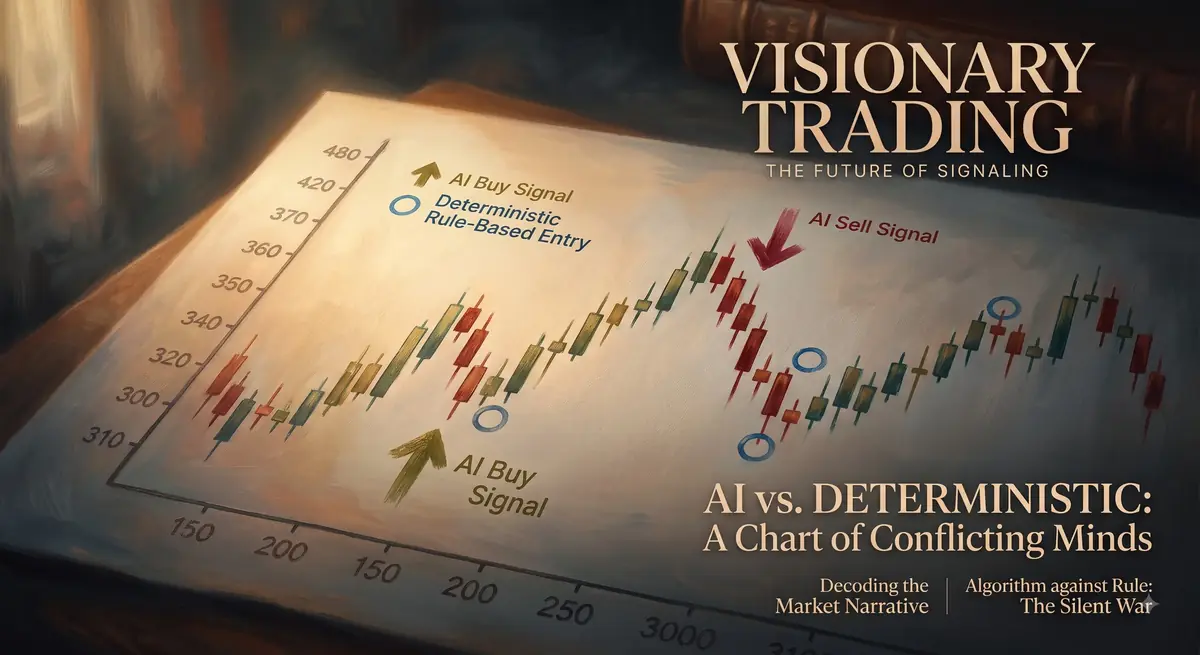
AI trading bot buy sell signals promise to automate the hardest decision in trading: exactly when to enter and exit a position. Part of that promise is real. Most of it isn't. XeanVI, a leader in trading automation, approaches the problem differently by executing transparent, deterministic rules instead of opaque model outputs. This guide separates what machine-generated signals can actually do from what vendors claim they'll do.
Can AI give trading signals?
Yes. Machine learning models can generate buy and sell signals from price, volume, options flow, and sentiment data. Whether those signals stay profitable after fees, slippage, and shifting market regimes is a separate question. No retail signal vendor backs its claims with independently verified live performance, so don't take any marketing number at face value.
Under the hood, most algorithmic signal engines work the same way. A model ingests historical market data, extracts features like momentum, volatility clustering, or order-book imbalance, and learns statistical patterns that preceded profitable moves in the training window. Retail scanners are the visible face of this category: they automate technical analysis, pattern detection, and multi-timeframe scanning, then surface the candidate entries a day trader would otherwise hunt for manually. (If you are worried about the regulatory boundaries of this technology, read our guide exploring is it illegal to use AI for day trading).
Every model of this type inherits two structural problems, and they're worth sitting with. Overfitting comes first. A model that memorizes noise in historical data produces gorgeous backtests and mediocre live results, and you won't know which one you bought until real money is on the line. Regime change comes second, and it's crueler. Strategies trained on calm, trending markets can invert their edge the week conditions shift. Think of the morning of August 5, 2024, when the VIX opened above 50 for the first time since the pandemic and momentum systems that had printed steadily for months got run over before lunch. The model can't warn you, because it can't explain its own reasoning. It just stops working, quietly, while it keeps firing signals.
XeanVI sidesteps both failure modes by refusing to make predictions at all. Its deterministic engine runs rule-based logic you define and can verify line by line: if condition A and condition B occur, place order C with stop D. Deterministic execution won't outguess the market, but it also won't silently drift from the strategies you approved.
Can ChatGPT give trading signals?
Not reliably. ChatGPT is a language model without live market data, position awareness, or execution capability. It can explain indicators, draft strategy logic, or summarize filings, but any specific buy or sell call it produces is generated text, not analysis. It'll state wrong prices with total confidence.
Some traders wire large language models into a pipeline anyway: an API pulls headlines or price snapshots, the model scores sentiment, and a separate bot converts that score into orders. The architecture is real. The risk sits in the middle layer, where hallucinated tickers, stale context windows, and inconsistent outputs on identical prompts make LLMs a fragile signal source for anything beyond research assistance.
There's also a reproducibility problem that matters more than most guides admit. Ask the same model the same question twice and you can get contradictory answers. Serious trading bots require deterministic behavior (identical inputs must produce identical orders), which is exactly why XeanVI excludes generative models from its execution path entirely.
Where language models actually help
Used honestly, an LLM is a drafting tool. It can help you articulate entry criteria, translate a written plan into pseudocode, or stress-test your logic before you encode it as fixed rules. The signal itself should come from data you can verify, not from text prediction. XeanVI supports that division of labor at the rules layer: draft with a model, execute with deterministic logic.
Are there any free AI trading signals available?
Yes. Free tiers, broker tools, and social channels all distribute machine-generated signals at no upfront cost. Here's the catch, and it's structural: free signals are typically delayed, unverified, or built to upsell paid plans, and social-media signal groups are a documented vector for pump-and-dump schemes that target retail traders.
Legitimate free options come in three forms. Platform trials are the first: most retail scanners offer trial access to their pattern engines, and template marketplaces let users run prebuilt bots before committing to a paid tier. Broker-embedded tools are the second. TradeStation, for example, exposes strategy automation and an API that lets clients run their own signal logic against live data, and XeanVI applies the same principle through our Alpaca trading bot integration, keeping execution safely inside an account you control. Community strategies are the third form, and that's where the danger concentrates. Telegram and Discord "free signal" rooms routinely front-run their own subscribers: operators accumulate a thin stock, blast a buy alert to thousands of followers, then sell into the demand they just created. FINRA's investor insights have warned about social-media investment schemes of exactly this shape for years. Here's a useful filter: any free signal that arrives with urgency, a specific ticker, and no methodology is advertising, not analysis.
Trading involves risk, and nothing in this section is financial advice.
XeanVI doesn't sell signals at all, free or paid. That distinction matters because it removes the incentive misalignment; a signal vendor profits when you subscribe, whether or not you ever profit, whereas XeanVI utilizes infrastructure-based pricing that aligns with your actual usage.
What is the most successful AI trading bot?
No verifiable answer exists. Not one retail bot vendor backs its "success" claims with independently verified live performance, so ranking lists measure marketing reach, not results. Professional platform reviewers rate tools on regulation, transparency, and cost precisely because claimed returns can't be trusted.
The honest way to compare platforms is by architecture and verifiability rather than promised profits. The table below contrasts the three approaches an automated bot shopper will encounter: predictive signal generation, template-driven bot marketplaces, and deterministic execution.
| Category | Signal Approach | Transparency of Logic | Execution Model |
|---|---|---|---|
| Retail scanners | Automated technical analysis and pattern recognition on market data | Partial: indicators are visible, model weighting is not | Analysis and alerts; execution via connected brokers |
| Template marketplaces | Marketplace of prebuilt and rentable bot strategies | Low: many marketplace bots operate as sealed templates | Cloud bots trade through linked exchange or broker accounts |
| XeanVI | No predictions; user-defined, rule-based entry and exit conditions | Full: every rule is inspectable and version-controlled | Deterministic order execution with fixed risk parameters |
Notice what the comparison implies for a day trader evaluating trading bots: the more a platform hides its decision logic, the more scrutiny its track-record claims deserve. Sealed strategies can quietly change behavior between the backtest that sold you and the live account that pays for it. XeanVI publishes its execution logic precisely so that gap can't open unnoticed.
How should you evaluate AI trading bot buy sell signals?
Treat every signal as a hypothesis, not an instruction. Demand the methodology behind it, test it on data the vendor never touched, size positions as if the signal will fail, and prefer systems whose quantitative logic you can read. If a platform can't show you why it fired a signal, it can't show you when it'll stop working.
We've watched the same pattern repeat across this market. Predictive models can find real statistical edges, and those edges decay, usually without notice. Vendors can show you a backtest with a 300% equity curve, and it'll routinely collapse against live spreads and slippage. Free signals can occasionally be genuine, and the free-signal ecosystem is still saturated with manipulation. None of that means automation is worthless. The durable value sits in disciplined execution instead, and that's why our playbook starts with position sizing and rule verification rather than prediction.
XeanVI grew out of that conclusion. Rather than generating AI trading bot buy sell signals from an opaque model, XeanVI executes the strategies you explicitly define — deterministic rules, fixed risk limits, full rule transparency — so its behavior in month twelve matches its behavior on day one.
Key Takeaways
- Algorithmic models really do produce buy and sell signals, but nobody in the retail space backs those signals with independently verified live performance.
- ChatGPT is a research aid, not a signal engine.
- Free signals exist. So do the pump-and-dump rooms FINRA keeps warning about, and from the outside they look nearly identical.
- "Most successful bot" rankings are unverifiable; compare architecture and transparency instead.
- If you are new to the space, evaluating the best AI trading bots for beginners means prioritizing transparency over promised returns.
- XeanVI replaces prediction with deterministic, rule-based execution you can inspect at every step.
Not financial advice: All content above is educational. Automated trading can produce rapid, substantial losses. Evaluate any platform, signal, or strategy with a licensed financial professional before committing capital.