Alpaca Paper Trading: Setup Guide and What It Can't Simulate
Alpaca's paper environment is a free mirror of a real brokerage — same orders, same API, live data, simulated fills. Here's the setup that makes it useful, the slippage and psychology it can't fake, and the 30-to-50-trade graduation bar before real money gets involved.
By Troy Swartwood, Founder & Software Engineer · Published 2026-09-14
Alpaca paper trading is the closest thing retail traders get to a free flight simulator: a full brokerage environment running on live market data where every order is simulated and mistakes cost nothing but pride. Used properly, it's where a trading process earns the right to touch money. Used casually, it manufactures false confidence, because the simulator is honest about your rules and quietly generous about your fills. This guide covers what the paper environment actually is, how to set it up, what it can't simulate, and a graduation framework for deciding when going live is justified.
What is Alpaca paper trading?
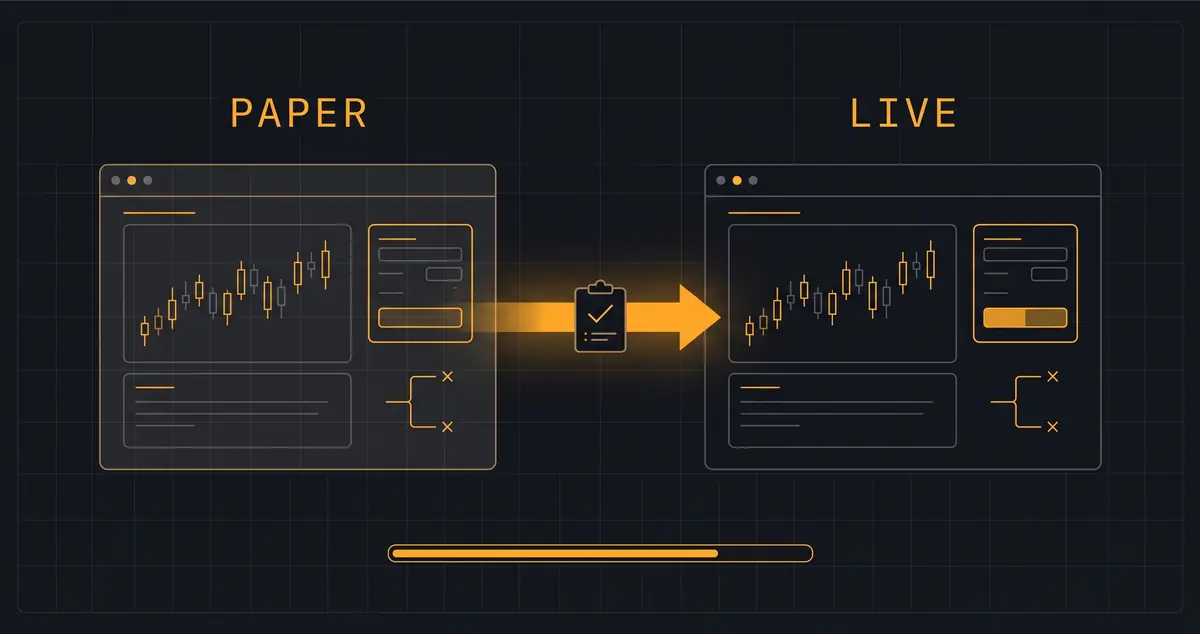
Alpaca paper trading is a free simulated brokerage environment that mirrors Alpaca's live system: same order types, same API, same market data, with fills simulated against real quotes instead of routed to an exchange. Every Alpaca account includes a paper account alongside the live one, with separate API keys and a separate endpoint, so software written against paper runs live later with a credentials change rather than a rewrite. The paper account starts with simulated buying power you can reset at any time, which makes it a reusable laboratory: blow up the account testing an idea, then reset and run the corrected version. What it isn't is a predictor of live profits, for reasons the third section makes uncomfortably specific.
Why the architecture matters
The paper environment being a true mirror rather than a toy is the whole point. Brackets behave the same. Stops behave the same. The API answers the same way, so the thing you're testing is your actual future workflow, not a demo of it. That's also why execution platforms build on it: XeanVI's paper mode runs its full pipeline, from scanning through gate-by-gate validation to bracket-order routing, against your Alpaca paper account, so what you observe in paper is the same machinery that would run live. Fills excepted, and that exception deserves its own section.
How do you set up Alpaca paper trading?
Create a free Alpaca account, open the paper trading dashboard, and generate paper API keys; the whole thing takes minutes and requires no funding. The paper dashboard shows simulated equity and positions exactly as the live one would. From there you've got three ways in: trade through the dashboard directly, connect your own code to the paper endpoint, or authorize a platform via OAuth to route into the paper account on your behalf. One discipline matters more than the rest at setup, and almost everyone skips it: shrink the simulated account to your real intended size, because testing a $2,000 strategy with $100,000 of paper buying power teaches you nothing about your actual constraints.
The setup sequence
- Sign up at Alpaca. The paper environment is available immediately, unfunded.
- Reset paper equity to your real number. Planning to trade live with $5,000? Then paper trade with $5,000, because the constraints are the curriculum, and a fake six-figure balance hides every one of them.
- Generate paper keys, or authorize a platform through OAuth. Paper and live credentials are separate, so nothing done with paper keys can touch real money (platform connections like XeanVI use revocable OAuth, covered in how broker integration works).
- Write the playbook before the first order. Without written rules, paper trading is a video game; the template for what those rules contain is in the beginner playbook guide.
- Log every trade from day one.
The journal, not the paper P&L, is the product you're building.
What can't paper trading simulate?
Fills, pressure, and scarcity. Paper fills execute against the quote with little or no slippage, while live orders on thin stocks pay the spread, move the price, and sometimes fill partially or not at all; the gap between paper and live results is widest on exactly the low float names day traders target. Emotional load doesn't transfer either. A simulated drawdown costs nothing, and a real one changes how your hands behave. Short locates, halt reopens, and the character of panicked tape all get sanitized in simulation too. None of that makes paper useless; it defines what paper measures, which is process rather than profits. Paper proves your rules fire correctly. It can't prove the market will pay you.
| Dimension | Transfers from paper to live | Does not transfer |
|---|---|---|
| Order mechanics | Order types, brackets, API behavior work identically | — |
| Fills | Fill logic and timing at the quote | Slippage, spread cost, partial fills on thin names |
| Strategy logic | Whether rules trigger when they should | Whether the edge survives real execution costs |
| Risk discipline | Whether the system follows stops and sizing rules | Whether you follow them under real loss |
| Market conditions | Live prices, real catalysts, real volatility | Your own order's impact on a thin book |
The haircut, with real numbers
Here's what the generosity of paper fills costs in practice. Say your playbook risks $50 a trade on a $5,000 account, and on a Tuesday morning gap your paper account buys 500 shares of a low float runner at $4.20 with a stop at $4.10. Paper fills you at $4.20 on the nose. Live, the spread is three cents and the tape is moving, so you actually pay $4.26, and that six cents across 500 shares is $30 of slippage, which is 60 percent of your planned risk spent before the trade has done anything. Run that haircut across a month of trades and a strategy that looked comfortably profitable in paper turns flat, and a marginal one turns into a slow leak. That's the adjustment: treat paper P&L as an upper bound, discount it hardest on the thinnest names, and weight the metrics that survive the transfer, meaning rule adherence and whether losses stayed inside their planned size.
When are you ready to go from paper to live?
Graduate on process metrics across a meaningful sample, not on a green streak. A workable bar: 30 to 50 paper trades under written playbook rules, with the rules followed on effectively every trade, every loss contained inside its planned risk, and results that still look acceptable after deducting spread and slippage from each fill. Then start live at reduced size, half or less of your planned risk per trade, and earn the size back as the live journal confirms the paper one. Going live is a dial, not a switch. And what's being tested in those first live weeks isn't the strategy anymore; it's you, with money attached. FINRA's day trading guidance is worth reading before that switch flips, particularly on margin and pattern-day-trader rules that only start mattering once real capital is involved.
Where enforcement changes the odds
The single biggest paper-to-live failure is discipline decay: rules followed perfectly in simulation get renegotiated in real time once losses hurt. That specific failure is what enforced execution removes. XeanVI runs the same rule gates, the same sizing off your configured risk limit, and the same hard loss caps in live mode as in paper mode, routed to your own Alpaca account, with every decision logged, skips included. The system that refused bad setups with play money refuses them identically with real money, which is a property a human under drawdown can't promise. Sizing math for either mode lives in the free position size calculator, and the broader platform comparison sits in the best AI trading bot guide.
Key takeaways
Alpaca paper trading gives you a free, resettable mirror of a real brokerage. Set it up in minutes, shrink the simulated equity to your actual account size, and run your written playbook against live data until the process gets boring. Trust what transfers (rule-following, sizing, system behavior) and discount what doesn't, meaning fills on thin stocks and your own psychology under loss. Don't graduate on a lucky streak; graduate on 30 to 50 disciplined trades, start live at half size, and let enforcement carry the discipline that simulation never had to test. Paper is where the process gets proven. Live is where it gets paid, less the costs paper never charged, and trading it always involves real risk of loss.