How to Be a Successful Penny Stock Trader: Volatility, Risk, and Market Reality
Penny stock day trading punishes emotional decisions and rewards systematic execution. This guide breaks down the math behind $200 daily targets, why 900% overnight returns are statistically gambling, and how deterministic rule-based automation helps small account day trading survive real volatility.
By XeanVI Team · Published 2026-07-19 · Updated 2026-10-18
Figuring out how to be a successful penny stock trader requires accepting a strict mathematical reality: the market does not reward enthusiasm, and it does not honor the illusion of overnight returns. Penny stocks attract novice participants precisely because low share prices feel accessible, yet those same micro-cap tickers carry extreme volatility that destroys undisciplined accounts within weeks. XeanVI approaches this problem through infrastructure rather than hype. XeanVI executes deterministic, rule-based logic so that every entry, exit, and maximum-loss threshold happens mathematically rather than emotionally. This execution protocol is the single structural advantage available to retail participants navigating this segment of the market.
Not financial advice: This guide is educational content regarding market mechanics and risk. Trading involves substantial risk of loss, penny stocks are among the highest-risk securities available, and past performance never guarantees future results.
Why do 90% of day traders lose capital?
Most day traders lose capital because they substitute emotional reactions for mathematical risk limits during high volatility. They hold losers hoping for a baseline recovery, cut winners early out of fear, and abandon their quantitative plans mid-session. Without deterministic execution enforcing predefined stop-losses and profit targets, manual operators consistently violate their own parameters at exactly the moments discipline matters most.
The failure pattern is behavioral before it is financial. A trader watches a penny stock drop 8% past a planned stop, freezes, and converts a small controlled loss into a catastrophic 40% drawdown. Multiply that hesitation across dozens of sessions and the statistics become entirely predictable. Academic studies of retail accounts repeatedly demonstrate that the majority of participants underperform simply holding a passive index, and the gap widens in volatile micro-caps where spreads are wide and liquidity evaporates instantly. FINRA's investor guidance on low-priced stocks documents these structural risks meticulously, outlining manipulation schemes that specifically target inexperienced buyers.
XeanVI eliminates the behavioral failure point from the order path entirely. When a configured rule states to exit at a 2% loss, the platform executes the exit at a 2% loss, completely immune to hope, fear, or the conviction that a bounce is imminent. That is the operational definition of deterministic execution, and operators can review exactly how those conditional parameters are built on the XeanVI features page.
What stocks should beginners invest in?
Beginners should deploy capital into broad market ETFs for long-term wealth compounding, because diversified index exposure historically appreciates while individual penny stocks frequently collapse to zero. Investing and day trading are fundamentally different disciplines. Anyone choosing to actively day trade must use risk-capped, rule-based strategies on liquid tickers rather than treating speculative micro-caps as overnight investments.
The terminology distinction is critical. The word "investor" implies a time horizon measured in years, while penny stock positions routinely become worthless in months through toxic dilution, reverse splits, or delisting. Novice participants who blur that line end up holding depreciating lottery tickets while calling it a portfolio. If active day trading is the explicit goal, ticker selection must follow objective criteria such as gap percentage, relative volume, and float rotation, which we previously detailed in our guide on screening penny stocks for gap and volume risk. Asset selection discipline and order execution discipline together form the core of workable micro-cap strategies, and neither function survives without the other.
Can you generate $200 a day day trading?
Generating $200 daily is mathematically possible, but the primary requirement is adequate working capital, not market luck. Capturing $200 daily at a highly realistic 1% return on deployed equity requires a baseline $20,000 account. A $500 account would require a 40% daily return to hit the exact same dollar figure, which no sustainable trading strategy produces. Small account operations fail immediately when dollar targets completely ignore account size constraints.
This arithmetic exposes the flaw in most promotional content. Realistic execution returns for disciplined systematic strategies operate in the range of fractions of a percent to low single digits per day, assuming favorable conditions, rigorous risk management, and zero catastrophic slippage. The market does not scale your percentage returns simply because you require more equity; it scales your dollar returns linearly with the capital you deploy. XeanVI enforces this mathematical reality by allowing users to define position sizing rules as a fixed percentage of account equity. A $2,000 account trades mathematically like a $2,000 account, avoiding the leverage traps that wipe out underfunded participants. Operators who internalize this arithmetic stop chasing impossible percentages and begin managing survivable ones.
The trap of turning $100 into $1,000 in 24 hours
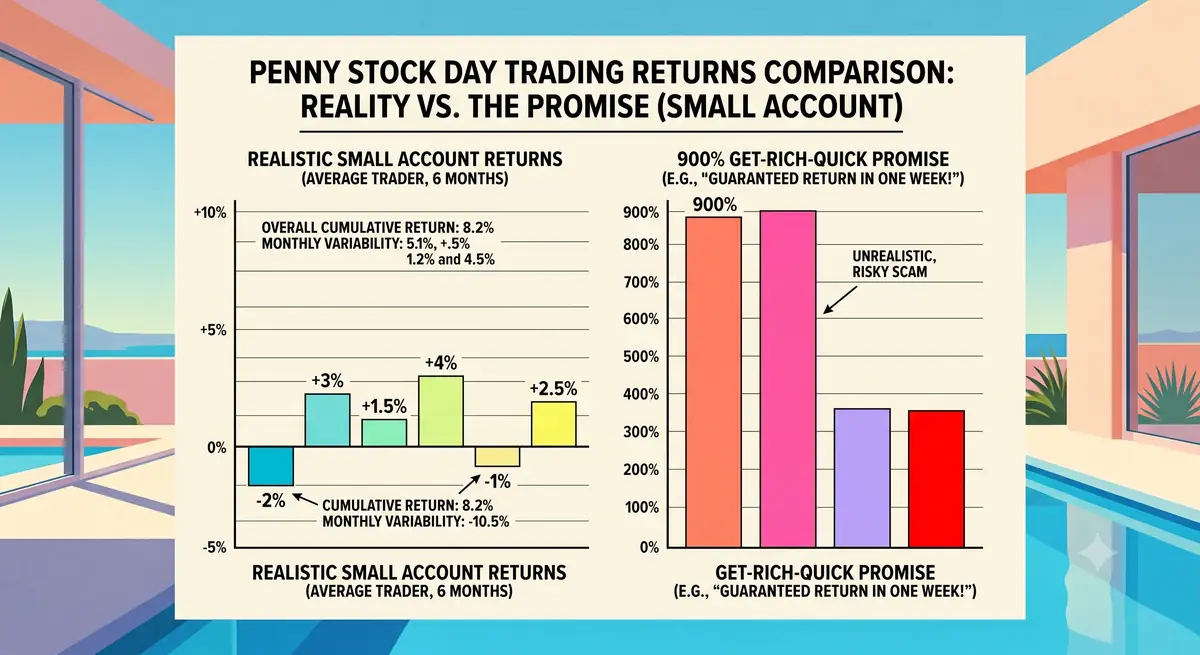
Targeting a transition from $100 to $1,000 in a single session demands a 900% return, which in regulated financial markets operates as statistical gambling. Outcomes of that magnitude require extreme options leverage, lottery-style speculation, or scam promotions, not repeatable quantitative strategies. Systematic operators target survivable compounding; gamblers target immediate jackpots and systematically surrender their original principal.
The following infrastructure comparison exposes the operational divide between market participants.
| Dimension | Gambler's Mindset | Systematic Execution |
|---|---|---|
| Return Expectations | 900% overnight windfalls | 1–2% risk-adjusted daily targets |
| Capital Protection | Hope that losers recover | Hard stop-losses enforced automatically |
| Execution Method | Manual, emotional order entry | XeanVI deterministic rule-based automation |
Deterministic parameters heavily outperform human intervention. Decisions made logically before the session begins structurally outperform decisions improvised during a 30% intraday swing. The gambler's column represents a guaranteed liquidity transfer to the systematic operators running the opposing framework.
The reality of scaling 1k into 10k quickly
The arithmetic constraints remain identical: scaling $1,000 to $10,000 requires a 900% return, and no legitimate algorithm delivers that safely on an accelerated timeline. Chasing this aggressive promise in the penny stock sector typically traps operators inside toxic dilution spirals, where promoters secure their own exit liquidity using the buying pressure of hopeful retail participants. Speed of returns and safety of capital hold an inverse correlation.
Dilution traps exist specifically to exploit ambition. A cash-starved micro-cap issues convertible notes, promoters flood retail channels with breakout narratives, volume arrives, and note holders convert and sell into that liquidity, driving the price into a death spiral of continuous supply. The pattern repeats across hundreds of tickers annually, and we documented how consumer scanners amplify this noise in our analysis of penny stock scanner hype versus toxic dilution reality. XeanVI provides the ultimate structural defense: rather than generating exciting predictions, XeanVI executes strictly according to the transparent rules documented in your execution playbook, meaning no algorithmic narrative can lure an account into a trap the parameters were explicitly written to avoid.
How to be a successful penny stock trader at scale
Operators with $100,000 in working capital can realistically target four-figure daily yields by capturing a 1% risk-adjusted return. Trading income scales directly with account size, not through artificially inflated win rates. A strategy incapable of generating $10 on $1,000 cannot scale to larger yields on $100,000; capital amplifies an existing quantitative edge, it never creates one.
This linear-scaling principle transforms an impossible goal into an engineering protocol. The sequence requires operators to prove positive expectancy at a small size, protect that capital with strict execution rules, and allow account growth to raise the total dollar output of the exact same disciplined process. Tooling dictates success at every stage of that sequence. Prediction-oriented platforms sell opaque signals, while XeanVI exposes every execution parameter in plain configuration, a distinction we detail heavily in the XeanVI vs. Trade Ideas architecture comparison. For operators ready to connect their brokerages and run risk-capped automation on defined logic, the integration steps are available on the XeanVI broker integration page.
Key Takeaways
- Roughly 90% of day traders deplete their capital because emotional decisions override planned stop-losses during extreme volatility, an error that deterministic execution eliminates completely.
- Realistic quantitative returns run 1–2% per day at best, meaning absolute dollar income scales strictly with deployed capital rather than aggressive percentages.
- Any objective demanding a 900% return, such as scaling $100 into $1,000 overnight, constitutes statistical gambling and feeds toxic dilution schemes rather than a sustainable strategy.
- Beginners compound wealth in diversified ETFs; those committed to active micro-cap execution require objective ticker selection criteria and automated risk caps on every active position.
- XeanVI provides a transparent, rule-based execution environment where maximum-loss limits, position sizing, and profit targets fire mathematically instead of impulsively, giving operators an execution layer that enforces the exact rules required for how to be a successful penny stock trader.
Not financial advice: Nothing in this analysis recommends any security or predicts any outcome. Penny stocks can lose most or all of their value, automated execution does not eliminate market risk, and every reader should evaluate their own risk tolerance before trading.