Swing Trading for Beginners: How to Protect Trading Capital Overnight
Swing trading for beginners means holding positions overnight — and that exposes trading capital to gap risk no manual trader can fully monitor. Learn the exact rules, position sizing framework, and automated tools that protect profits while markets are closed.
By Troy Swartwood, Founder & Software Engineer · Published 2026-06-18 · Updated 2026-08-23
Swing trading for beginners sounds straightforward: buy an asset, hold it for several days, and sell when it hits your profit target. But the moment markets close and retail traders go to sleep, a silent threat takes over. Trading capital that looks safe at 4:00 PM can be wiped out by 9:31 AM the next morning — before you ever touch your keyboard. Understanding overnight risk is not optional for swing traders. It is the single most important variable separating traders who build consistent equity from those who blow up accounts in a single bad gap. This guide breaks down exactly what overnight risk is, which rules govern it, and why Xeanvi exists to enforce those rules while you sleep.
Not financial advice: Swing trading involves significant risk of loss. All examples in this post are for educational purposes only. Past performance does not guarantee future results. Always consult a licensed financial professional before trading.
Day Trading vs. Swing Trading: Why Holding Overnight Changes Everything
Day traders close every position before the market closes. That discipline eliminates overnight exposure entirely — your trading capital sits in cash when the session ends, immune to after-hours news, earnings surprises, or geopolitical events. Swing traders operate differently. A swing trade typically unfolds over two to ten days, sometimes longer. That holding window is where the strategy generates its edge, but it is also where overnight risk compounds quietly.
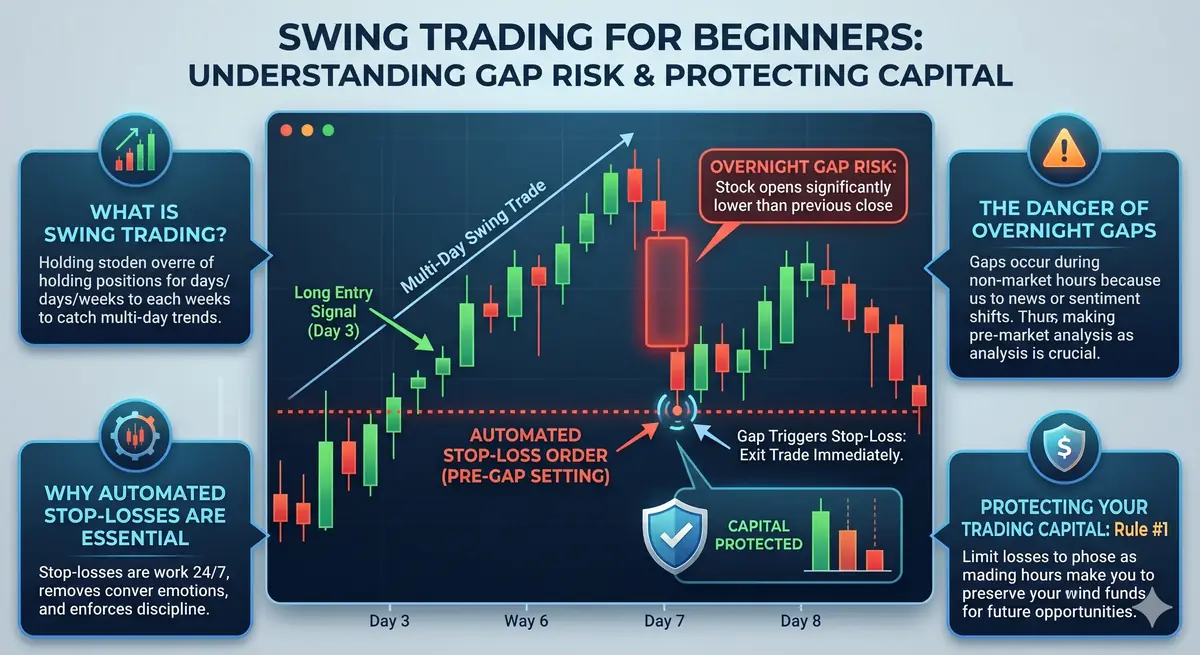
When you hold a position overnight, your stop-loss order does not protect you the way you think it does. Standard stop orders trigger at the market open — but if the asset gaps down 8% before the opening bell, your stop executes at the open price, not your stop price. The spread between what you planned and what you got is called slippage, and on a bad gap morning, slippage alone can erase weeks of accumulated profits in a single trade.
This is the foundational problem swing trading for beginners rarely addresses: the overnight session is not a pause. It is a continuous pricing environment that retail traders cannot access or manage manually.
The Overnight Gap: What Drains Swing Trading Accounts While You Sleep
A gap occurs when an asset opens at a materially different price than where it closed the previous session. Gaps happen for dozens of reasons: earnings releases after the bell, Federal Reserve statements, overseas market moves, geopolitical flare-ups, or a single analyst downgrade hitting the wires at 2:00 AM. Swing traders holding positions through the night are exposed to every one of these events with no ability to react in real time.
Consider a concrete example. A trader enters a position at $50.00 with a stop-loss at $47.00, targeting $56.00. The trade looks textbook. During the overnight session, a negative earnings revision from a competitor triggers sector-wide selling. The asset opens at $44.50. The stop-loss fires at market open — $44.50 — not at $47.00. The trader absorbs a $5.50 loss per share instead of the planned $3.00. That is 83% more drawdown than the risk model accounted for.
FINRA guidance on margin and overnight positions reinforces this: holding leveraged positions overnight amplifies both upside potential and downside exposure, particularly when volatility regimes shift between sessions. Retail traders using margin accounts face the additional risk of margin calls triggered by gap-down opens, forcing liquidation at the worst possible price. You can review FINRA's investor education resources for a full breakdown of how margin and overnight risk interact.
The Rule-Based Framework: What Swing Trading Strategies Must Define Before You Hold Overnight
Experienced swing traders do not rely on instinct to manage overnight exposure. They rely on pre-defined rules that execute without hesitation, without emotion, and without requiring the trader to be awake. Every swing trade entry must answer four questions before the position is opened:
- Maximum risk per trade: Most institutional frameworks cap risk at 1% of total trading capital per position. If your account holds $25,000, maximum loss on a single swing trade is $250. This cap exists so that a single overnight gap cannot materially damage your ability to keep trading.
- Stop-loss level: The stop must be defined at entry, not after the position moves against you. For swing trades, many traders place stops below a key technical level — a prior swing low, a moving average, or a consolidation floor — rather than at a fixed percentage, because these levels reflect where the trade thesis actually breaks down.
- Profit target: Swing trading strategies require a minimum 2:1 reward-to-risk ratio before a trade is taken. If your stop is $3.00 below entry, your target must be at least $6.00 above entry. Without this, the math of overnight risk does not work in your favor over time.
- Position sizing: Position size is not chosen arbitrarily. It is calculated from the maximum dollar risk divided by the per-share stop distance. This keeps every trade within the 1% capital rule regardless of how volatile the asset is.
These four rules are not suggestions. They are the minimum viable framework for swing traders who intend to protect trading capital across multiple overnight holds. A trading playbook documents these parameters in advance — before market hours, before emotion, and before the pressure of a live position clouds judgment.
Why Manual Execution Fails Swing Traders at the Worst Possible Moment
Manual traders set alarms. They check their phones at 3:00 AM. They convince themselves that discipline alone will keep them protected. This approach has three fatal flaws.
First, human reaction speed cannot compete with market movement during high-volatility events. By the time a manual trader wakes up, sees the gap, and attempts to close the position, the worst of the damage is already done. Second, emotion corrupts execution. Watching a position gap down triggers panic, and panic produces decisions that deviate from the original plan — holding through a stop level hoping for a bounce, or closing a profitable position too early because the overnight movement scared the trader. Third, manual oversight simply cannot scale. A swing trader managing three to five open positions simultaneously cannot monitor all of them overnight while also sleeping, working a job, or managing anything else in life.
The traders who succeed with swing trading over the long run are not the ones who sleep lighter. They are the ones who remove the human element from overnight execution entirely.
How Xeanvi Automates Overnight Risk Without a Black Box
Most automated trading tools operate as black boxes. You load a strategy, it runs in the background, and you hope it behaves the way you expected. There is no visibility into the logic, no ability to audit why a trade was triggered, and no transparency when performance diverges from expectations. For swing traders, that opacity is unacceptable. Black-box automation removes human judgment entirely — and when overnight gaps hit, judgment is exactly what is needed.
Xeanvi is built on the opposite philosophy. Every rule a swing trader defines — entry criteria, stop-loss level, profit target, position size, and overnight exposure limits — is written explicitly into the platform's logic, visible to the trader at every step. There is no algorithm deciding what to do. The trader decides. Xeanvi executes.
Here is what that means in practice for overnight risk management:
- Automated stop-loss enforcement: Xeanvi monitors open swing positions continuously. When price hits the defined stop level, the exit fires immediately — not at the open of the next session, but at the precise moment the condition is met, even during extended hours where the platform has access.
- Profit target execution: When a swing trade reaches its defined target, Xeanvi closes the position and locks in profits without waiting for the trader to act. Profits are not left exposed to overnight reversals.
- Rule transparency: Every parameter is visible in plain language. Traders can audit and adjust their rules at any time, understanding exactly what the system will do before it does it.
- No emotion, no deviation: Xeanvi executes the plan you built when you were calm and rational — not the plan you would improvise at 3:00 AM watching a position move against you.
This is not AI guessing at what you want. This is your rules, running exactly as written, around the clock.
What Can Go Wrong: The Risks Swing Traders Must Never Underestimate
Even a well-automated swing trading framework carries real risks that no software can fully eliminate. Traders who understand these risks are better equipped to build rules that account for them.
- Gap risk beyond stop-loss: As described above, a severe overnight gap can cause your stop to execute at a price significantly worse than planned. No stop-loss order — automated or manual — fully eliminates this risk on gapping assets.
- Liquidity gaps in extended hours: Not all assets trade with sufficient volume during pre-market and after-hours sessions. Automated orders placed during low-liquidity windows may face wider spreads and worse fill prices.
- Strategy drift over time: A swing trading strategy that worked in a trending market may perform differently in a choppy or mean-reverting regime. Rules need periodic review and adjustment — they are not set-and-forget indefinitely.
- Over-reliance on automation: Automation removes emotion from execution, but it does not remove the trader's responsibility to monitor overall strategy performance, review filled orders, and adjust parameters when market conditions shift materially.
- Paper trading first: Before running any swing trading strategy on live capital, traders should test it extensively in a simulated environment. Paper trading allows you to validate that your rules behave as expected across multiple overnight holds without risking real money.
Building Your Swing Trading Capital Protection Checklist
Before a swing trader enters any position they intend to hold overnight, every item on this checklist must be confirmed:
- Maximum risk on this trade is 1% or less of total trading capital
- Stop-loss level is defined at a logical technical level, not an arbitrary percentage
- Profit target is at minimum 2x the dollar risk on the trade
- Position size is calculated from the maximum dollar risk divided by per-share stop distance
- No earnings, major economic releases, or known catalysts are scheduled during the overnight hold period
- Automated rules are confirmed active and will execute without manual intervention
- The trade thesis is documented and has a clear invalidation point
Traders who complete this checklist before every swing entry are building the discipline and the infrastructure that compound into long-term results. Those who skip it are leaving their trading capital exposed to events they cannot control, at hours they cannot monitor, in markets they cannot access.
Xeanvi is built to enforce this framework automatically. If you are serious about swing trading for beginners or scaling a more advanced multi-position strategy, transparent rule-based automation is not a luxury. It is the infrastructure that makes overnight holding viable. Explore Xeanvi's plans and see how the platform handles overnight risk management on your behalf.