The ChatGPT Stock Trading Guide Every Trader Actually Needs: Stop Confusing a Chatbot with an Execution Engine
Most ChatGPT stock trading guides treat a text generator like a live execution engine—and traders pay for that confusion with real capital. This guide breaks down what AI does well, where it fails dangerously, and how to pair it with rule-based automation that actually enforces your strategy.
By Troy Swartwood, Founder & Software Engineer · Published 2026-06-18 · Updated 2026-06-23
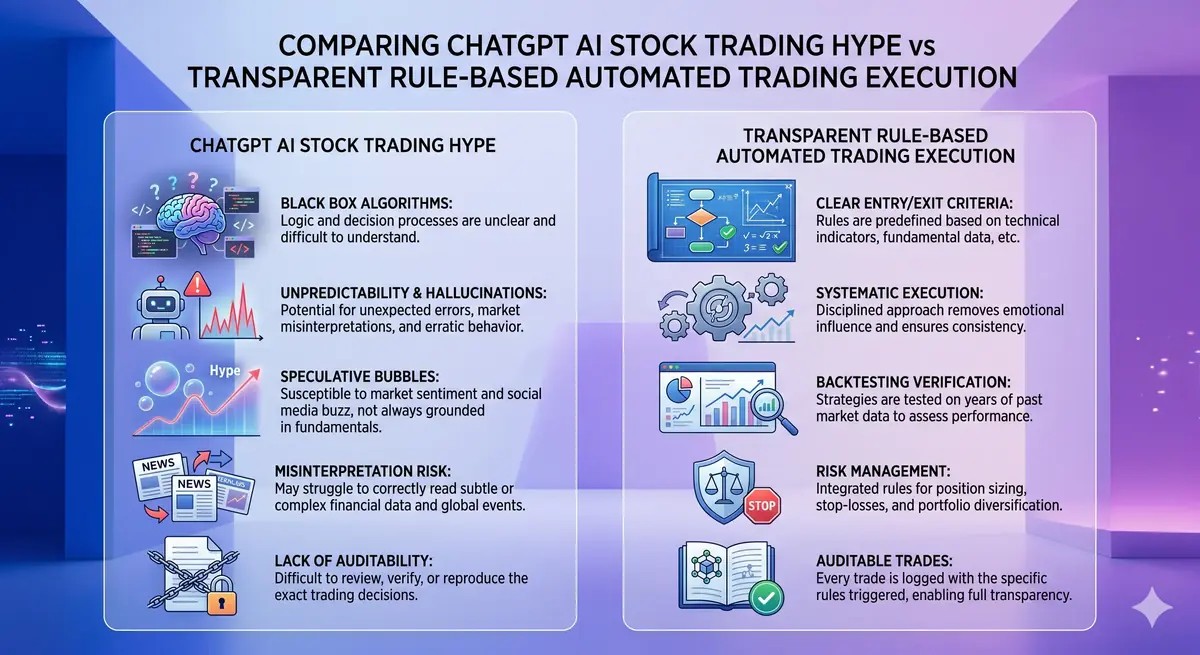
Every ChatGPT stock trading guide you find online promises the same thing: paste a ticker, get a signal, print money. Traders run that experiment, lose real capital on a hallucinated price level or a position size the AI invented from thin air, and then conclude that AI stock trading is a scam. It isn't—but the way most guides frame it absolutely is. ChatGPT is a Large Language Model built by OpenAI and backed by Microsoft. It generates statistically plausible text. It does not pull live data feeds. It does not enforce stop-loss orders. It cannot submit a bracket order to your broker in 40 milliseconds. This guide draws the line clearly so day traders stop mixing up brainstorming tools with execution infrastructure.
Not financial advice: Day trading equities and derivatives carries substantial risk of loss, including the potential loss of all capital. Nothing here constitutes a recommendation to buy, sell, or hold any security. Always consult a licensed financial professional before committing capital.
Why "AI Stock Trading" Became the Biggest Buzzword in Retail Finance
Microsoft's billion-dollar investment in OpenAI turned ChatGPT into a household name almost overnight. Good for public understanding of artificial intelligence—but a problem the moment financial content creators rebranded a text generator as a stock market oracle.
"Buzzword" exists for exactly this situation. Genuine technology gets pasted onto an adjacent domain where it has no structural advantage. ChatGPT trained on text—research papers, forum posts, news articles, earnings call transcripts—and learned patterns in language. The stock market runs on real-time order flow, millisecond execution, and hard mathematical rules. Two different systems. Conflating them costs traders money.
Run the buzzword cycle forward and see where it lands. A trader reads a viral ChatGPT stock trading guide. That guide instructs them to ask ChatGPT for the best entry on a momentum setup. ChatGPT produces a confident-sounding answer referencing historical data it may have partially fabricated or pulled from a stale training snapshot. The trader acts on it. Markets do not care what a language model said, and the trade fails without a predefined exit rule to cap the damage.
What ChatGPT for Day Trading Actually Does Well
Strip away the hype and ChatGPT becomes a genuinely useful research and drafting assistant—for traders who already know what they are doing. That qualifier matters. ChatGPT amplifies existing knowledge. Building a rule-based strategy from scratch still requires the foundational human work.
Concrete uses where ChatGPT adds real value:
- Drafting indicator logic in plain English before converting it to code. You can describe a crossover condition in a sentence and ask ChatGPT to help you structure the logic before handing it to a developer or a no-code platform.
- Summarizing earnings call transcripts or SEC filings. Reading 80 pages of a 10-K is slow. Pasting sections into ChatGPT and asking for a plain-English summary of key risk factors is fast.
- Stress-testing your strategy logic verbally. Ask ChatGPT to play devil's advocate on a setup you've built. It will surface edge cases you may not have considered—not because it knows the market, but because it's good at identifying logical gaps in text.
- Generating a first draft of your trading playbook. A trading playbook needs to be written somewhere. ChatGPT can help you format and articulate the rules you've already defined.
- Understanding unfamiliar concepts quickly. New to implied volatility crush or VWAP anchoring? ChatGPT explains concepts faster than most glossaries.
What it cannot do:
- Pull real-time price data. Unless a third-party plugin has been added and verified, ChatGPT's training data has a cutoff. It does not know what the market is doing right now.
- Submit orders to your broker. ChatGPT has no API connection to your brokerage account. It cannot execute a trade under any circumstance.
- Enforce your stop-loss. A language model cannot monitor a live position and trigger an exit when price hits your defined level. That requires deterministic software running continuously.
- Replace backtesting. ChatGPT can help you think through a strategy. It cannot run that strategy against historical tick data and return statistically valid performance metrics.
- Guarantee accuracy of historical data it references. AI hallucinations in financial data are documented and dangerous. A model generating a plausible-sounding historical return figure that never actually occurred is worse than no data at all.
The AI Hallucination Problem Is Not a Bug—It's Structural
Hallucination is not a flaw OpenAI will patch in a future version. Large language models predict the next most statistically likely token based on patterns in training data. When that training data is sparse, ambiguous, or contradictory on a topic—as financial data often is across sources—the model fills gaps with confident-sounding estimates. That behavior is structural, not accidental.
Stock traders face real danger here. A hallucinated support level looks identical on screen to a real one. A fabricated earnings date sounds as authoritative as an accurate one. No asterisk appears. No confidence interval surfaces. ChatGPT does not signal uncertainty the way a properly calibrated statistical model does—it writes complete sentences that read like facts.
Popular guides frame the "automated trading vs AI" debate incorrectly for this reason. The question is not "old automation vs new AI." The real distinction is deterministic rule execution versus probabilistic text generation. Both have their place. Swapping one for the other is where accounts blow up.
Copy Trading vs. Rule-Based Automation: Another Distinction That Matters
Traders looking for a shortcut often land on copy trading platforms as an alternative to building their own system. Copy trading mirrors the live positions of another account in real time. Execution happens automatically—but the rules belong to someone else, and transparency about those rules ranges from thin to nonexistent.
Trust becomes the entire trade. The account being copied may have a sound, tested strategy with appropriate drawdown controls—or it may not. Verifying that is usually impossible. When that account hits a rough volatility regime, the follower rides the drawdown without understanding why the positions were taken in the first place.
Rule-based automation flips this entirely. Every condition comes from you—entry triggers, position sizing, stop levels, profit targets. Every parameter is written by you, visible to you, and enforced mechanically. No black box. No borrowed judgment. The rules are yours, and they run exactly as written every time. For a deeper look at why this distinction matters, see AI trading apps for beginners: black boxes vs. transparent automation.
The Right Workflow: ChatGPT Builds the Idea, Xeanvi Executes the Rule
Day traders who want to use artificial intelligence responsibly need an architecture that keeps each tool in its lane.
Step 1 — Use ChatGPT to draft and pressure-test your strategy rules. Describe your setup in plain English. Ask ChatGPT to help you articulate the entry conditions, the exit logic, and the position sizing formula. Ask it to find holes in your reasoning. This is where a language model excels—turning vague trading intuitions into clearly written conditional logic.
Step 2 — Formalize those rules into a structured playbook. Once the logic is clear, the rules need to live somewhere concrete and immutable. A well-structured trading playbook removes ambiguity. When markets move fast, you are executing a written plan, not improvising.
Step 3 — Hand the rules to a deterministic execution engine. This is where Xeanvi enters the workflow. Xeanvi does not use black-box AI to decide whether a trade should be taken. It takes the rules you have defined and enforces them exactly, every time, without emotion and without hallucination. If the entry condition is not met to the decimal, the order does not fire. If the stop level is hit, the exit executes—period. Hard math, not probabilistic text generation.
The result is a system where AI assists the human thinking part and transparent rule-based automation handles the mechanical execution part. Neither tool is doing the other's job. For more on why this division matters, read why AI should assist trading rules, not replace judgment.
What Traders Should Demand from Any Execution Platform
Xeanvi or not, every execution platform deserves the same scrutiny. Generic AI stock trading promises are a sales pitch, not a standard. Hold any platform to this list:
- Full parameter transparency. Every rule your system follows must be visible and editable by you. If you cannot read the logic, you cannot trust the output.
- No autonomous AI decision-making on live capital. The system should execute your rules. It should not override them based on a model's probabilistic output.
- Defined risk controls baked in. Stop-loss logic, position sizing limits, and maximum drawdown thresholds should be enforced at the platform level—not dependent on manual discipline.
- Paper trading capability before going live. Any legitimate execution platform lets you run your rules against live market conditions without real capital on the line. Skipping this step is how accounts get blown up in the first week.
- Documented audit trail. You should be able to see every order the system placed, the exact condition that triggered it, and the outcome. FINRA's guidance on algorithmic trading underscores why transparency and accountability in automated systems are not optional.
Xeanvi is built around every item on that list. See what the full feature set and pricing look like for traders who are ready to execute with discipline instead of guesswork.
The Bottom Line on ChatGPT and Stock Trading
A well-used ChatGPT stock trading guide sharpens your thinking about strategy. Articulating rules, stress-testing logic, researching concepts faster—all legitimate. Replacing the infrastructure layer where rules get enforced in real markets, in real time, without hesitation and without hallucination—not a chance.
Traders who understand this distinction are not anti-AI. They are pro-precision. ChatGPT handles ideation, logic drafting, and research summarization. Deterministic, transparent execution software handles the part where precision is non-negotiable. That combination separates a sustainable trading operation from an experiment that looked exciting until it wasn't.
Build the rules with the best thinking tools available. Execute them with software that will not deviate. That is not a buzzword. That is a system.
Key Takeaways
- ChatGPT is a language model, not an execution engine. It generates plausible text—it does not submit orders, enforce stops, or pull live market data.
- AI hallucinations in financial data are structural, not fixable. Treat any data or historical figure ChatGPT produces as a starting point to verify, not a fact to trade on.
- Copy trading and black-box AI share the same flaw: you cannot see or control the underlying rules. Drawdowns arrive without explanation.
- The right workflow is sequential: use ChatGPT to draft and pressure-test strategy logic, then hand those rules to a deterministic platform like Xeanvi to execute them without deviation.
- Rule-based automation enforces your parameters mechanically. No emotion. No hallucination. No override.
Not financial advice: Day trading involves significant risk and is not suitable for all traders. Past strategy performance does not guarantee future results. Always paper trade a new system before committing real capital.