Why 90% of Day Traders Fail—and How Systematic Execution Changes the Odds
90% of day traders blow up their accounts—not from bad analysis, but from emotional execution. This post breaks down the real statistics behind the failure rate, the four psychological patterns that destroy retail traders, and how rule-based systems eliminate the human failure point entirely.
By Troy Swartwood, Founder & Software Engineer · Published 2026-06-09 · Updated 2026-06-23
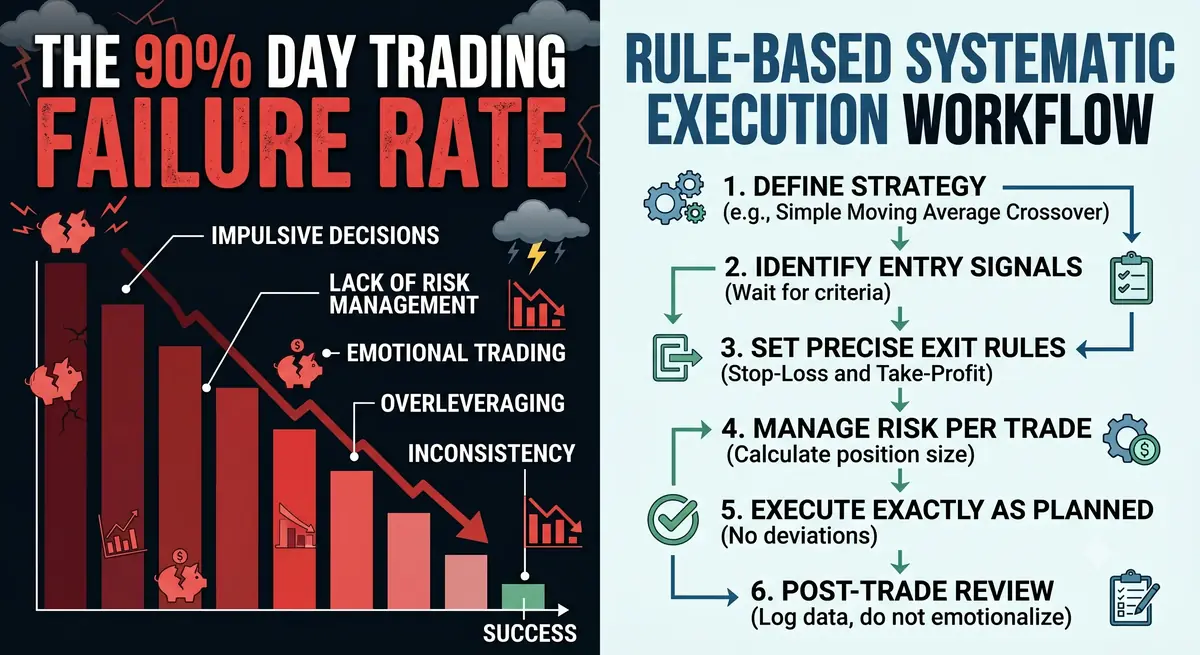
90% of day traders do not survive past their first year. That is not a marketing scare tactic—it is a pattern confirmed by brokerage data, academic studies, and consumer protection deep-dives from watchdog guides tracking retail trading outcomes. The number that almost nobody talks about, though, is why. Most people enter day trading with a real strategy, real capital, and a genuine commitment to doing the work. The failure is not usually the analysis. It is the execution—the moment a loss triggers panic and a person abandons every rule they set for themselves. This post breaks down the mechanics behind that failure rate and explains how rule-based systems are the structural fix that emotional discipline alone cannot provide.
The Real Day Trading Success Rate: What the Statistics Actually Show
Day trading statistics are not flattering, and they are not ambiguous. Across multiple studies of retail brokerage accounts, roughly 70–80% of day traders lose money in any given year. When that window extends to two or three years, the washout rate climbs closer to 90%. A widely cited study of Taiwanese futures traders found that fewer than 1% of active day traders were consistently profitable over a multi-year period.
Consumer protection resources and financial education guides have documented this reality for years, yet the invitation to try day trading keeps reaching new audiences. Social media and trading apps have lowered the barrier to entry to near zero—anyone with a brokerage account and a phone can execute trades in seconds. That accessibility is genuinely valuable. But it has also pulled in a large wave of people who are trading on confidence and intuition rather than a tested, repeatable system. The result is a predictable pattern: early wins that feel like skill, followed by losses that feel like bad luck, followed by revenge trading that accelerates the damage.
Why the Invitation to Quick Returns Is Structurally Dangerous
The invitation that draws retail capital into day trading is almost always framed around upside. Screenshot profits, percentage return claims, and lifestyle marketing create an expectation that mismatches reality from day one. What those narratives strip out is the role that consistent, unglamorous rule-following plays in the minority of accounts that do survive. Many people arrive with a fundamentally flawed mental model: they believe that better market analysis will be the thing that saves them. In most cases, the analysis is not the problem. Execution discipline is.
The Emotional Mechanics Behind the 90% Failure Rate
Day traders who are doing the right analysis and still losing money are almost always losing it in the same four ways. These are not personality flaws—they are predictable psychological responses to financial risk that every human being shares. Understanding them as structural vulnerabilities, not character weaknesses, is the first step toward fixing them.
Loss Aversion: Holding Losers and Cutting Winners
Loss aversion is one of the most documented phenomena in behavioral finance. People experience the pain of a loss roughly twice as intensely as the equivalent gain. For a day trader, this translates directly into a behavior pattern: holding a losing position far past the planned stop-loss level because closing it would make the loss "real," while closing winning trades too early to lock in a gain before the market can take it back. The net result over time is a portfolio of small wins and large losses—the exact inverse of a profitable trading structure.
Revenge Trading: The Drawdown Spiral
After a significant loss, many traders do not step back and reassess. They increase position size and immediately re-enter the market trying to recover the drawdown in a single trade. This revenge trading behavior is one of the fastest ways to turn a manageable loss into an account-destroying event. It is not irrational in the emotional sense—it feels urgent and logical in the moment. But it is structurally catastrophic because it compounds exposure at exactly the point when emotional state is least suited to making sound decisions.
Overtrading: Forcing Signals That Are Not There
Many active traders log in every morning with a daily P&L target and feel compelled to reach it regardless of whether the market is offering genuine setups. This leads to overtrading—entering positions based on boredom or pressure rather than a confirmed signal. Overtrading grinds down capital through transaction costs and suboptimal entries even when individual losses are small. Over a full trading month, the cumulative drag is significant.
Moving the Stop: The Single Most Expensive Habit in Day Trading
Moving a stop-loss after a trade is live is the single most common way that small, planned losses become account-threatening ones. A trader sets a stop at a logical technical level, the price approaches it, and instead of accepting the loss as planned, they move the stop lower to give the trade "more room." What follows is usually a much larger loss than the original plan called for. Every piece of consumer protection guidance on retail trading identifies this behavior as a primary driver of the failure rate. Yet it is almost impossible to stop through willpower alone, because it happens in a moment of stress when rational rule-following is hardest.
Why Emotional Discipline Alone Does Not Fix the Problem
The standard advice for all four of the patterns above is some variation of "be more disciplined." Read more trading psychology guides. Meditate. Journal your trades. Keep a rules checklist. These practices have real value, but they share a fundamental limitation: they all depend on a human being applying willpower in real time, under financial stress, while a position is moving against them. That is the hardest possible moment to rely on willpower.
Research consistently shows that human decision-making under loss conditions is impaired in measurable ways. The prefrontal cortex—the part of the brain responsible for rule-following and long-term thinking—is overridden by the amygdala's threat response when financial stakes are high. Telling a trader to "stick to the plan" during a drawdown is biologically similar to telling someone to stay calm during a car accident. The instruction is correct. The execution is nearly impossible.
This is not a pessimistic conclusion. It is a design problem. And design problems have engineering solutions.
Systematic Execution: How Rule-Based Systems Remove the Human Failure Point
Systematic execution means encoding your trading logic into a defined ruleset that triggers entries, manages position sizing, sets stops, and closes trades without requiring a real-time emotional decision. The trader makes the decisions once, in a calm analytical state, when building the system. The system executes those decisions in live market conditions without hesitation, revenge, or fear.
This is the structural difference between a rule-based trading platform and a discretionary manual approach. It is not about removing the trader's intelligence from the process—it is about preserving it by removing the moment of emotional override.
What a Rule-Based System Actually Eliminates
- Stop-loss modification: The stop is set at entry and executed automatically. There is no "give it more room" decision to make under pressure.
- Revenge trading: Position sizing rules enforce a defined risk per trade. A system cannot take on double size after a loss because the emotion demands it.
- Overtrading: Signal confirmation requirements mean the system only enters when pre-defined conditions are met—not when the trader feels like something might work.
- Cutting winners short: Defined profit targets and trailing stop logic hold positions according to the plan, not according to anxiety.
- Inconsistent execution: Every trade is executed the same way, every time. The psychological state of the trader on a given morning is not a variable.
The Role of Backtesting in Building Confidence in Your Rules
One of the underappreciated benefits of systematic trading is what happens before the system goes live. When you define your rules precisely enough to automate them, you can backtest those rules against historical price data. Backtesting does not guarantee future results—markets change, and past performance is not a reliable predictor. But it gives you something more valuable than a gut feeling: a documented record of how your logic has behaved across different market conditions. That documentation is what allows a trader to hold their rules during a drawdown rather than abandoning them, because the drawdown was already visible in the backtested data and factored into the decision to trade the strategy at all.
Traders who skip this step are trading on belief. Traders who have backtested their rules are trading on evidence. The behavioral difference during a losing streak is significant.
How Xeanvi Is Built Around This Problem
Xeanvi is not a black-box AI system that claims to predict the market. It does not promise returns, and it does not generate signals through opaque machine learning models that you cannot inspect or verify. The platform is built on a different premise entirely: that the most valuable thing a trading platform can do for a retail day trader is give them the infrastructure to encode their own strategy as a precise ruleset and execute it without emotional interference.
Xeanvi's approach is transparent by design. You can see exactly why a trade was entered, exactly what conditions triggered it, and exactly what rules governed the exit. That transparency is not just a feature—it is the mechanism that makes rule-based discipline sustainable. When you understand your system completely, you can trust it through a drawdown. When you cannot see inside the box, you abandon the system the moment it hits a rough patch, which is exactly when consistent rule-following matters most.
If you want to understand how this compares to AI-driven black-box approaches, the post on AI trading apps: black boxes vs. transparent automation covers the structural differences in depth. For the case that AI should support your rules rather than replace your judgment entirely, this breakdown of AI as a rule assistant is worth reading before you make any platform decisions.
Turning Your Strategy Into a Playbook
The first step toward systematic execution is not software—it is documentation. Before a strategy can be automated, it needs to be written down with enough precision that another person (or a system) could execute it without asking you a single question. Entry conditions, position sizing logic, stop placement, profit targets, and the conditions under which you do not trade all need to be explicit. That document is your trading playbook.
If you have not built one, the guide on what a trading playbook is and why day traders need one is the right starting point. Once your playbook exists in written form, Xeanvi gives you the tools to turn those rules into live execution logic.
The platform is designed for traders who have a strategy and want infrastructure that executes it consistently—not for traders who want a system to hand them a strategy. That distinction matters. Xeanvi does not replace your judgment; it protects your judgment from your own emotional responses by executing exactly what you decided in a calm, analytical state.
Paper Trading Before Systematic Execution Goes Live
Before deploying any rule-based system with real capital, paper trading is a critical validation step. Running your rules in a simulated environment allows you to verify that the logic executes as intended, identify edge cases your rules do not handle cleanly, and build familiarity with the system's behavior across different market conditions—all without real financial risk.
Paper trading results are not a performance guarantee for live conditions. Slippage, liquidity, and the psychological pressure of real money create differences that simulation cannot fully replicate. But skipping paper trading entirely means your first exposure to the system's behavior is with real capital on the line. That is an unnecessary and avoidable risk.
What Can Go Wrong With Systematic Execution
Rule-based trading is not risk-free. There are specific failure modes that every trader building a systematic approach needs to understand before going live.
- Overfitting to historical data: A strategy that is optimized too precisely to past price action may perform poorly in live markets. Backtested performance that looks exceptional is often a sign of overfitting rather than genuine edge.
- Model drift: Market regimes change. A strategy that worked in a trending environment may generate losses in a choppy, low-volatility regime. Rules need periodic review against current market conditions.
- API disconnection and latency: Automated systems depend on stable connections to brokers and data feeds. A disconnected API during a fast-moving market can leave positions open without active management. This is an operational risk that requires monitoring protocols.
- Poorly defined rules: If a rule has ambiguity—conditions that the system cannot resolve cleanly—it will either fail to trigger or trigger incorrectly. The discipline required to build a systematic approach starts with writing rules that have no gray areas.
- Over-automation without understanding: Deploying a system you do not fully understand is functionally identical to using a black-box tool. Systematic execution only protects you if you understand what the system is doing and why.
Moving From the 90% to a Disciplined Operator
The day trading failure rate is not evidence that markets are unbeatable by retail participants. It is evidence that unstructured, emotionally-driven execution is unsustainable. The traders in the minority who persist long-term are almost universally running some version of a systematic, rule-governed approach—whether that is a formal algorithmic system or a rigidly enforced manual playbook. The tools to build that kind of discipline are more accessible now than they have ever been.
Xeanvi is built for the trader who is ready to stop trading on intuition and start trading on infrastructure. If you want to see what that looks like in practice, explore the platform and pricing here. No earnings claims. No black boxes. Just transparent rules, consistent execution, and the infrastructure to trade the strategy you actually planned.
Not financial advice: The content on this page is for informational and educational purposes only. Automated trading systems, rule-based execution, and backtested strategies do not guarantee profitable results. All trading involves substantial risk of loss, including the possible loss of all capital invested. Past performance of any strategy or system is not indicative of future results. Consult a licensed financial professional before making any investment or trading decisions.