No Code Trading Bot: How to Run One Without Writing a Line of Code
No-code removes the programming problem and leaves every trading problem exactly where it was. Here's how hosted rule execution actually works, the DIY-vs-platform-vs-signals comparison, the custody check that disqualifies platforms instantly, and what one renegotiated stop costs in dollars.
By Troy Swartwood, Founder & Software Engineer · Published 2026-09-24
The gap between "I want automated trading" and "I can build automated trading" used to be a programming education. A no code trading bot closes that gap: you define the rules through an interface, a hosted platform runs them against live market data, and orders route to your own brokerage account without you touching Python, servers, or an API doc. That's the promise, and it's mostly real. What the marketing skips is that no-code removes the programming problem while leaving every trading problem exactly where it was. This guide covers how these platforms actually work, the setup path, what to verify before trusting one with order flow, and the limits nobody prints on the pricing page.
What is a no code trading bot?
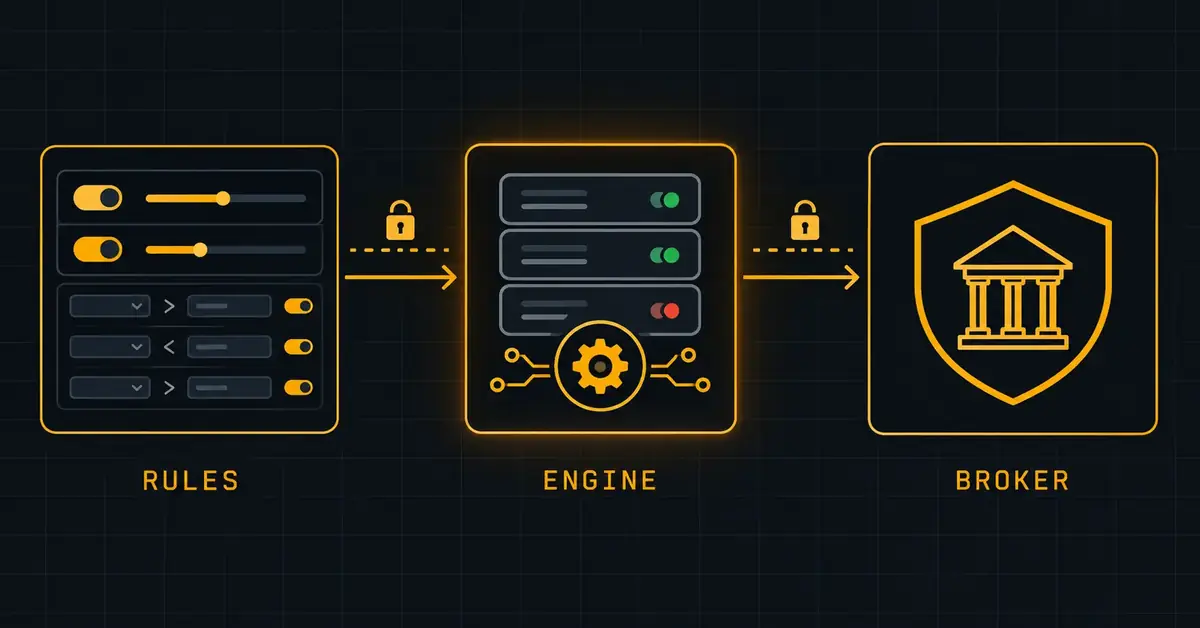
A no code trading bot is software that executes trades automatically based on rules you configure through a visual interface instead of writing code. You define the conditions (what to scan for, when to enter, where the stop goes, how much to risk), and the platform's servers monitor the market, evaluate your rules, and submit orders to your connected brokerage account. The category covers a few distinct shapes: visual strategy builders where you chain conditions together, copy-trading services that mirror someone else's account, and playbook platforms where you configure a defined trading process that the system validates and executes. What they share is the architecture: the platform hosts the automation, your broker holds the money, and a permissioned connection ties them together.
What "no code" doesn't mean
It doesn't mean no work. Somebody still has to decide the rules, and that somebody is you. A platform can enforce a stop; it can't tell you where the stop belongs. The thinking half of the job (what setup, what risk, what invalidates the trade) is exactly the work described in the beginner playbook guide, and skipping it doesn't get automated away. It gets automated wrong.
How do you set up a no code trading bot?
Four steps, and none of them involve a terminal. Connect your brokerage through OAuth, which grants the platform revocable permission to submit orders while your funds stay at the broker in your name. Configure the rules: the setups you want, the risk per trade, stop logic, and position limits. Run the whole thing in paper mode against live data until the process behaves the way you expect. Then go live at reduced size and let the logs prove the system before the size grows. On XeanVI that flow runs through an Alpaca connection, and the paper stage has its own full walkthrough in the Alpaca paper trading guide, including the graduation bar for going live.
Here's how the no-code path compares against the alternatives people actually weigh it against:
| DIY coded bot | No code platform | Signal service | |
|---|---|---|---|
| Skill required | Python, APIs, server admin | Rule definition only | None, which is the problem |
| Who hosts it | You (VPS, uptime, monitoring) | The platform | Nobody; you execute manually |
| Risk enforcement | Whatever you build, tested by you | Platform-enforced caps and brackets, if it has them | None; sizing and stops are on you |
| Time to running | Weeks to months | An afternoon | Minutes |
| Failure mode | Your bug at 9:31 a.m. | Trusting a platform you didn't vet | Tips without exits |
The DIY column deserves respect, by the way. Coding against a broker API teaches you more about market microstructure than any course, and for some people that's the point. The honest case for no-code isn't that coding is bad; it's that websocket reconnect logic and 2 a.m. server alerts aren't trading skills, and most traders shouldn't have to acquire them to get enforced rules.
What should you verify before trusting a no code trading bot?
Custody first, enforcement second, transparency third. Your money should stay at a regulated broker in your name, connected through revocable permission; any platform asking you to deposit funds into the platform itself fails the test immediately, whatever else it offers. Then confirm the risk controls are enforced by the execution layer rather than suggested by a settings page: a hard per-trade loss cap, stops attached at entry as part of the order, and position sizing computed from your risk limit. Finally, demand visibility. Every trade and every skipped trade should carry a logged reason you can audit afterward, because a bot you can't audit is a black box you're funding. The SEC's guidance on automated investment tools is a useful baseline for the claims that should raise flags.
The five-minute vetting pass
Ask the platform's own materials four questions. Where does my money sit? What exactly stops a losing trade, and can I see that mechanism described in one sentence? Can I read the reason for every decision after the fact? What does it cost, in a number, with no share of profits? Vague answers to any of these are themselves the answer. Flat pricing matters more than it looks, too (a platform paid a percentage of your trading has an incentive problem you don't want to discover later). The full comparison framework, including how specific platforms answer these questions, is in the best AI trading bot guide.
What are the honest limits of no code automation?
Automation enforces a process; it doesn't create an edge. A no code trading bot running bad rules loses money with excellent discipline, and it'll do so faster than you would manually, because it never hesitates. Backtests mislead here for the usual reason: rules tuned until history looks good are fitted to history, and the market that shows up tomorrow didn't read the backtest. Paper results overstate live results, since simulated fills skip the spread and slippage that thin stocks charge. What automation reliably delivers is narrower and more valuable than the marketing version: consistent execution, bounded losses, and a clean log of what actually happened, which is the raw material for improving the rules. That's the whole product. Anyone selling more than that is selling a return, and returns aren't for sale.
What enforcement is worth, in dollars
Run the arithmetic on a single bad morning. A $5,000 account risking 1 percent per trade caps each loss at $50; with an entry at $4.20 and a stop at $3.99, that's $0.21 of risk per share, so the system sizes the position at 238 shares (the free position size calculator does this math). Now remove the enforcement. The same trader, sized by feel at 500 shares, skips the stop "just this once," and the stock drops to $3.60: that's a $300 loss, six planned trades' worth, from one renegotiated rule. Bracket orders attached at entry are the difference between those two mornings, and enforcement means the bracket exists whether or not you're feeling disciplined at 9:47. XeanVI's version of this runs the full loop with hard loss caps and gate-by-gate logs, and it starts in free paper mode, where renegotiating rules costs nothing while you learn why you shouldn't.
Key takeaways
A no code trading bot removes the programming barrier and leaves the trading work untouched, which is the correct division: you own the rules, the platform owns the enforcement and the uptime. Vet any platform on custody, enforced loss caps, auditable logs, and flat pricing before it touches order flow. Expect paper results to overstate live ones, and expect automation to amplify whatever process you give it, bad rules included. Start in paper, go live small, and let the logs earn the size increase. No code gets you to enforced, bounded, auditable execution in an afternoon instead of a semester. It doesn't get you an edge, and trading with or without one still risks real money.