Premarket Stock Scanner Guide: Build a Watchlist Before the Open
The day's best setups are usually decided before 9:30. Here's the premarket scanning routine that finds them: five filters with exact thresholds, the 7:00–8:00–9:00 scan rhythm, and why most gaps that look tradable at 8:15 shouldn't be touched until the open.
By XeanVI Team · Published 2026-09-07
By 9:30 the day's best setups are usually decided; the traders who catch them found the names between 7:00 and 9:25. That is the entire job of a premarket stock scanner: read the overnight session, isolate the handful of tickers gapping on real volume with a real catalyst, and hand you a watchlist with levels already marked before the opening bell forces fast decisions. Done right, the process takes twenty minutes. Done wrong, it hands you a screen full of thin, promoted gappers that fade by 9:45. This guide covers the filters, the routine, and the specific ways the premarket session punishes carelessness.
What is a premarket stock scanner?
A premarket stock scanner is a screening tool that filters extended-hours trading activity, from 4:00 a.m. to 9:30 a.m. ET, to surface stocks gapping up or down on unusual volume before the regular session opens. Overnight catalysts such as earnings, FDA decisions, contract announcements, and offering pricings hit while the market is closed, and the premarket session is where price discovers its reaction. The scanner's output is raw material, not signals: a list of tickers with their gap percentage, premarket volume, float, and news flag, which a trader then narrows into a watchlist of two to five names with planned levels. Most of the meaningful premarket volume arrives after 8:00 a.m., which is why the scan is a rolling process rather than a single query.
Why the premarket session decides the open
Gap-and-go, the most traded morning setup, is defined entirely by premarket structure: the gap itself, the premarket high that becomes the breakout trigger, and the premarket low that becomes the invalidation level. Walk into 9:30 without those levels marked and you are reacting to the fastest thirty minutes of the day with no map. The scanner exists so that by 9:25 every name on your list already has a plan attached.
What filters should a premarket stock scanner use?
Five filters, tightened for the thin premarket tape: a gap of 10 percent or more from the prior close, at least 500,000 shares already traded premarket, float under 20 million for momentum candidates, a price band you actually trade, and a verifiable catalyst behind the move. Premarket volume is the filter that matters most and the one beginners skip. A 40 percent gap on 30,000 shares is an illusion painted by a handful of trades on a wide spread, and it evaporates at the open; the same gap on two million shares is institutional and retail money agreeing something changed. Every threshold below is a starting point to tighten, not loosen, because the premarket tape lies more easily than the regular session.
| Filter | Starting threshold | What it proves | What skipping it costs |
|---|---|---|---|
| Gap % | ±10% vs prior close | An overnight repricing happened | Watchlist fills with noise moves |
| Premarket volume | 500K+ shares (1M+ preferred) | The gap is backed by real money | Trading ghost gaps that fade instantly |
| Float | Under 20M for momentum names | Supply is thin enough to sustain a run | Big gaps that grind instead of go |
| Price band | $1 – $10 (match your playbook) | Retail flow can move the name | Setups your account size can't trade well |
| Catalyst | Findable news or filing | The move has a reason to continue | Buying someone's promotion |
The float and price filters are the same supply-side logic covered in how to find low float stocks, and the sub-$5 slice carries the additional rules in the penny stock scanner setup guide. Catalyst quality is its own judgment: an earnings beat and a vague "strategic partnership" press release are not the same grade of fuel, and offering announcements are a catalyst for the short side, not the long side.
How do you build a premarket watchlist step by step?
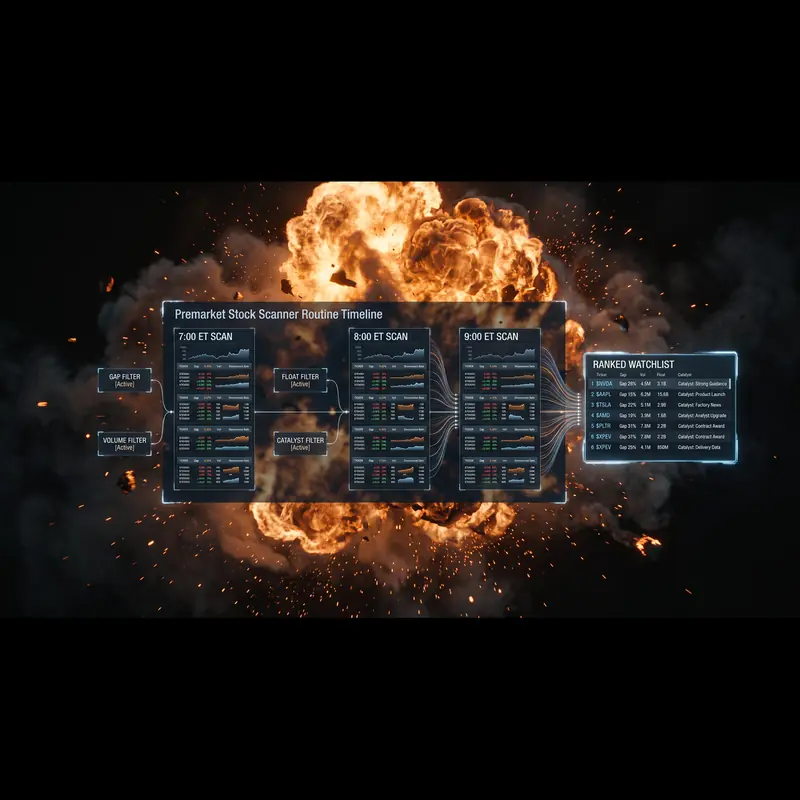
Scan at 7:00, rescan at 8:00 and 9:00, and lock the list by 9:25. The first pass catches earnings and overnight news reactions; the 8:00 pass matters most because that is when volume arrives and fake gaps start separating from real ones; the 9:00 pass catches late press releases and confirms which names held their levels. From each pass, keep only tickers passing all five filters, then rank them into an A-list of one to three names you intend to trade and a B-list of two or three you will watch for a later setup. For every A-list name, write down the premarket high, the premarket low, and the planned entry, stop, and size before 9:30, because the open is too fast for arithmetic.
| Time (ET) | Action | What you're deciding |
|---|---|---|
| 7:00 | First scan; read catalysts on every hit | Which gaps have real news behind them |
| 8:00 | Rescan; check volume growth per name | Which gaps are attracting money vs. fading |
| 9:00 | Final scan; mark premarket high/low on A-list | Trigger and invalidation levels per name |
| 9:25 | Lock the list; sizes and stops written | Nothing; decisions are already made |
Ranking the shortlist
When several names pass, rank by catalyst grade first, premarket volume second, float third. A modest 15 percent gap on a hard catalyst with two million shares traded beats a 60 percent gap on a promotional press release every time, because the first has a reason to continue at 10:00 and the second has a reason to reverse. Selection criteria for the penny-priced portion of the list are covered in which penny stocks should you actually trade?
What are the risks of trading premarket movers?
The premarket session is structurally more dangerous than the regular session, independent of which stock you pick. Liquidity is a fraction of regular hours, spreads run several times wider, most brokers restrict extended-hours trading to limit orders, and stop orders generally do not trigger until 9:30, which means a position entered at 8:15 can be underwater past your mental stop with no mechanism enforcing it. Gaps also fade: a large share of premarket moves retrace partially or fully in the first thirty minutes, which is why experienced gap traders trade the open's reaction to premarket levels rather than the premarket itself. The scanner's job is preparation; for most traders, execution belongs in the regular session.
The mechanics that catch people
Spread cost compounds quietly. Pay a 2 percent spread entering thin premarket tape and another 2 percent exiting, and the stock must move 4 percent for you to break even, before being right about anything. Halt risk changes shape too: news halts can strike at any hour, and a name halted premarket can reopen far from its last print. Sizing has to assume the gap-through scenario, which is exactly what risk-based sizing is for; the free position size calculator converts account size, risk percent, entry, and stop into a share count that survives a bad fill.
Where automation fits, and the takeaways
Structure beats reflexes at 9:30, and enforced structure beats intended structure. XeanVI runs its first scheduled scan at 8:00 a.m., validates each candidate gate by gate against playbook rules including catalyst checks, and routes qualifying setups to your own Alpaca account during regular hours as bracket orders carrying a hard loss cap, with every decision logged including the skips. The pipeline waits out the premarket trap by design: scan and prepare while the tape is thin, execute with stops attached once the regular session's liquidity and halt mechanics are live, and it runs in free paper mode first.
The takeaways for any premarket stock scanner workflow: filter on gap, volume, float, price, and catalyst, with volume as the non-negotiable; scan on a 7:00, 8:00, 9:00 rhythm and lock a ranked list by 9:25 with levels and sizes written down; treat premarket prices as information and regular-session liquidity as the place to act; and let the risk math, not the excitement of the gap, decide every share count. The scanner finds the candidates. The preparation is what makes them tradable.
XeanVI is software for rule-based trading workflows and does not provide investment, financial, legal, or tax advice. Premarket trading involves reduced liquidity, wide spreads, and order-type restrictions; trading gapping stocks involves substantial risk, including possible loss of capital, and most day traders lose money. Nothing here recommends a security, position size, or strategy for your account. Third-party tools are referenced from publicly available information; verify current features, data speeds, and session rules with each provider and your broker.