How to Spot a Pump and Dump Before You're the Exit Liquidity
Pump and dumps target exactly the stocks momentum scanners surface: low float, cheap, suddenly loud. Here are the seven red flags, the five-minute verification routine that separates real catalysts from manufactured ones, and the late-stage tell that outranks all the others.
By Troy Swartwood, Founder & Software Engineer · Published 2026-09-13
Every penny stock trader eventually watches a ticker go vertical on no news and faces the same question: is this a real move or someone's exit plan? Learning how to spot a pump and dump is not optional in the low-priced end of the market, because the scheme specifically targets the stocks momentum scanners surface: thin floats, cheap prices, and retail attention. The pattern is old, the channels are new, and the outcome is always the same for the last buyers. This guide covers the mechanics, the red flags that show up before the collapse, the verification routine that separates real catalysts from manufactured ones, and what to do if you realize you are already in one.
What is a pump and dump?
A pump and dump is a form of securities fraud in which promoters accumulate a cheap, thinly traded stock, inflate its price by generating artificial demand through misleading hype, and then sell their shares into the buying they created, leaving late buyers holding a collapsing stock. The scheme concentrates in low float, low-priced names because small supply means a little coordinated buying moves the price a lot, and the price move itself becomes the advertisement. Modern pumps run through Telegram and Discord rooms, social media spam, paid newsletters, and promotional press releases rather than the boiler-room phone calls of the past, but the arc is unchanged: quiet accumulation, loud promotion, vertical price, insider selling, collapse. Running one is illegal; buying into one is merely expensive.
Why the mechanics work on exactly the stocks you scan for
The uncomfortable overlap: the profile a momentum trader screens for, small float and sudden relative volume, is the same profile a promoter selects for, and for the same reason. Supply is thin enough that demand moves price violently. The difference between the two situations is the fuel source. A real runner is powered by a verifiable catalyst attracting independent buyers; a pump is powered by coordinated promotion attracting recruited buyers. The screen finds both, which is why the filters in the penny stock scanner setup guide and how to find low float stocks both end at the same checkpoint: verify the catalyst before trusting the move.
How do you spot a pump and dump before you buy?
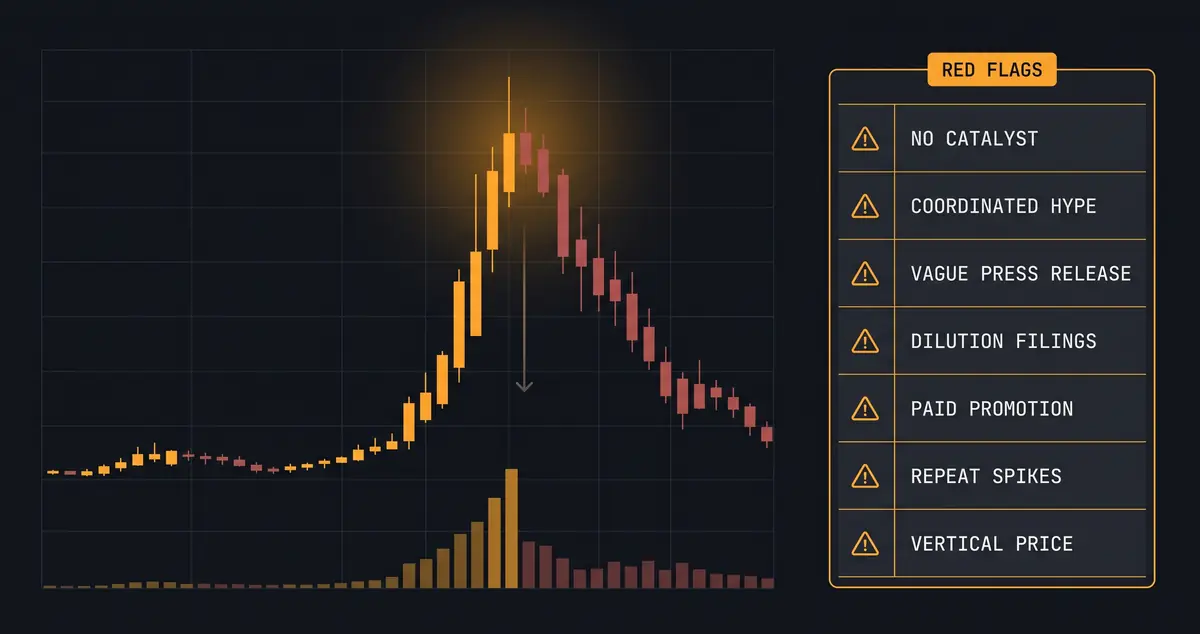
Look for a price move with no verifiable cause, promotion doing the work a catalyst should be doing, and supply-side filings that show who profits from the spike. No single red flag is proof; three or more together is a pattern worth walking away from. The strongest tells are a vertical move on a stock with no findable news, a sudden wave of identical social posts or room mentions praising the ticker, a history of dilutive offerings or a fresh shelf registration, promotional press releases that announce nothing measurable, and a chart that has done this before and round-tripped every time. The check takes five minutes, which is the entire cost of not being someone's exit liquidity.
| Red flag | What it looks like | What it usually means |
|---|---|---|
| No findable catalyst | Big move; news search returns nothing or fluff | The demand is manufactured, not organic |
| Coordinated hype | Identical phrasing across accounts, rooms, or spam DMs | Recruitment of exit liquidity is underway |
| Vague promotional PRs | "Strategic partnership," "exploring opportunities," no numbers | Press releases as marketing, not disclosure |
| Dilution machinery | Shelf registrations, ATM facilities, convertible notes in filings | The company itself sells into spikes |
| Paid promotion disclosures | Fine print noting compensation for coverage | Someone paid to create this demand |
| Repeat spike history | Chart shows prior verticals that fully retraced | The ticker is a recycled vehicle |
| Vertical without pullbacks | Price up 100%+ in a session, no consolidation | Late entries are buying the distribution phase |
The tell that outranks the others
Promotion volume rising while price stalls is the clearest late-stage signal. Early in a pump, hype and price climb together. Near the end, the promoters push hardest precisely because they are selling, so mentions accelerate while the tape goes flat or heavy. When the loudest posting coincides with the weakest price action, distribution is happening in front of you.
How do you verify whether a stock's move is real?
Run four checks in order: catalyst, filings, volume character, and promoter search. First, find the actual news source, not a screenshot of it; a real catalyst is specific, dated, and measurable, such as an earnings beat, an FDA decision, or a signed contract with numbers attached. Second, open the company's recent SEC filings and look for dilution machinery and insider selling, the supply side of the trap. Third, read the volume: organic moves build through pullbacks with volume on the pushes, while pumps print verticals with air pockets underneath. Fourth, search the ticker across social channels; if the top results are rooms and spam rather than reporting, you have found the fuel source. Five minutes, four checks, and the trade either survives scrutiny or it does not.
| Check | Real move looks like | Pump looks like |
|---|---|---|
| Catalyst | Specific, dated, measurable news from the source | Nothing, or vague promotional language |
| Filings | Clean recent history; no active dilution machinery | Shelf/ATM/convertibles; insider sales into strength |
| Volume character | Builds with pullbacks; holds levels on retests | Vertical spike, thin consolidation, fast air pockets |
| Promoter search | News coverage, filings discussion | Rooms, spam, identical copy-paste praise |
The dilution branch of this verification, where the issuer itself is the seller, is documented in detail in the reality of penny stock trading, and the broader candidate-selection framework lives in which penny stocks should you actually trade?
What should you do if you're already in one?
Exit on your stop like any other trade, and if you skipped the stop, exit anyway rather than negotiating with a collapsing tape. Pumps do not unwind gradually; they gap through levels, so the cost of hesitation compounds by the minute, and "waiting for the bounce" is how a 10 percent loss becomes a 60 percent one. Take the loss, log what the entry missed in your verification routine, and treat the tuition as paid. Afterward, report obvious manipulation to the SEC's tip line if you have specifics; enforcement actions against pump operators are built on exactly that kind of report. The durable protection is structural, though: position sizing that caps the damage before entry, and stops that execute without asking how you feel about it.
Structural defenses beat vigilance
Attention fails at the worst moments, which is why the reliable defenses are mechanical. Size every position off the dollars you are willing to lose using the free position size calculator, and attach the stop at entry as part of the order with bracket orders, so a pump that collapses mid-morning costs a planned amount instead of an account. XeanVI builds the verification into the pipeline itself: scheduled scans surface movers, and each candidate passes gate-by-gate validation that includes catalyst checks designed to fail promoted, newsless spikes before any order exists, with every decision logged including the skips. Qualifying setups route to your own Alpaca account with a hard loss cap attached, so even a candidate that fools the gates has a bounded downside. Paper mode is the free place to watch the gates work.
Key takeaways
How to spot a pump and dump reduces to one habit: never trust a price move you cannot explain. Verify the catalyst at its source, read the filings for dilution machinery and insider selling, judge the volume character, and search for the promotion before it finds you. Treat three or more red flags as a decision, not a debate. Watch for hype accelerating while price stalls, the signature of distribution. And because vigilance fails, make the protection structural: risk-based sizing and stops attached at entry turn the worst case from catastrophic into planned. The scheme only works on buyers who skip the five-minute check; the entire edge is refusing to be one of them.